Loading video…


 17 Concepts
 108.3K views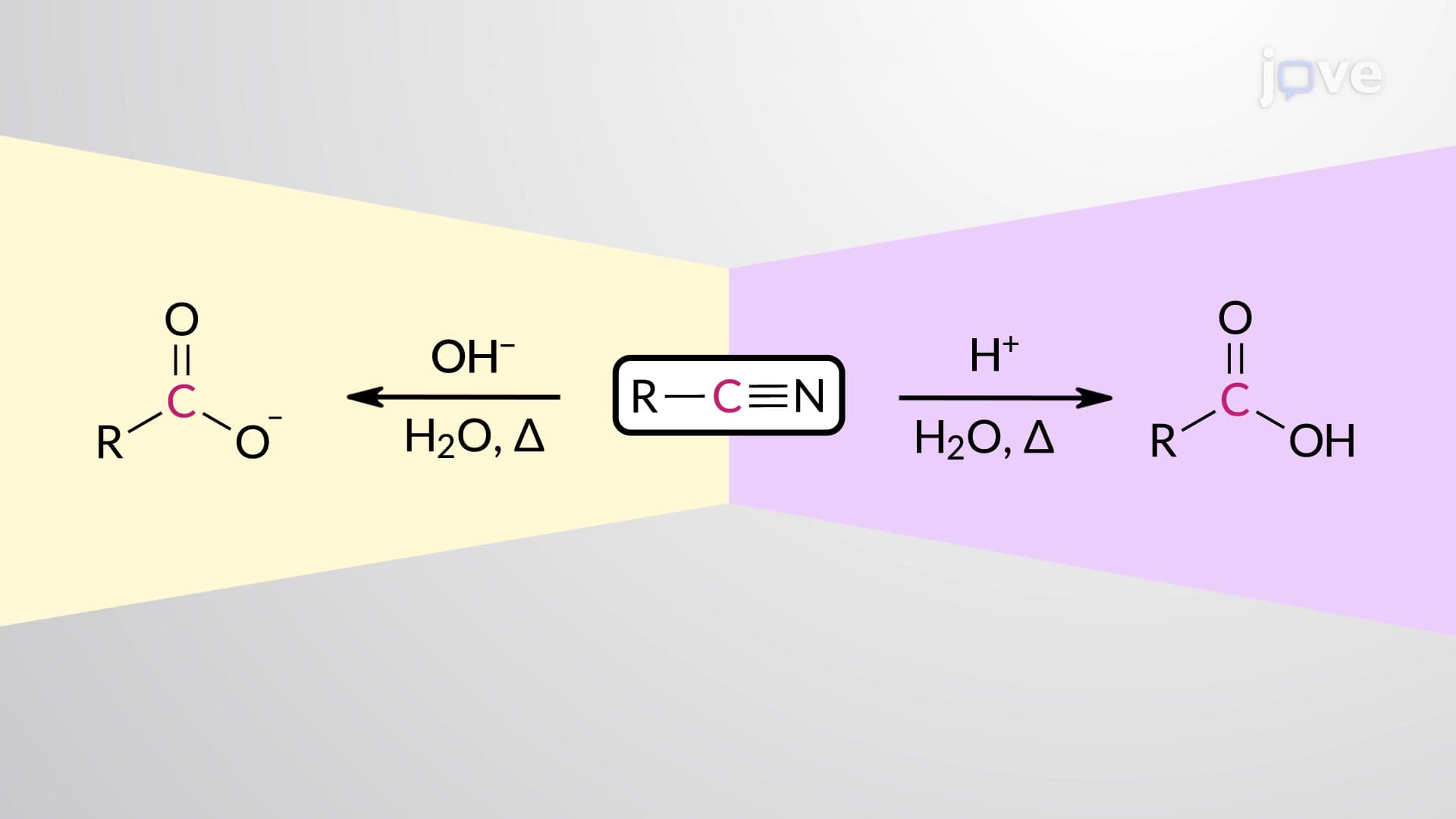

Video Summary: Preparation of Carboxylic Acids Hydrolysis Explained
Ever wondered how pharmaceutical companies create life-saving medications like ibuprofen? The preparation of carboxylic acids hydrolysis is a crucial organic chemistry reaction that transforms nitriles into carboxylic acids through strategic water-based reactions. This process involves either acidic or basic conditions, with each pathway following distinct mechanistic steps that determine the final product. Companies like Pfizer and Johnson & Johnson rely on these synthetic pathways to manufacture anti-inflammatory drugs and other essential medications. Watch the full video on JoVE Coach to master this concept with expert-led visuals and step-by-step explanations.
The preparation of carboxylic acids hydrolysis represents one of organic chemistry's most versatile synthetic transformations. This reaction converts nitriles (compounds containing the cyano group, -C≡N) into carboxylic acids through water-mediated bond breaking and formation. Students encountering this topic in AP Chemistry, college organic chemistry courses, or preparing for the MCAT will find this reaction essential for understanding carbonyl chemistry and pharmaceutical synthesis.
Under acidic conditions, the mechanism begins with protonation of the nitrile nitrogen, creating a positively charged intermediate that dramatically increases the electrophilicity of the cyano carbon. This activation allows water, typically a weak nucleophile, to successfully attack the carbon center. The resulting intermediate undergoes deprotonation to form an imidic acid, which then tautomerizes through a two-step process involving protonation and subsequent deprotonation to yield a more stable amide intermediate.
Basic conditions follow a different pathway, directly producing carboxylate anions rather than neutral carboxylic acids. This distinction proves crucial in synthetic planning, as the final product's ionization state affects subsequent purification and reaction steps. College students studying for organic chemistry exams should note that the choice of acidic versus basic conditions often depends on the desired final product form and compatibility with other synthetic steps.
The pharmaceutical industry extensively utilizes this transformation in drug synthesis. Ibuprofen production, manufactured by companies like Advil and Motrin, demonstrates this reaction's commercial importance. The synthetic route involves forming a nitrile intermediate from a haloalkane precursor, then applying base-catalyzed hydrolysis to generate the final carboxylic acid structure essential for the drug's anti-inflammatory properties.
This hydrolysis reaction serves as part of a powerful two-step sequence for converting haloalkanes to carboxylic acids while simultaneously extending the carbon chain by one unit. This transformation proves invaluable when synthesizing compounds requiring specific carbon frameworks, particularly in pharmaceutical and materials chemistry applications that students may encounter in advanced coursework or research experiences.
Related Micro-courses