Loading video…


 17 Concepts
 108.3K views
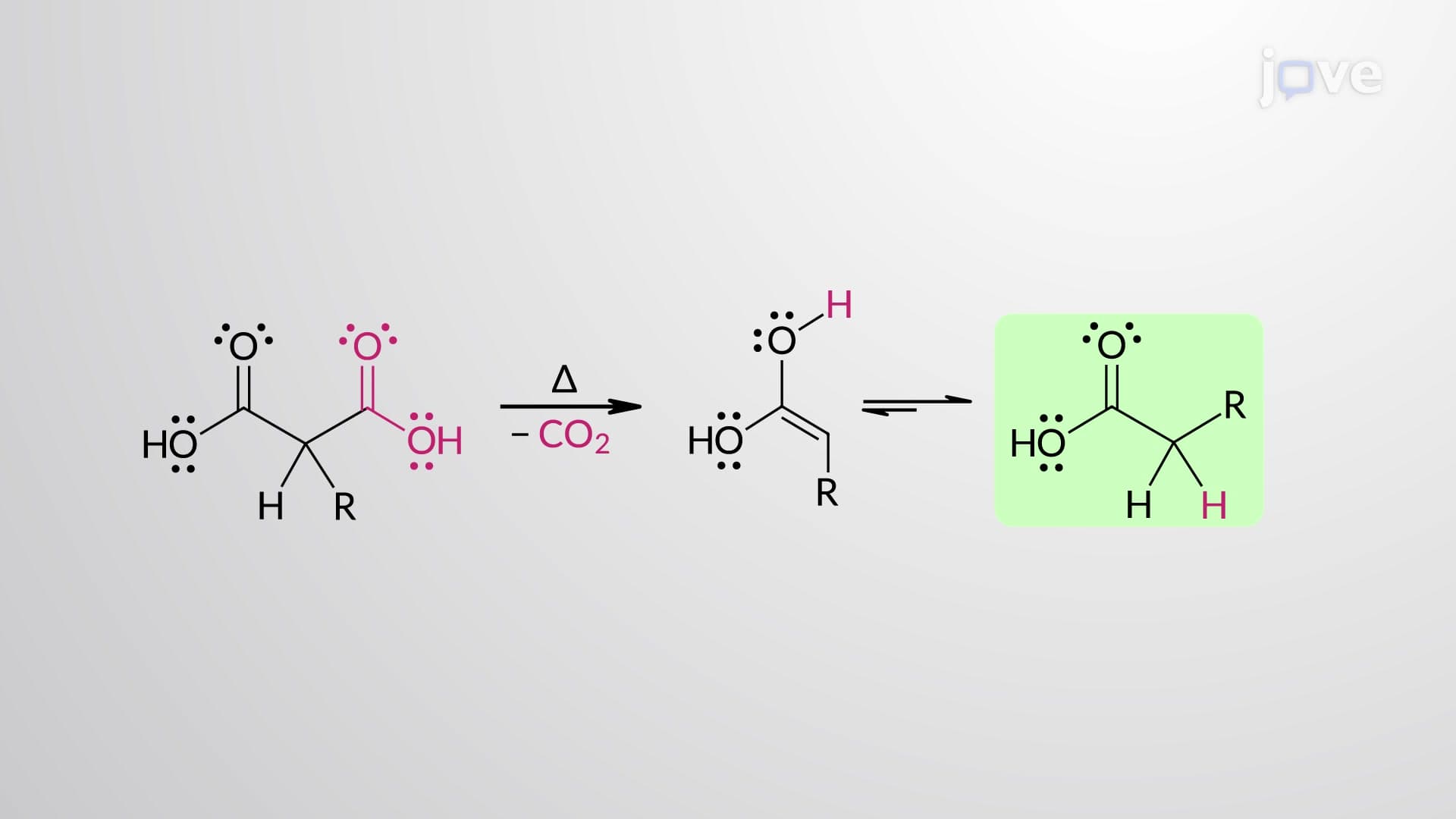

Video Summary: Decarboxylation of Malonic Acid Derivatives
Ever wonder how pharmaceutical companies create new drugs by precisely removing carbon atoms from molecules? Decarboxylation of malonic acid derivatives is the key mechanism that enables chemists to transform complex molecules into simpler, therapeutically active compounds. For instance, companies like Pfizer use this reaction to synthesize intermediates for pain medications. This fundamental organic chemistry process involves the controlled removal of CO2 from β-dicarboxylic acids through a cyclic transition state mechanism. Watch the full video on JoVE Coach to master this concept with expert-led visuals and step-by-step explanations.
Decarboxylation reactions represent one of the most elegant transformations in organic chemistry, allowing chemists to remove carboxyl groups while maintaining structural integrity. The decarboxylation of malonic acid derivatives follows a highly predictable mechanism that makes it invaluable for synthetic applications in both academic and industrial settings.
The decarboxylation process begins with thermal activation, typically requiring temperatures between 150-200°C. The reaction proceeds through a concerted mechanism involving a six-membered cyclic transition state. This geometry allows for optimal orbital overlap as the C-C bond breaks and CO2 is eliminated. The resulting enol intermediate immediately tautomerizes to form the final carboxylic acid product. This mechanism explains why β-dicarboxylic acids decarboxylate readily while α- or γ-dicarboxylic acids require much harsher conditions.
The most significant application of malonic acid decarboxylation appears in malonic ester synthesis, a cornerstone reaction taught in advanced high school AP Chemistry and undergraduate organic chemistry courses. Students preparing for the MCAT frequently encounter this reaction in passages about drug synthesis. The process begins with diethyl malonate, where the acidic hydrogen between the two ester groups is deprotonated using sodium ethoxide. The resulting enolate anion attacks primary or secondary haloalkanes via SN2 mechanism, creating alkylated malonates. Upon hydrolysis and decarboxylation, these compounds yield carboxylic acids with precisely two additional carbons compared to the starting haloalkane.
Advanced applications include the synthesis of cycloalkanecarboxylic acids using dihalides. When diethyl malonate reacts with α,ω-dihalides, intramolecular alkylation creates cyclic structures that, upon decarboxylation, yield valuable cyclic carboxylic acids. This methodology proves essential in pharmaceutical chemistry, where companies like Johnson & Johnson synthesize cyclic intermediates for anti-inflammatory medications. The ring size depends on the dihalide chain length, making this approach highly versatile for creating three- to seven-membered rings.
Related Micro-courses