Loading video…


 10 Concepts
 116K views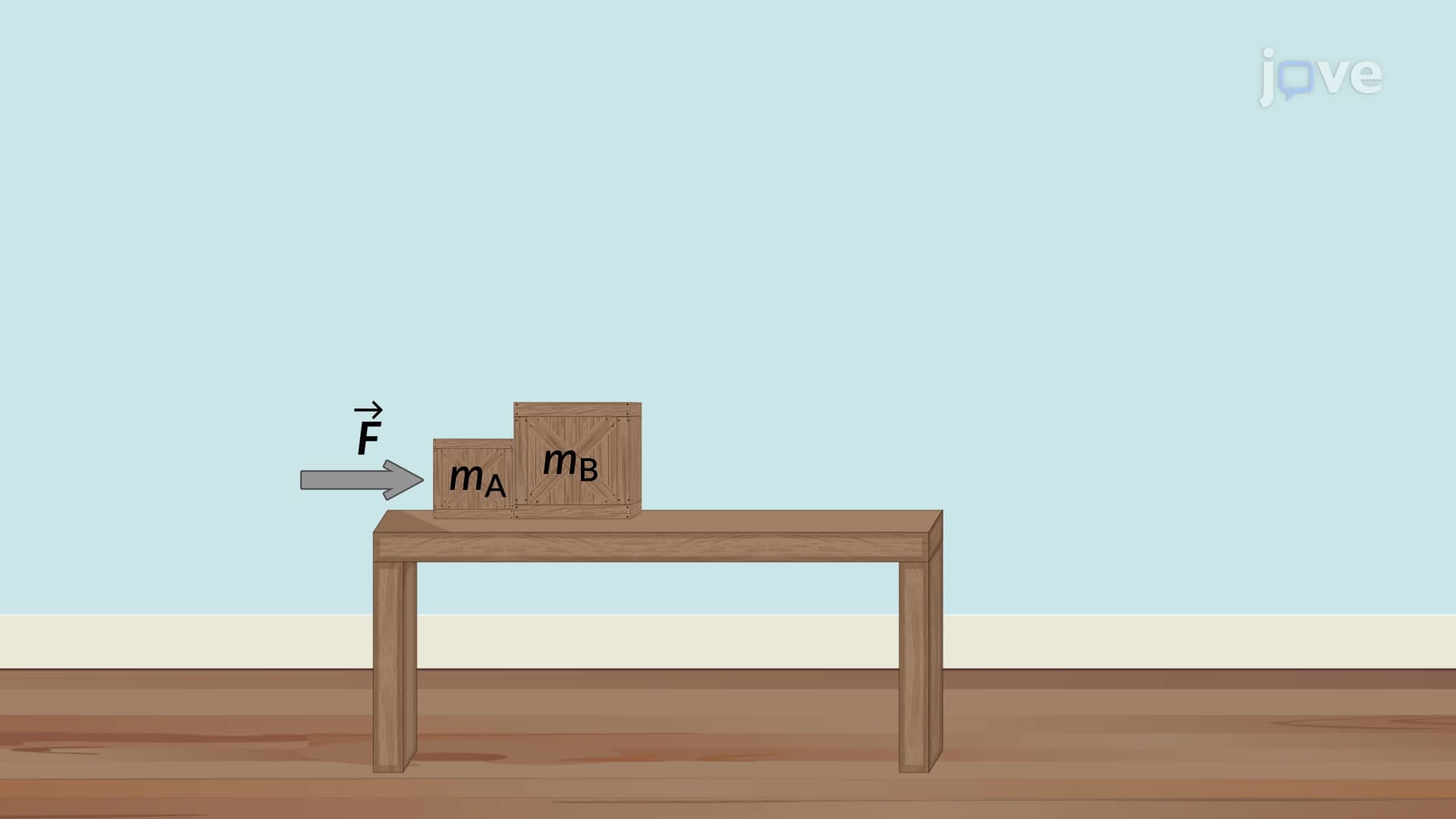

Video Summary: Second Law Motion Under Same Force Explained
Ever wondered why pushing a shopping cart with groceries feels different than pushing just the cart? Second law motion under same force demonstrates how multiple objects respond when connected and accelerated together. When a NASA engineer calculates thrust requirements for rocket stages, they apply these same principles to determine how forces distribute between connected masses. The concept of Second Law Motion Under Same Force Explained reveals why contact forces emerge between objects and how Newton's laws govern their interaction. Watch the full video on JoVE Coach to master this concept with expert-led visuals and step-by-step explanations.
When multiple objects move together under a single applied force, Newton's second law governs the entire system while revealing fascinating internal dynamics. This scenario appears frequently in engineering applications, from train cars pulling each other to spacecraft components accelerating in unison during launch sequences.
The key to solving second law motion under same force problems lies in treating the system both as a whole and as individual components. For two masses m(A) and m(B) on a frictionless surface with force F applied to m(A), the system's total acceleration equals a = F/(m(A) + m(B)). This unified acceleration ensures both masses move together without separation.
Individual analysis reveals internal forces. Mass m(A) experiences the applied force F forward and contact force from m(B) backward. Meanwhile, m(B) only experiences the contact force forward. These contact forces represent Newton's third law pairs-equal in magnitude but opposite in direction.
Consider a semi-truck pulling a loaded trailer on Interstate 80. The truck's engine provides the driving force, but the trailer experiences acceleration through the hitch connection. Engineers at companies like Peterbilt calculate these contact forces to design proper coupling systems that won't fail under acceleration stress.
Similarly, SpaceX engineers apply these principles when designing multi-stage rockets. Each stage must transmit thrust forces to accelerate the entire vehicle, with internal structural forces calculated using identical physics principles.
This concept appears prominently on AP Physics exams, where students must analyze multi-object scenarios. College physics courses at institutions like MIT and Stanford emphasize these problems because they bridge theoretical understanding with practical engineering applications. The Mathematical approach typically involves:
1. Finding system acceleration: a(system) = F(applied)/(m(total)) 2. Analyzing individual forces: F(net on A) = m(A) × a(system) 3. Calculating contact forces: F(contact) = F(applied) - F(net on A)
Students preparing for the MCAT encounter similar dynamics problems in their physics sections, particularly when analyzing biological systems like muscle force transmission through skeletal structures.
Related Micro-courses