Loading video…


 17 Concepts
 36.7K views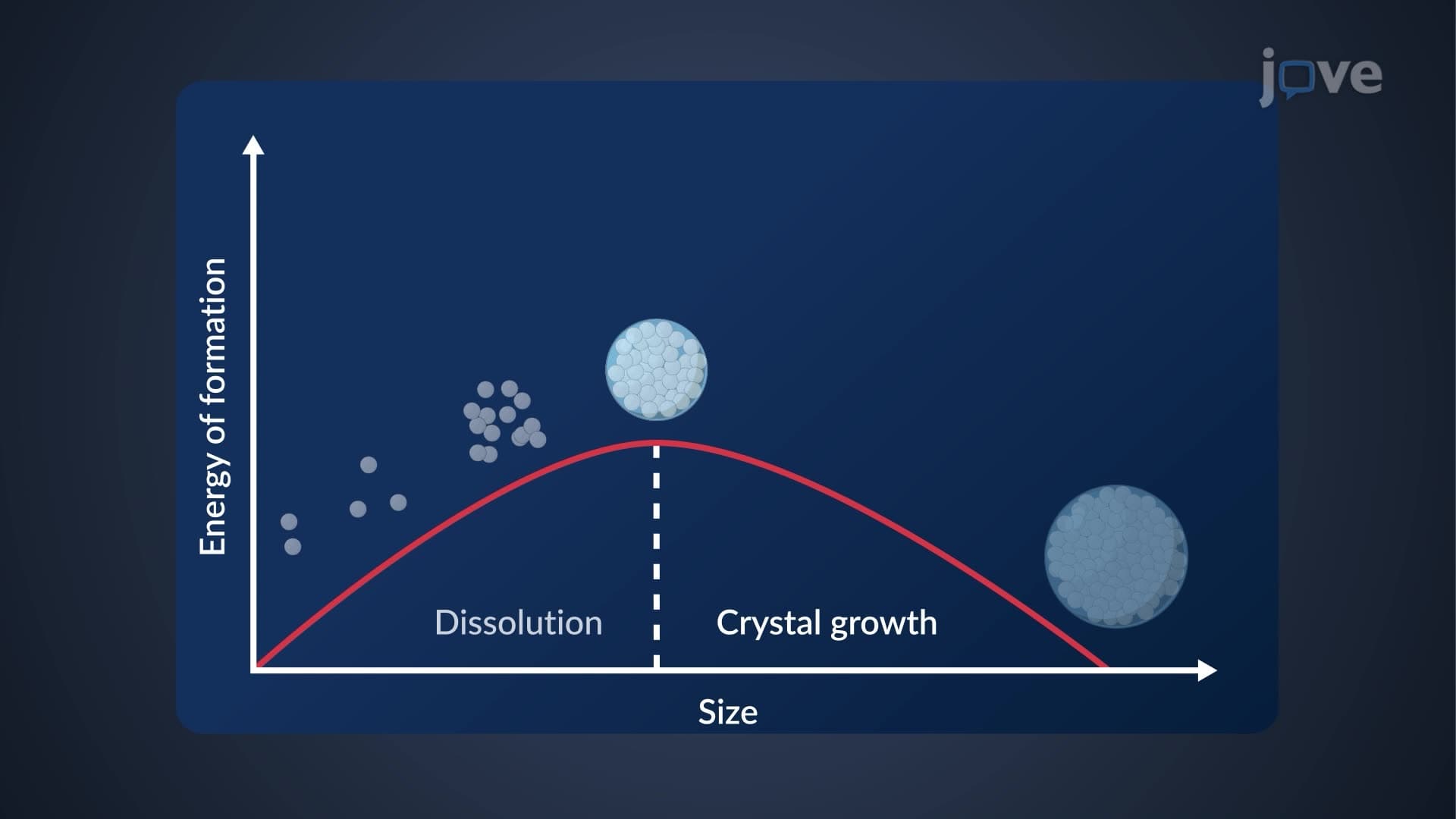

Video Summary: Crystal Growth Principles of Crystallization Explained
Did you know that the Tylenol in your medicine cabinet exists because pharmaceutical companies mastered crystallization principles explained in chemistry labs? Understanding how crystals form and grow in solution is crucial for everything from drug manufacturing to semiconductor production. Crystal growth principles of crystallization explained involve nucleation processes and supersaturation ratios that determine crystal size and quality. Major pharmaceutical companies like Pfizer rely on these principles to produce consistent, pure medications. Watch the full video on JoVE Coach to master this concept with expert-led visuals and step-by-step explanations.
Crystallization represents one of nature's most elegant organizational processes, where dissolved molecules spontaneously arrange into highly ordered three-dimensional structures. This fundamental phase transformation occurs when solutions become supersaturated, creating conditions where crystal formation becomes thermodynamically favorable. Students encounter these principles of crystal growth chemistry in AP Chemistry, college general chemistry courses, and advanced materials science programs.
The journey of how crystals form and grow in solution begins with primary nucleation, occurring in two distinct pathways. Homogeneous nucleation happens spontaneously within pure solutions when molecular clusters randomly achieve critical size thresholds. This process requires significant energy barriers and typically occurs at high supersaturation levels. Conversely, heterogeneous nucleation occurs on foreign surfaces-dust particles, container walls, or impurities-dramatically reducing energy requirements. Most industrial crystallization processes, including pharmaceutical manufacturing at companies like Johnson & Johnson, deliberately introduce nucleating agents to control this heterogeneous pathway.
Secondary nucleation revolutionizes crystallization control by utilizing existing crystals as templates. This process, fundamental to pharmaceutical quality control, involves introducing seed crystals that promote controlled growth. The supersaturation crystallization relationship becomes critical here: when the concentration-to-solubility ratio (S) exceeds unity, crystal growth proceeds favorably. Temperature reduction and solvent evaporation represent primary methods for achieving supersaturation in laboratory and industrial settings.
Crystal lattice formation principles appear frequently on MCAT physical sciences sections and AP Chemistry exams, particularly in thermodynamics and kinetics contexts. Students studying for college organic chemistry midterms encounter crystallization during purification techniques. Understanding crystallization rate control helps explain why pharmaceutical companies invest heavily in process optimization-slight variations in nucleation conditions dramatically affect drug bioavailability and shelf stability. The semiconductor industry similarly relies on precise crystal habit morphology control for microchip manufacturing, making these concepts relevant across multiple STEM disciplines.
Related Micro-courses