Loading video…


 17 Concepts
 36.7K views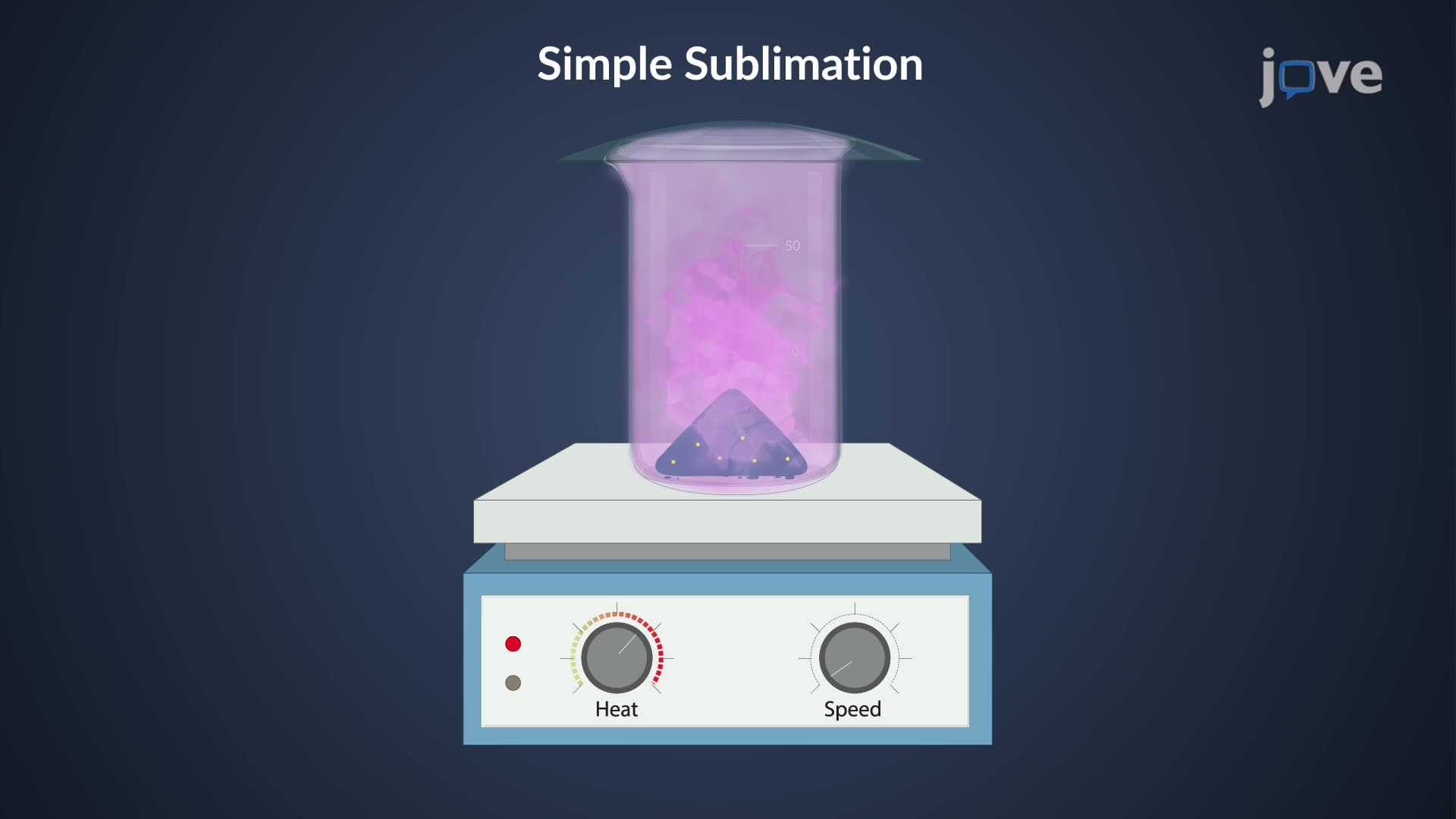

Video Summary: What Is Sublimation
Ever wondered why dry ice used in Halloween fog machines disappears without leaving puddles? This fascinating phenomenon demonstrates sublimation chemistry explained, the direct transformation of matter from solid to gas without becoming liquid. Dry ice, commonly used by food service companies across the US for shipping frozen goods, sublimates at -78°C, bypassing the liquid phase entirely. This unique phase change has critical applications in laboratory purification techniques and industrial processes. Watch the full video on JoVE Coach to master this concept with expert-led visuals and step-by-step explanations.
Sublimation chemistry explained begins with recognizing this as a unique phase transition where solids transform directly into gases without passing through the liquid phase. Unlike the familiar melting and boiling sequence, sublimation occurs when specific temperature and pressure conditions allow solid molecules to gain enough kinetic energy to enter the gas phase immediately. This process is governed by the substance's vapor pressure curve and occurs below the triple point, the unique combination of temperature and pressure where all three phases coexist in equilibrium.
The driving force behind sublimation involves molecular kinetics and thermodynamics. When a solid is heated, its molecules vibrate more vigorously. In typical substances, this leads to melting first. However, certain compounds have vapor pressures that exceed atmospheric pressure before reaching their melting point. Carbon dioxide exemplifies this perfectly, at standard atmospheric pressure (1 atm), solid CO2 cannot exist as a liquid and sublimates directly at -78.5°C. This explains why dry ice, widely used by companies like FedEx and UPS for cold-chain shipping, never creates wet messes.
Sublimation purification technique represents one of chemistry's most elegant separation methods. The process exploits differential sublimation rates between target compounds and impurities. In a typical setup, the impure solid is heated in a covered vessel, with pure crystals collecting on a cooled surface above. This technique proves invaluable for purifying compounds that decompose before melting, such as certain pharmaceutical intermediates. Students encounter this method frequently in AP Chemistry labs and undergraduate organic chemistry courses, where it's used to purify compounds like caffeine, iodine, and naphthalene.
How sublimation is used in chemistry extends far beyond academic laboratories into crucial industrial processes. Lyophilization (freeze-drying) represents the most commercially significant application, used extensively by companies like Pfizer for vaccine preservation and by food manufacturers like Nestlé for instant coffee production. The process involves freezing materials under vacuum, then allowing ice to sublime directly to water vapor, leaving behind a lightweight, shelf-stable product that retains its original structure and biological activity.
This technology proves essential for preserving heat-sensitive pharmaceuticals, creating astronaut food for NASA missions, and manufacturing specialty chemicals that would degrade under conventional drying methods. Students preparing for the MCAT will encounter sublimation in biochemistry contexts, particularly regarding protein preservation and pharmaceutical manufacturing processes.
Related Micro-courses