Loading video…


 13 Concepts
 18.7K views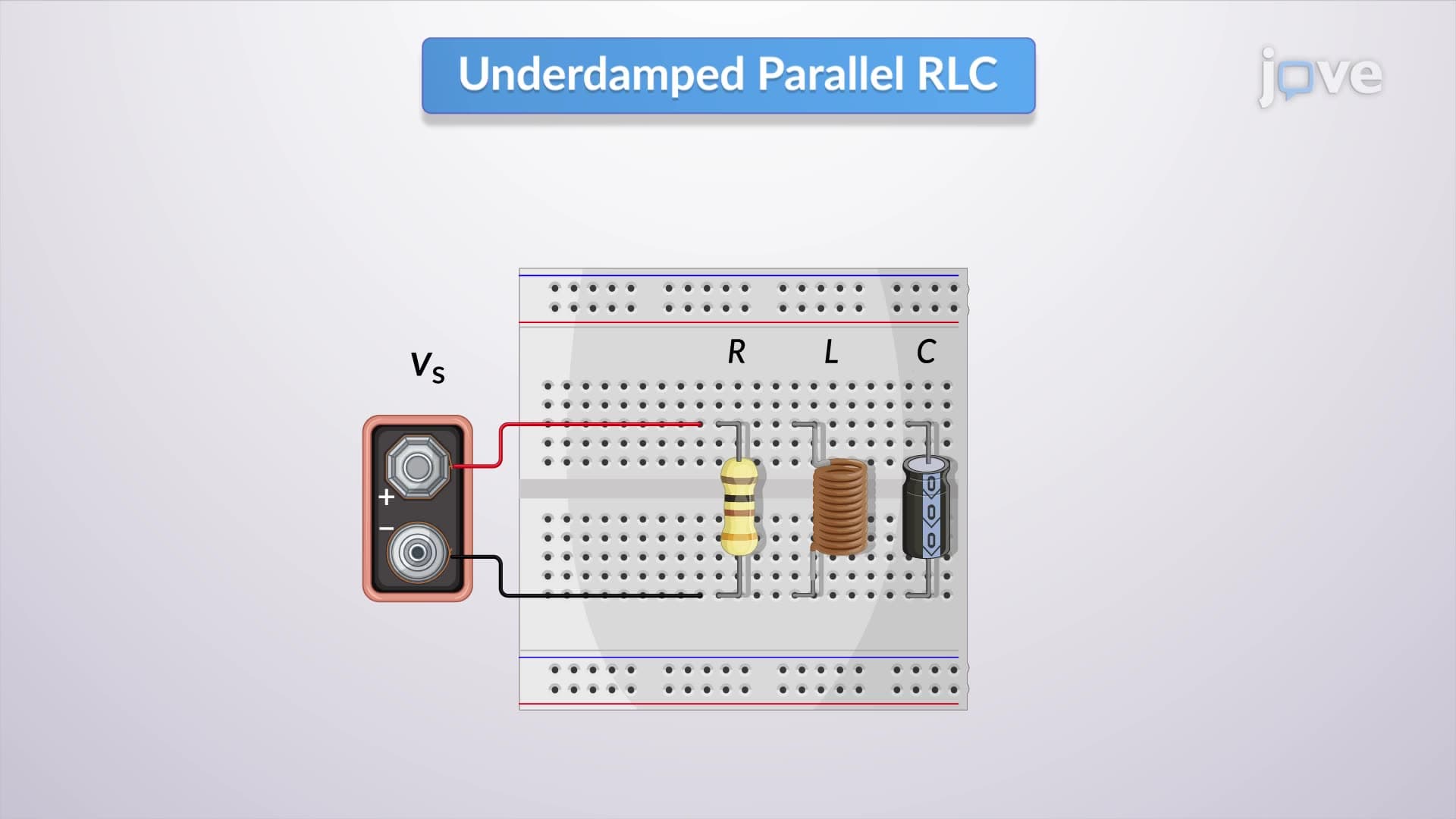

Video Summary: Design Example Underdamped Parallel Rlc Circuit Explained
Ever wonder how your smartphone's radio picks up crystal-clear signals from towers miles away? Sinusoidal sources power the oscillator circuits that make wireless communication possible. The Design Example Underdamped Parallel RLC Circuit Explained demonstrates how engineers at companies like Qualcomm calculate precise component values to create stable 4 kHz oscillations with controlled damping. This engineering design process requires understanding how resistance, inductance, and capacitance interact to produce sustained sinusoidal waveforms. Watch the full video on JoVE Coach to master this concept with expert-led visuals and step-by-step explanations.
When electrical engineers design oscillator circuits for applications like radio transmitters, signal generators, or timing circuits, they must carefully balance three fundamental components: resistance (R), inductance (L), and capacitance (C). The Design Example Underdamped Parallel RLC Circuit Explained showcases a systematic approach to achieving specific performance targets through mathematical precision.
In this particular design challenge, an engineer must create an oscillator with a damped natural frequency of 4 kHz and a damping factor of 4 rad/s, using a fixed 200-ohm resistance. This scenario mirrors real engineering constraints faced at companies like Texas Instruments or Analog Devices, where component availability and cost considerations often fix certain values while others must be calculated.
Sinusoidal sources in RLC circuits can be either externally applied (like AC voltage sources) or internally generated through natural oscillation. Underdamped parallel RLC circuits represent the latter category, where the circuit itself becomes a sinusoidal source through sustained oscillations. Understanding what are sinusoidal sources overview reveals that these circuits convert DC energy into AC waveforms through the interplay of stored magnetic energy (inductance) and stored electric energy (capacitance).
The mathematical foundation begins with the damping factor relationship: damping factor = 1/(2RC). With R = 200 ohms and damping factor = 4 rad/s, students can solve for capacitance: C = 1/(2 × 200 × 4) = 625 microfarads. This calculation appears frequently in AP Physics C and college-level circuit analysis courses.
The resonant frequency equation f₀ = 1/(2π√(LC)) governs the natural oscillation frequency of the LC combination, while the damped natural frequency incorporates the resistive losses. For underdamped behavior, the damped frequency is always lower than the resonant frequency, creating the characteristic decaying sinusoidal response that defines this sinusoidal sources concept.
In practical applications, engineers use these relationships to design everything from quartz crystal oscillators in digital watches to variable-frequency oscillators in software-defined radios. The precise mathematical control demonstrated in this design example enables the reliable frequency standards that synchronize cellular networks across the United States.
The design validation confirms underdamped operation through two key checks: the damped natural frequency remains below the resonant frequency, and the inductance satisfies L < 4R²C. These conditions ensure sustained oscillation without excessive damping that would prevent oscillation or insufficient damping that could cause instability. Such validation steps are essential in industries like aerospace, where oscillator stability affects navigation systems and communication equipment reliability.
Related Micro-courses