Loading video…

 14 Concepts
 1.1K views

Video Summary: Solving Quadratic Equations in the Complex Number System
Did you know that some quadratic equations have solutions that don't exist on the real number line? Quadratic equations in the complex number system emerge when the discriminant becomes negative, forcing mathematicians to expand beyond real numbers. Consider finding the dimensions of a rectangle with perimeter 20 cm and area 30 cm², the math leads to complex solutions, proving such a rectangle cannot physically exist. This fascinating concept bridges abstract mathematics with real-world constraints. Watch the full video on JoVE Coach to master this concept with expert-led visuals and step-by-step explanations.
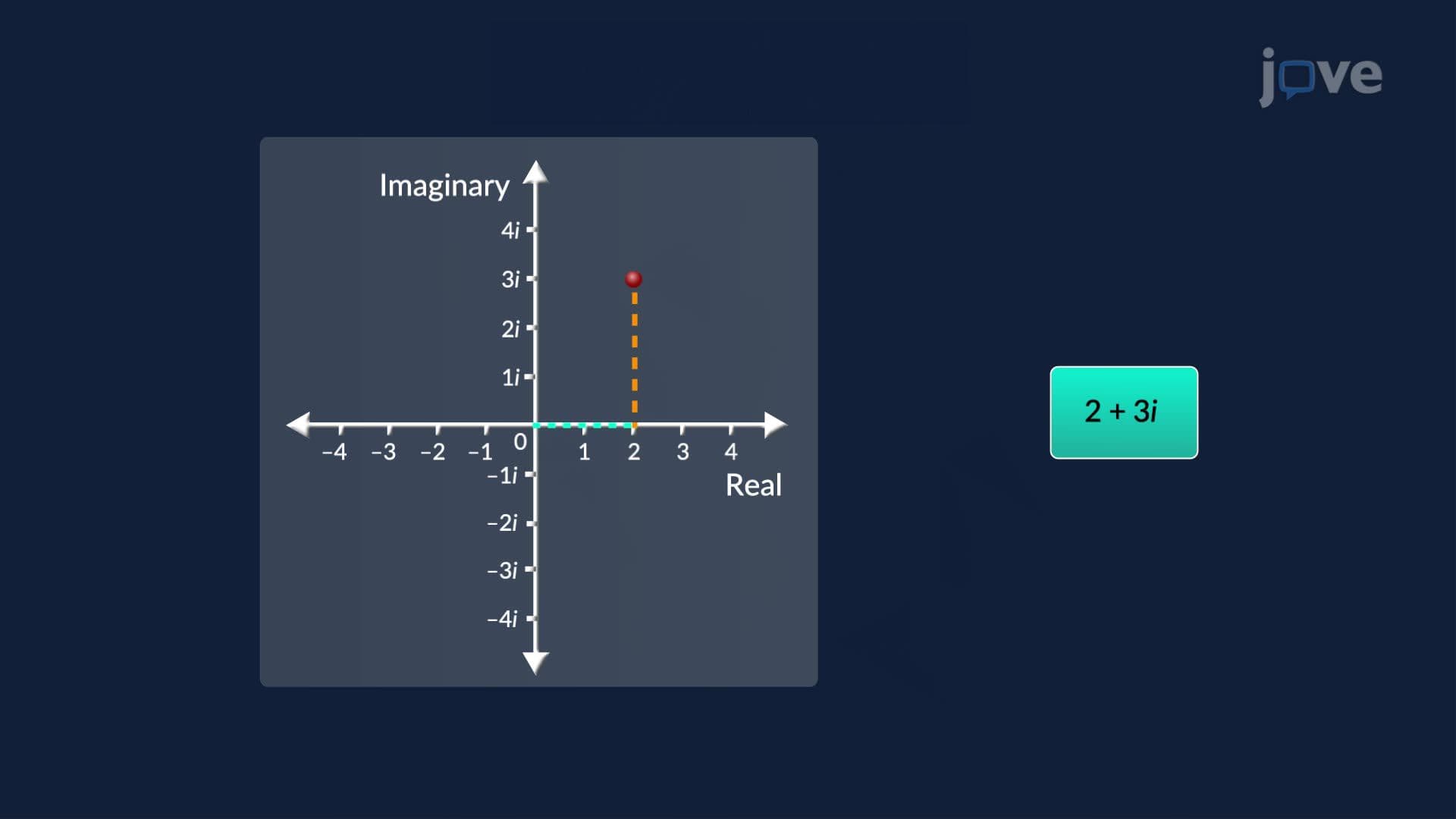
When high school students first encounter quadratic equations in the complex number system, they're witnessing mathematics' elegant solution to an apparent impossibility. The quadratic formula x = (-b ± √(b² - 4ac))/2a works perfectly for real solutions, but what happens when b² - 4ac < 0? This scenario forces us beyond the familiar real number line into the rich world of complex numbers.
The discriminant (b² - 4ac) serves as your roadmap for understanding solution types. When positive, you get two distinct real solutions, the parabola crosses the x-axis twice. When zero, you get one repeated real solution, the parabola just touches the x-axis. When negative, you enter complex territory, the parabola never touches the x-axis, existing entirely above or below it.
For AP Calculus and SAT Subject Test preparation, recognizing these patterns becomes crucial. Consider the equation x² + 2x + 5 = 0. The discriminant equals 4 - 20 = -16, immediately signaling complex solutions: x = (-2 ± √(-16))/2 = (-2 ± 4i)/2 = -1 ± 2i.
Complex solutions always appear in conjugate pairs when dealing with real coefficients. If -1 + 2i is a solution, then -1 - 2i must also be a solution. This fundamental property ensures that when you multiply out factors containing complex conjugates, the imaginary terms cancel, yielding real coefficients, maintaining the equation's original form.
The rectangle problem from the transcript perfectly illustrates complex numbers' practical significance. When seeking dimensions for a rectangle with perimeter 20 cm and area 30 cm², the mathematics produces complex solutions, definitively proving no such rectangle can exist in physical reality. This concept appears frequently in engineering applications, where complex solutions often indicate impossible or unstable conditions in circuit analysis, structural design, or economic modeling.
For college-bound students, mastering this concept provides essential preparation for advanced courses in electrical engineering, physics, and applied mathematics, where complex numbers become indispensable tools rather than abstract curiosities.
Related Micro-courses