Loading video…

 14 Concepts
 1.1K views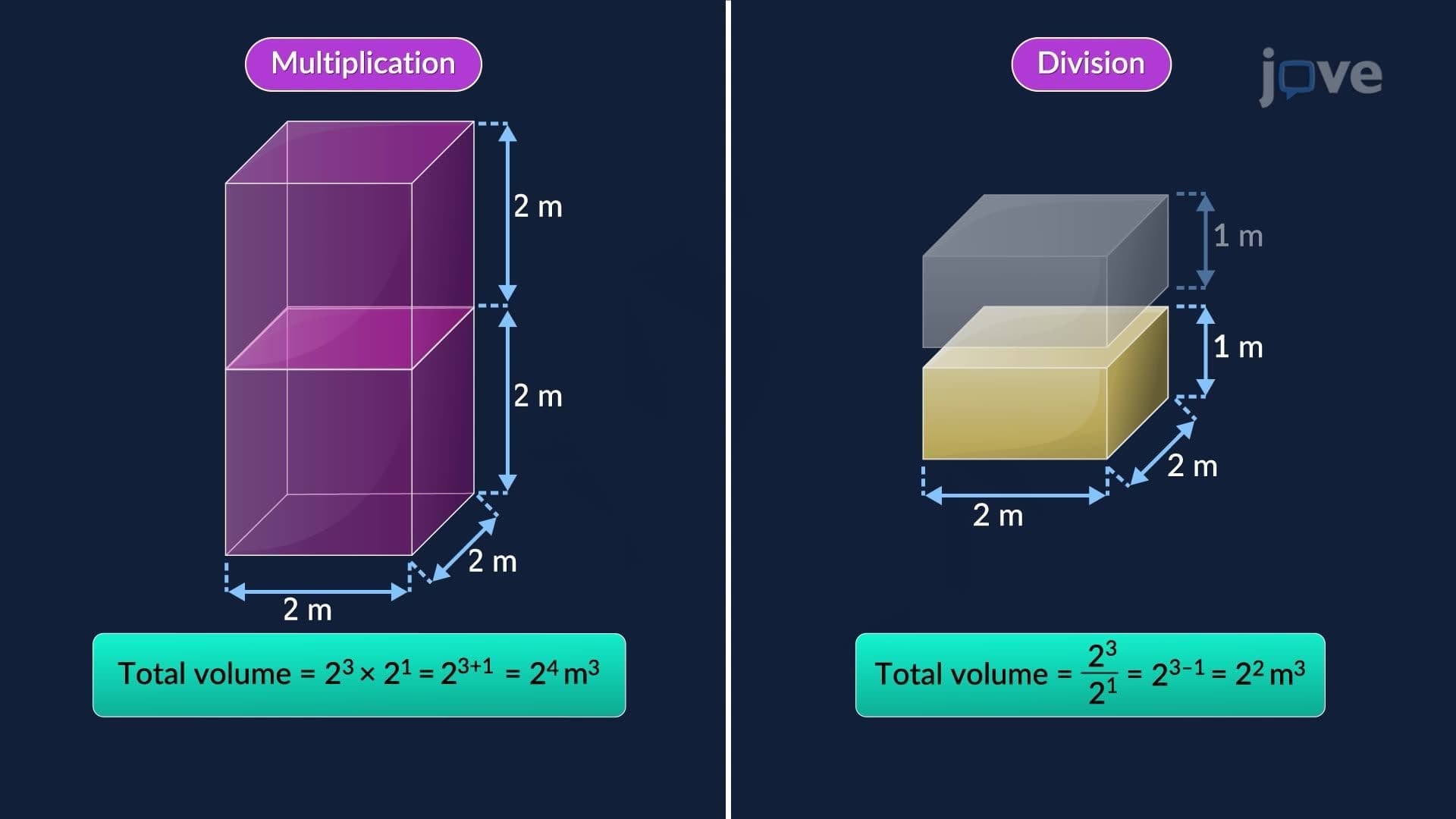

Video Summary: What Is Exponents
Did you know that doubling the edge length of a cube increases its volume by 8 times? Exponents make this mathematical relationship clear and predictable. When a 1-meter cube becomes a 2-meter cube, we calculate the volume using 2³ (2 to the third power), demonstrating how exponents show repeated multiplication. NASA engineers use these same exponential calculations when scaling spacecraft components. Watch the full video on JoVE Coach to master this concept with expert-led visuals and step-by-step explanations.
Exponents represent one of mathematics' most powerful shortcuts for expressing repeated multiplication. An exponent consists of two parts: the base (the number being multiplied) and the power (how many times multiplication occurs). When we write 2³, the base is 2 and the exponent is 3, meaning 2 × 2 × 2 = 8.
This concept becomes immediately practical when calculating areas and volumes. A square room with 4-foot sides has an area of 4² = 16 square feet. Similarly, a cubic storage container with 3-foot edges contains 3³ = 27 cubic feet of space. These calculations appear frequently on the SAT Math section and AP Calculus exams.
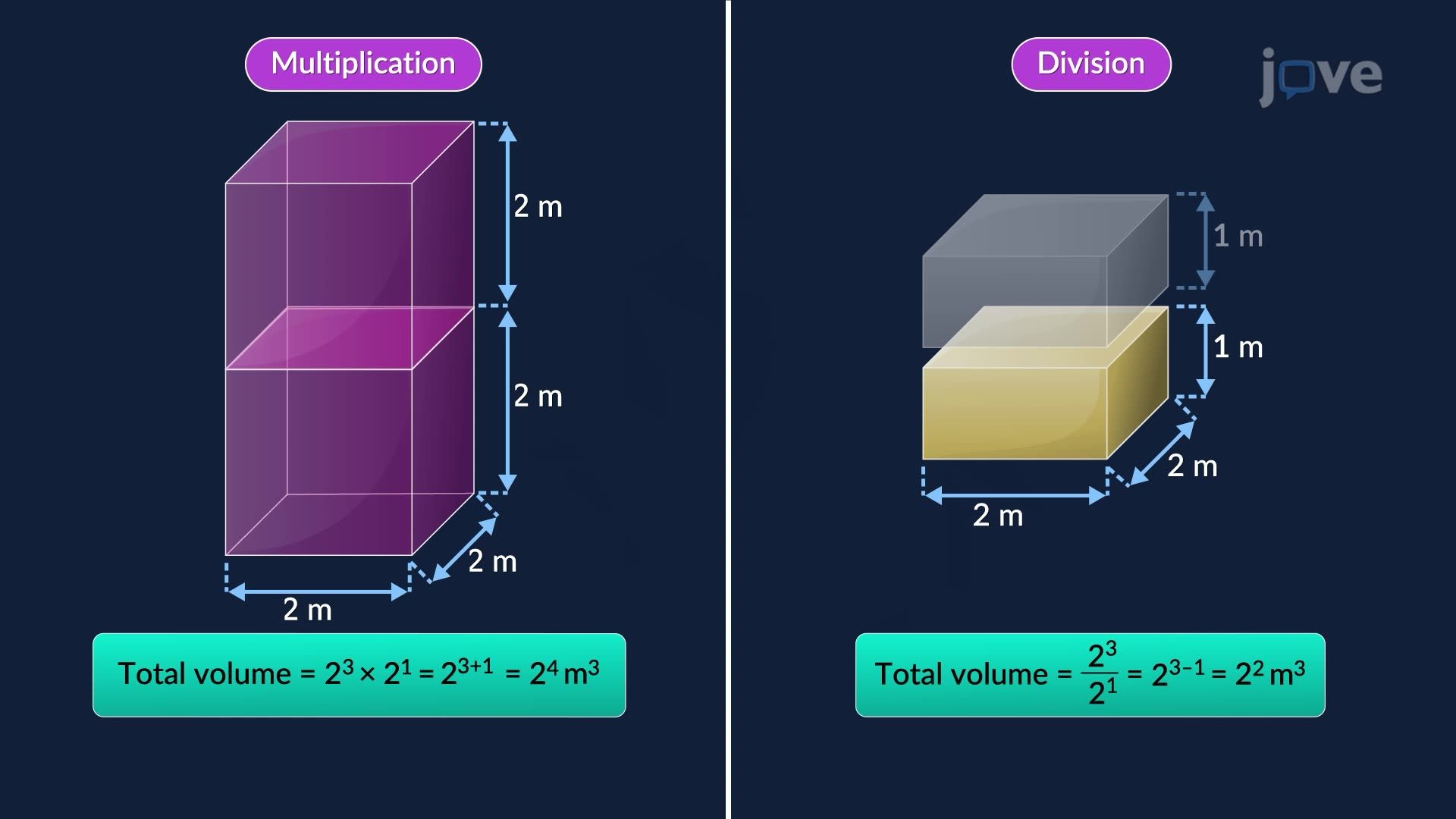
The fundamental rules governing exponents create consistency across mathematical applications. When multiplying expressions with identical bases, add the exponents: 2³ × 2² = 2⁵ = 32. This rule proves essential when working with scientific measurements-if bacteria populations double every hour, after 5 hours you'd calculate 2⁵ times the original population.
Division follows the opposite pattern: subtract exponents when dividing identical bases. The expression 2⁴ ÷ 2² equals 2² = 4. This rule frequently appears in chemistry calculations when determining concentration ratios and in physics when analyzing decay rates.
Powers of 10 form the backbone of scientific notation, enabling scientists and engineers to express extreme values efficiently. The distance from Earth to the Moon (approximately 240,000 miles) becomes 2.4 × 10⁵ miles in scientific notation. Conversely, the diameter of a human red blood cell (approximately 0.000008 meters) appears as 8 × 10⁻⁶ meters.
American university students encounter these applications across STEM courses. Engineering students use exponential calculations for structural load analysis, while pre-med students apply them in pharmacology dosage calculations. Business students utilize exponential functions for compound interest and market growth projections.
College-level mathematics extends exponential concepts into logarithms, exponential functions, and growth models. Economics students analyze inflation rates using exponential models, while environmental science majors calculate population dynamics and resource depletion curves.
Understanding exponents proves crucial for standardized test success. The MCAT includes exponential calculations in physics and chemistry sections, while business school entrance exams feature compound growth problems requiring exponential manipulation skills.
Related Micro-courses