Loading…
Loading video…

10,864 views
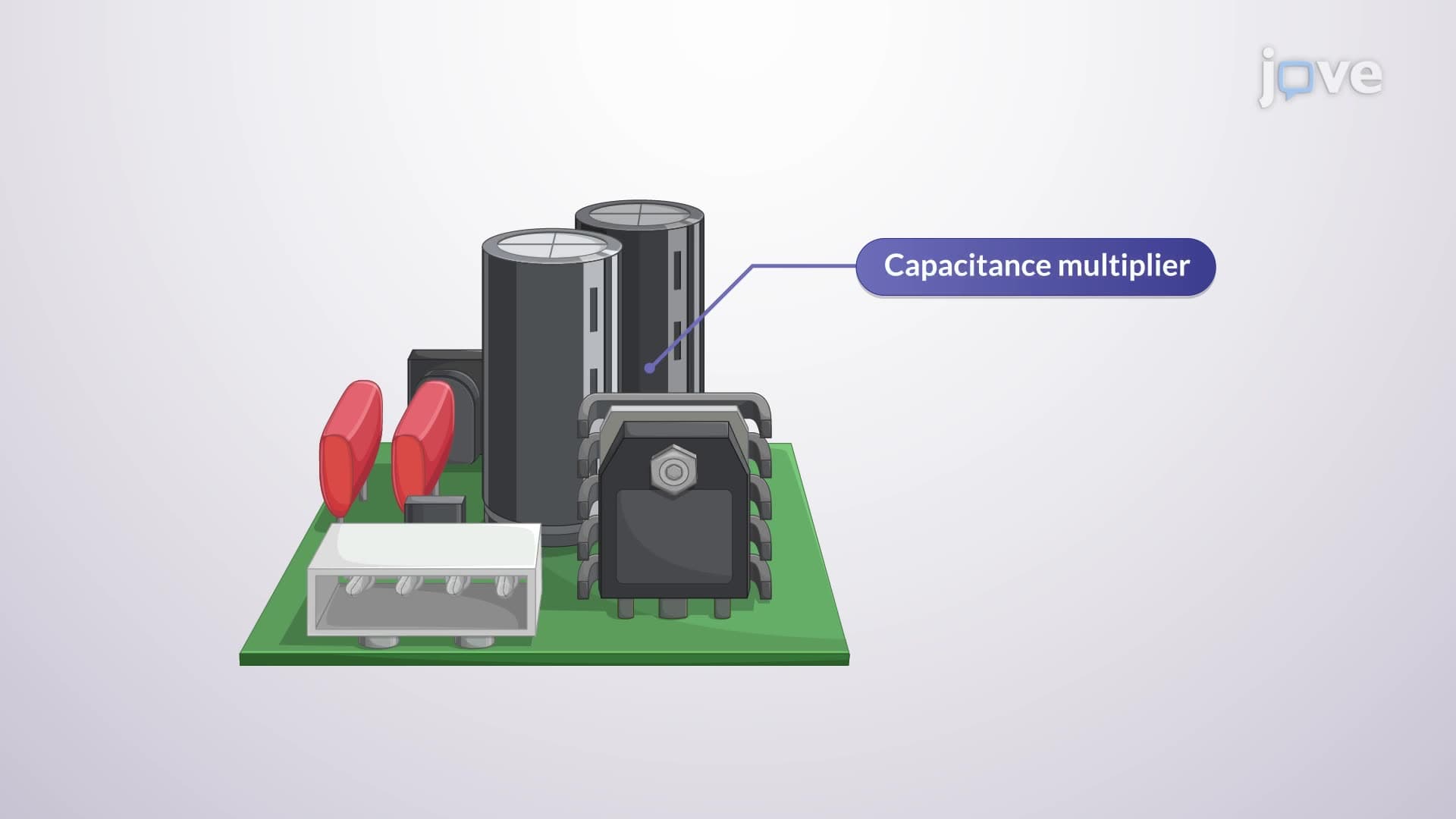
Ever wondered how your smartphone's touchscreen can detect the slightest finger touch? The secret lies in instantaneous power calculations within capacitance multiplier circuits that amplify tiny electrical signals. These sophisticated circuits use operational amplifiers to create effective capacitances hundreds of times larger than physical components, enabling ultra-sensitive touch detection in devices like iPhones and medical equipment used in US hospitals. Watch the full video on JoVE Coach to master this concept with expert-led visuals and step-by-step explanations.
Capacitance multiplier circuits represent a cornerstone of modern analog circuit design, particularly relevant for students preparing for the AP Physics C exam or college-level electrical engineering courses. These circuits solve a fundamental problem: creating large effective capacitances without using physically large capacitors, which is crucial for integrated circuit design where space is premium.
The circuit employs two operational amplifiers in distinct configurations. The first op-amp functions as a voltage follower (unity gain buffer), providing high input impedance and low output impedance. This configuration ensures minimal loading on the input signal source. The second op-amp operates as an inverting amplifier, creating the phase inversion necessary for the multiplication effect. Students studying for the MCAT should note how these configurations mirror biological signal processing in neural networks, where impedance matching is crucial for signal integrity.
The circuit's behavior follows fundamental electrical principles taught in college physics courses. Using Kirchhoff's Current Law (KCL), we can derive that the input current equals the current through the feedback capacitor. The instantaneous power definition becomes critical here, as P(t) = V(t) × I(t) determines the dynamic power consumption. For a circuit with multiplication factor M, the effective capacitance becomes C(eff) = M × C(physical), where typical values range from 10 to 1000 times the original capacitance.
Understanding what is instantaneous power in detail helps explain why these circuits have voltage limitations. As the multiplication factor increases, the maximum allowable input voltage decreases proportionally to prevent op-amp saturation. This trade-off appears frequently in engineering design problems on college examinations. Real-world applications include audio crossover networks in professional sound systems used in US concert halls, precision timing circuits in medical equipment, and touch-sensitive interfaces in automotive dashboards manufactured by companies like Ford and General Motors.
Frequently Asked Questions
A capacitance multiplier circuit uses operational amplifiers to create an effective capacitance much larger than the physical capacitor in the circuit. It works by using a voltage follower and inverting amplifier configuration that makes the input terminal "see" a capacitance that's a multiple of the actual component value. This technique is essential in integrated circuits where large physical capacitors would be impractical.
Instantaneous power determines the dynamic limitations of these circuits, particularly regarding maximum input voltage levels. As the multiplication factor increases, the instantaneous power handling capability decreases, requiring careful design trade-offs. This concept frequently appears on AP Physics C and college electrical engineering exams.
While specific circuit analysis may not appear directly on the MCAT, understanding operational amplifier principles and capacitance concepts is valuable for the physics section. AP Physics C students will likely encounter similar circuit analysis problems involving op-amps and reactive components during the electricity and magnetism portion.
These circuits are widely used in US industries including smartphone touchscreens (Apple, Google), medical monitoring equipment in hospitals like Mayo Clinic, automotive electronics in vehicles from Tesla and GM, and professional audio equipment manufactured by companies like Bose and Harman International.
Basic algebra and understanding of Ohm's Law are sufficient to grasp the fundamental concepts. The mathematical analysis primarily involves simple current and voltage relationships using Kirchhoff's laws, which are taught in high school physics courses. Advanced calculus is not required for introductory understanding.
Focus on understanding the two op-amp configurations separately first, then analyze how they work together. Practice calculating effective capacitance values for different resistance ratios, and understand the voltage limitations. Create circuit diagrams and work through numerical examples to reinforce the mathematical relationships.
Consider exploring active filter design, which uses similar op-amp configurations for frequency-selective circuits. Other related topics include impedance matching networks, analog signal processing, and integrated circuit design principles commonly taught in junior-level electrical engineering courses.
Understanding instantaneous power in capacitance multipliers provides foundation knowledge for advanced topics like switch-mode power supplies, RF circuit design, and power electronics. These concepts are particularly relevant for students planning careers in semiconductor design or power systems engineering.
Related Micro-courses
Related Subjects
 Civil Engineering 30 micro-courses›Mechanical Engineering 28 micro-courses›