Loading…
Loading video…

25,808 views

Ever wonder why bridge engineers don't just calculate the weight of a single car, but instead consider traffic spread across the entire span? Distributed loads represent forces spread over an area or length rather than concentrated at a single point. From snow accumulating on a roof in Colorado to water pressure against the Hoover Dam, these loads create varying pressures measured in Pascals across surfaces. Understanding distributed loads is crucial for analyzing real-world engineering scenarios where forces aren't simply point loads. Watch the full video on JoVE Coach to master this concept with expert-led visuals and step-by-step explanations.
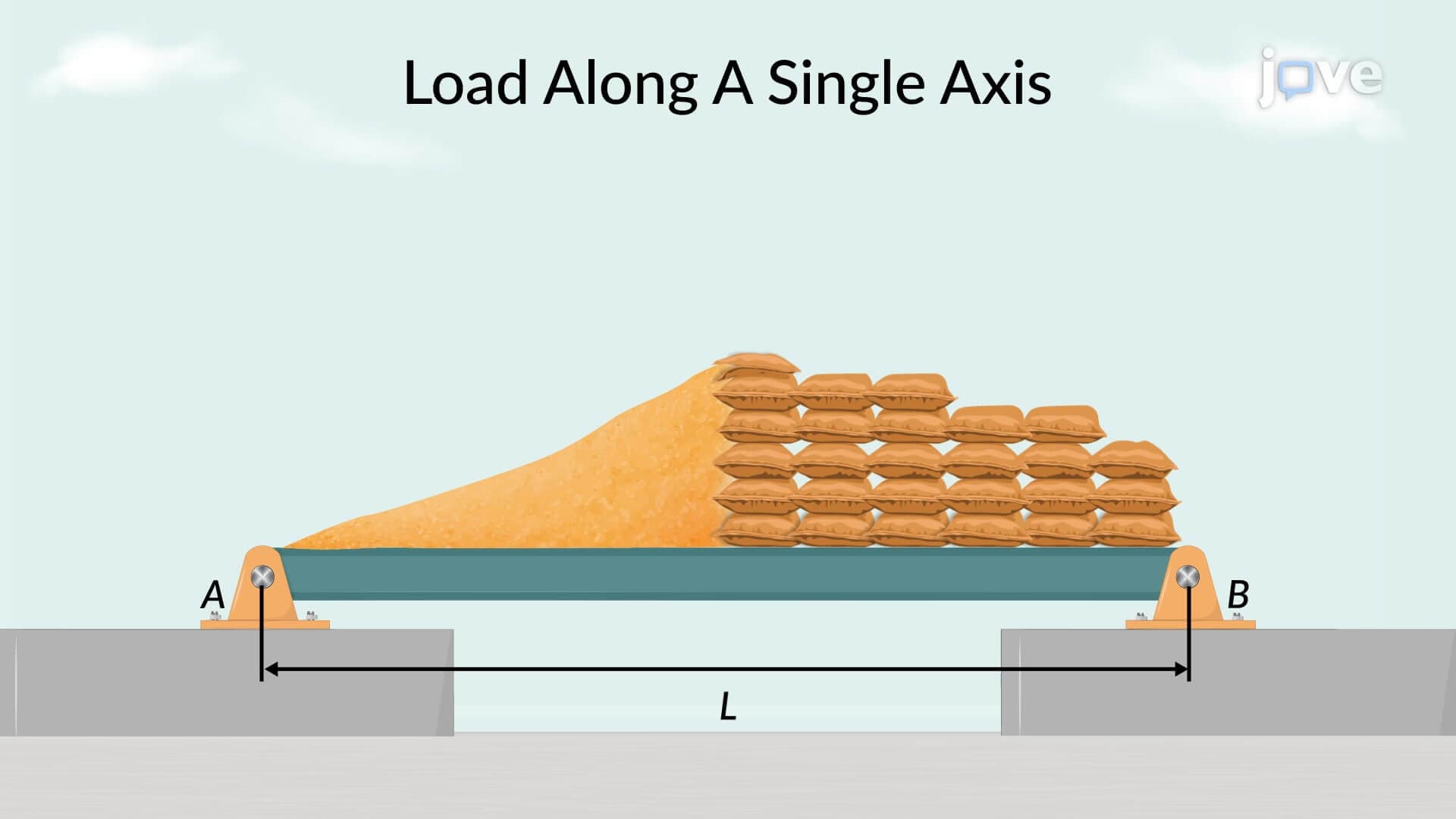
Distributed loads represent one of the most fundamental concepts in structural and mechanical engineering, describing forces that spread across an area or length rather than acting at a single point. Unlike concentrated loads that apply force at specific locations, distributed loads create varying pressure patterns across surfaces, measured in force per unit area (Pascals or pounds per square inch).
Engineers encounter several types of distributed loads in practice. Uniform distributed loads maintain constant intensity across the loaded area, such as snow uniformly covering a building roof in Minnesota. Variable distributed loads change intensity across the surface, like wind pressure on a skyscraper's facade in Chicago, where pressure increases with height. Triangular distributed loads often appear in fluid pressure applications, such as water pressure against the concrete face of California's Oroville Dam, where pressure increases linearly with depth.
The mathematical foundation of distributed loads involves integration to determine total forces and their points of application. For a distributed load function w(x), the total force equals the area under the load curve: F = ∫w(x)dx. This integration concept frequently appears on AP Physics C and college-level statics exams. The center of pressure represents where the resultant force acts, calculated using the centroid of the load distribution area. Understanding this concept proves essential for analyzing structures like the concrete arch of Arizona's Glen Canyon Dam, where engineers must precisely locate where water pressure forces act.
Distributed loads appear throughout American infrastructure. Highway bridge designers consider traffic loads distributed across bridge decks, following American Association of State Highway and Transportation Officials (AASHTO) standards. Building codes mandate analyzing distributed wind and seismic loads for structures in hurricane-prone Florida or earthquake-active California. These applications directly connect to coursework in civil engineering programs at institutions like MIT, Stanford, and the University of Texas at Austin, where students learn to model complex loading scenarios using distributed load principles.
Frequently Asked Questions
Distributed loads are forces spread over an area or length, creating pressure patterns across surfaces, while point loads concentrate all force at a single location. Think of snow covering a roof (distributed) versus a heavy air conditioning unit placed at one spot (point load). Distributed loads require integration to find total forces and their application points.
Exam questions typically focus on uniform rectangular loads, triangular loads (like hydrostatic pressure), and linear variable loads. Students must calculate total forces using integration, locate centers of pressure, and determine reaction forces. Practice problems often involve beams, pressure vessels, or fluid mechanics scenarios.
SAT Physics emphasizes conceptual understanding rather than complex calculations. Questions focus on recognizing distributed versus concentrated loads, understanding pressure relationships, and applying basic integration concepts. Students might analyze simple beam loading or fluid pressure scenarios without advanced mathematical manipulation.
Highway bridges experience distributed traffic loads, skyscrapers face distributed wind pressure, and dams withstand triangular water pressure distributions. The Golden Gate Bridge, Empire State Building, and Hoover Dam all demonstrate distributed loading principles. These examples help students connect theoretical concepts to familiar structures.
Basic integration skills suffice for most distributed load problems encountered in introductory courses. Students comfortable with finding areas under curves and simple integration can master these concepts. High school AP Calculus AB provides adequate mathematical background for most engineering applications.
Focus on drawing clear free-body diagrams, practicing integration techniques for various load shapes, and memorizing standard formulas for common distributions. Work through problems involving beams, pressure vessels, and fluid statics. Create a reference sheet with center of pressure formulas for rectangular and triangular loads.
Progress to influence lines for moving loads, distributed loads on curved surfaces, and three-dimensional loading scenarios. Explore finite element analysis methods and advanced structural analysis techniques used in professional engineering software like SAP2000 or ANSYS.
Distributed loads require solid integration skills but follow predictable patterns once students understand the fundamental approach. Most students find them moderately challenging—more complex than simple equilibrium but less demanding than advanced dynamics problems. Consistent practice with various load shapes builds confidence quickly.
Related Micro-courses
Related Subjects
 Civil Engineering 30 micro-courses›Electrical Engineering 33 micro-courses›