Loading…
Loading video…

17,768 views

Ever wonder why pushing a shopping cart across a parking lot requires constant effort even on flat ground? Rolling resistance problem solving explains this everyday physics challenge that affects everything from bicycle efficiency to truck fuel consumption. This systematic approach involves analyzing forces, moments, and geometric relationships when objects roll across surfaces - like calculating the force needed to push a 100 kg lawn roller used by groundskeepers at Yankee Stadium. Watch the full video on JoVE Coach to master this concept with expert-led visuals and step-by-step explanations.
Rolling resistance problem solving is a systematic approach to analyzing the forces required to maintain constant-speed motion of rolling objects across surfaces. Unlike sliding friction, rolling resistance occurs due to deformation at the contact point between the rolling object and surface, creating a moment arm that opposes motion. This concept is essential for mechanical engineering applications ranging from designing more efficient vehicle tires to optimizing industrial conveyor systems.
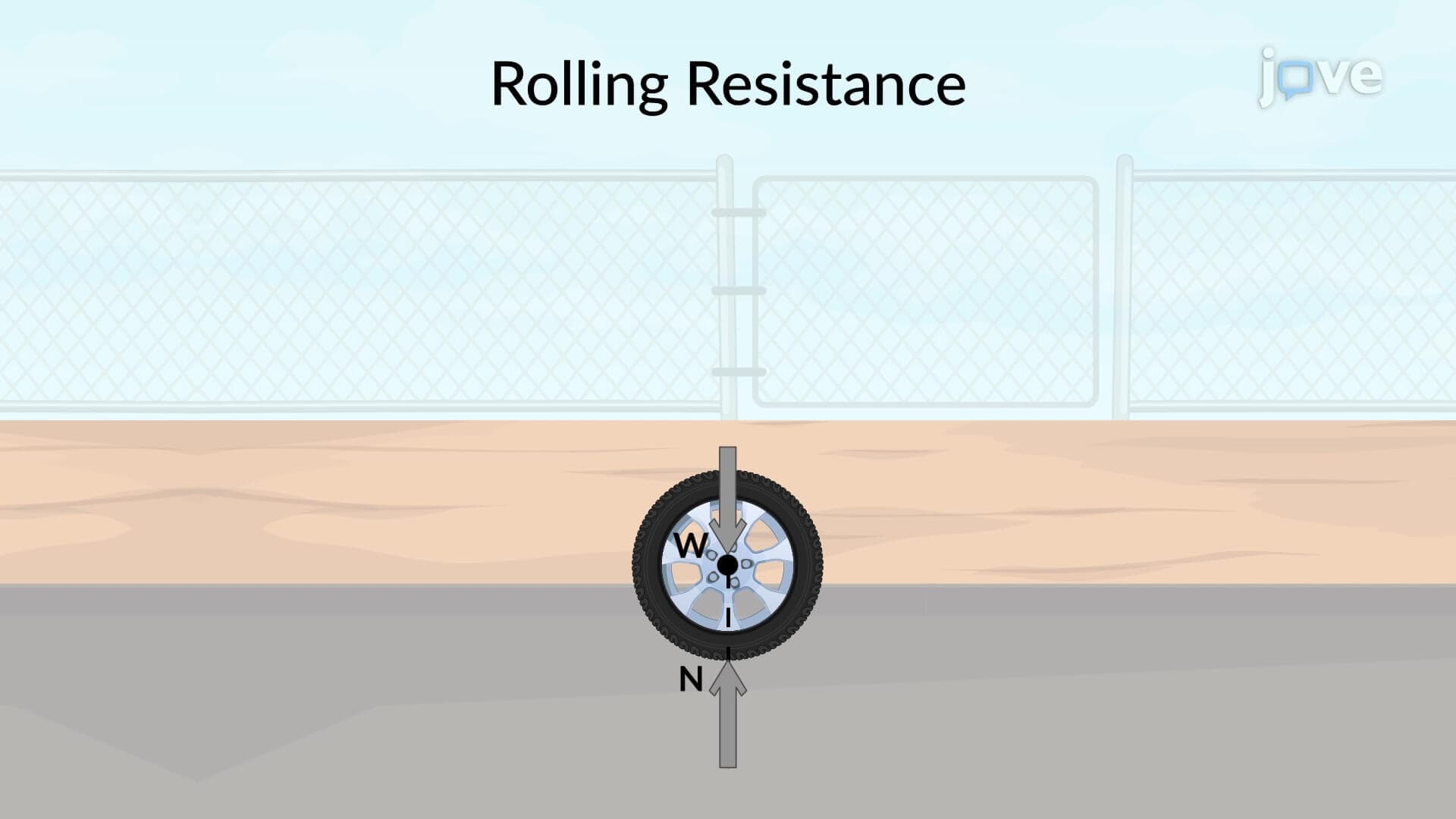
The foundation of rolling resistance problem solving begins with constructing accurate free-body diagrams. Engineers must identify three primary forces: the object's weight acting downward through the center of mass, the normal force acting upward at the contact point (offset by the rolling resistance), and any applied driving forces. When handles or arms extend at angles - common in equipment like the lawn rollers used by groundskeeping crews at Major League Baseball stadiums - the driving force must be resolved into horizontal and vertical components for proper analysis.
The critical insight in rolling resistance problem solving involves applying moment equilibrium around the contact point. This approach eliminates the unknown normal force from calculations, simplifying the solution process. Students preparing for AP Physics or college-level statics courses must understand that the moment arm for rolling resistance equals the coefficient of rolling resistance (typically measured in millimeters), while other forces create moments based on their perpendicular distances from the contact point.
Successful rolling resistance problem solving requires systematic geometric analysis. The angle between the normal force and vertical axis depends on the rolling resistance coefficient and object radius. For the lawn roller example, with a 25 mm coefficient and 250 mm radius, this geometric relationship becomes crucial for determining accurate force requirements. Civil engineering students studying pavement design must master these calculations to predict vehicle fuel efficiency and road wear patterns across different surface materials.
This problem-solving methodology appears frequently on standardized exams like the Fundamentals of Engineering (FE) exam and college mechanics midterms, where students must demonstrate proficiency in force resolution, moment calculations, and equilibrium analysis under time constraints.
Frequently Asked Questions
Rolling resistance problem solving analyzes forces needed to roll objects at constant speed, focusing on deformation at contact points rather than sliding surfaces. Unlike kinetic friction which acts tangentially, rolling resistance creates a moment arm that opposes rotation. This approach is essential for designing efficient wheels, tires, and rolling equipment used in industries from agriculture to transportation.
AP Physics C and college statics exams frequently test rolling resistance through multi-step problems involving force resolution, moment equilibrium, and geometric analysis. Students must construct free-body diagrams, apply equilibrium conditions, and solve for unknown forces or coefficients. Practice problems often feature realistic scenarios like moving cylindrical objects up inclines or analyzing agricultural equipment performance.
The primary difficulty lies in properly setting up moment equilibrium equations around the contact point and understanding geometric relationships between forces and moment arms. MCAT physics sections may include simplified versions, while engineering students must master the complete analysis including coefficient interpretations. Success requires strong trigonometry skills and systematic problem-solving approaches rather than memorizing formulas.
Rolling resistance analysis is crucial for automotive engineers designing fuel-efficient tires, agricultural equipment manufacturers optimizing tractors and harvesters, and logistics companies improving warehouse conveyor systems. Major US companies like John Deere, Ford, and FedEx rely on these calculations to reduce energy consumption and improve equipment performance across their operations.
Rolling resistance problem solving requires solid algebra, trigonometry, and basic calculus concepts typically covered in high school physics and pre-calculus courses. Students comfortable with force vectors, moment calculations, and geometric relationships can successfully master this topic. The mathematical complexity is manageable for anyone planning to take AP Physics or introductory college engineering courses.
Focus on practicing free-body diagram construction and systematic problem-solving steps rather than memorizing specific solutions. Work through problems with different geometries and force orientations, paying attention to how coefficient values affect required forces. Create summary sheets showing the standard approach: draw diagrams, resolve forces, apply moment equilibrium, and solve systematically.
Rolling resistance forms the foundation for studying vehicle dynamics, bearing design, and energy efficiency analysis in mechanical systems. Students who master this concept are better prepared for advanced courses in machine design, automotive engineering, and robotics where rolling elements are critical components requiring precise force and moment analysis.
Related Micro-courses
Related Subjects
 Civil Engineering 30 micro-courses›Electrical Engineering 33 micro-courses›