Loading subject page…


119,804 views

Video Summary: Hofmann and Curtius Rearrangements for Primary Amine Synthesis Overview
Ever wonder how pharmaceutical companies create life-saving medications like appetite suppressants and antidepressants? The Hofmann and Curtius rearrangements for primary amine synthesis are fundamental organic chemistry reactions that convert amides and acyl azides into primary amines through fascinating molecular rearrangements. These reactions power the synthesis of drugs like phentermine, used to treat obesity in millions of Americans. Watch the full video on JoVE Coach to master this concept with expert-led visuals and step-by-step explanations.
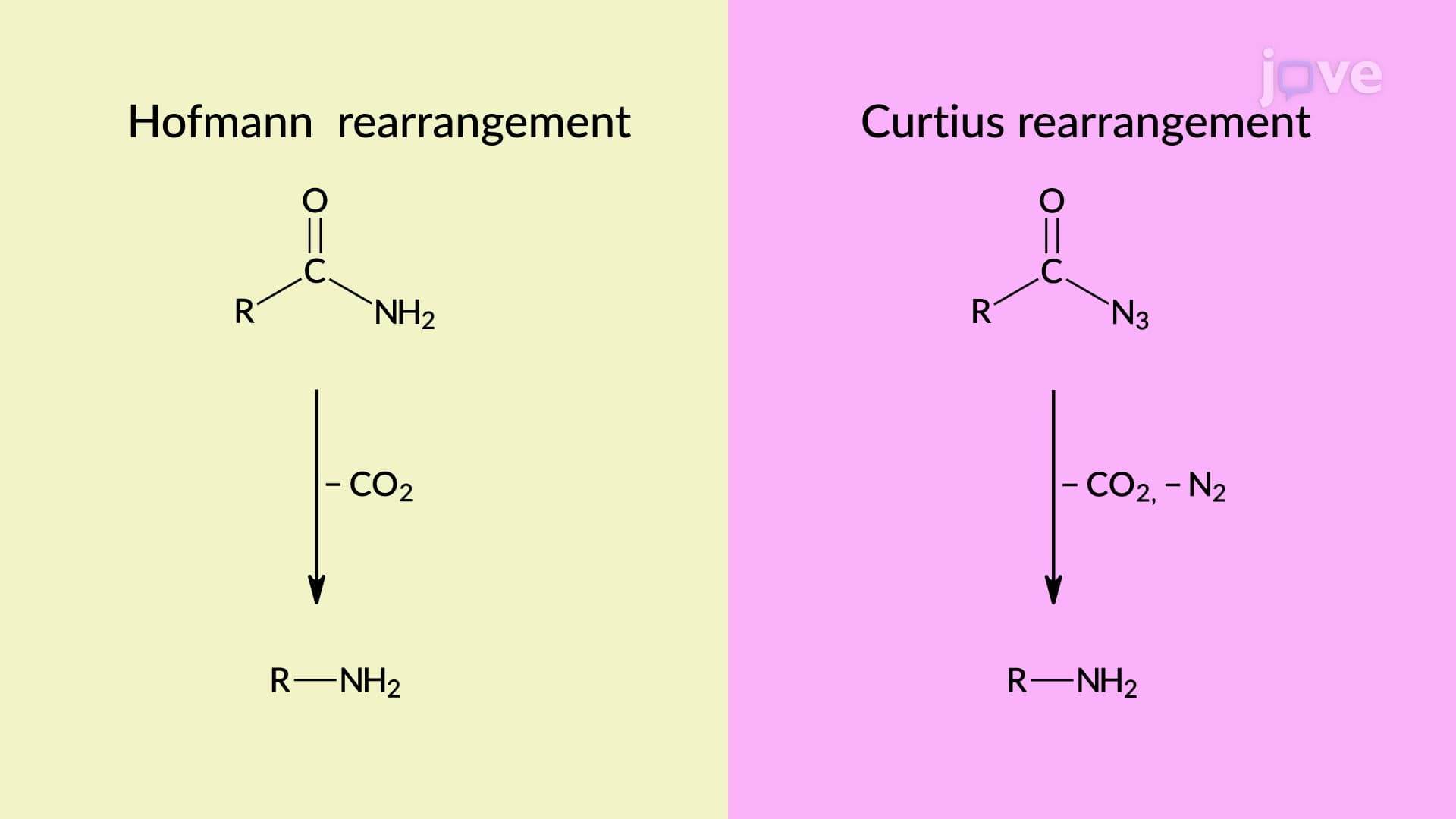
These two classical organic reactions represent elegant solutions to a fundamental synthetic challenge: converting carbonyl-containing compounds into primary amines. Both reactions involve remarkable molecular rearrangements where alkyl groups migrate from carbon to nitrogen, creating new C-N bonds while eliminating small molecules as driving forces.
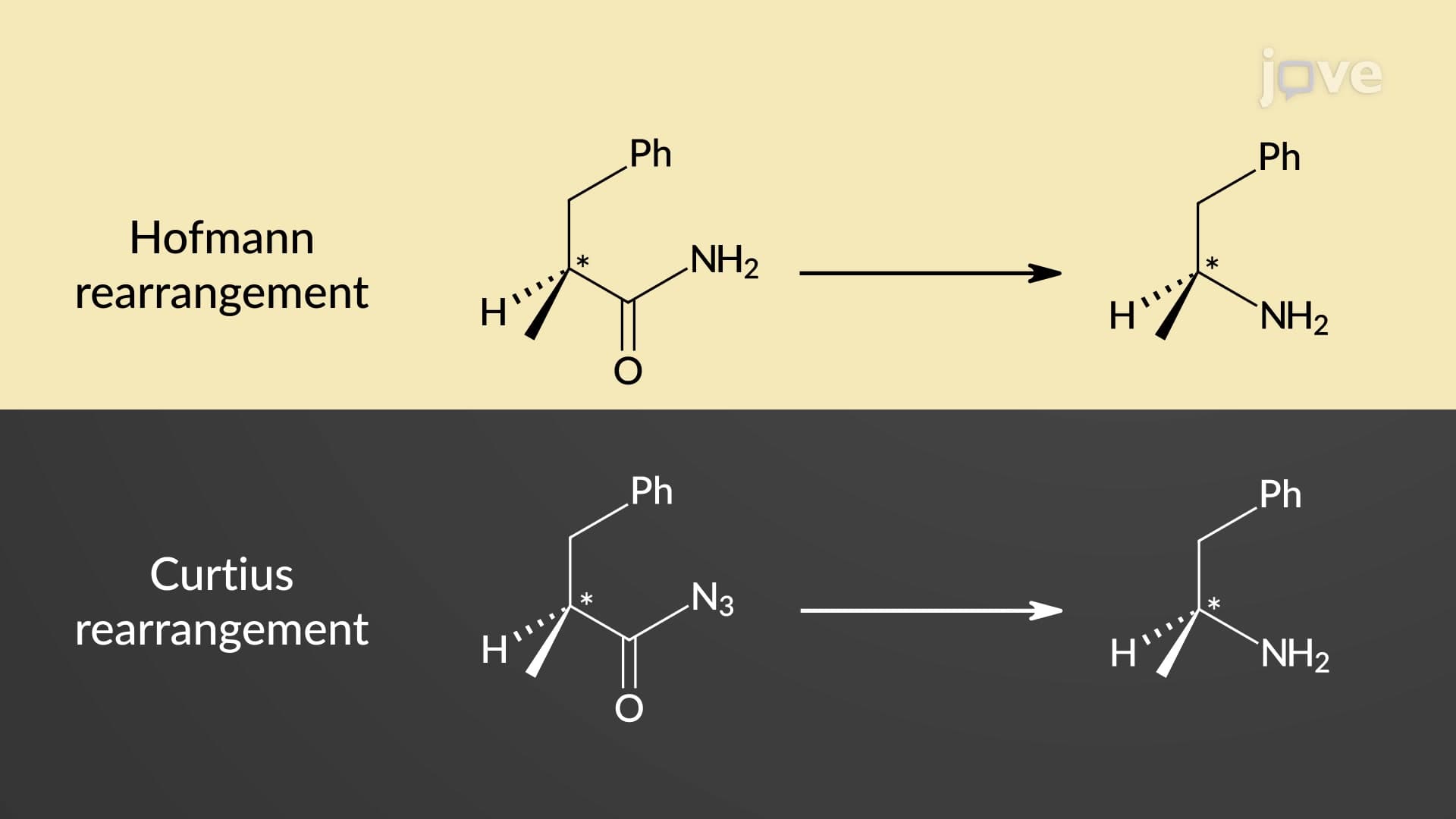
The Hofmann rearrangement transforms primary amides into primary amines using halogen (typically bromine or chlorine) in aqueous base conditions. The mechanism proceeds through several key steps: initial halogen addition to the amide nitrogen, base-promoted deprotonation, and the crucial 1,2-alkyl shift from the carbonyl carbon to nitrogen. This migration occurs with complete retention of stereochemistry-a critical factor in pharmaceutical applications.
The pharmaceutical industry extensively uses this reaction. Phentermine, prescribed to over 2.4 million Americans annually for weight management, exemplifies this application. Starting from an aryl amide precursor, the Hofmann rearrangement efficiently generates the primary amine structure essential for phentermine's appetite-suppressing activity. Students preparing for AP Chemistry or MCAT exams frequently encounter this reaction in synthesis problems.
The Curtius rearrangement offers an alternative pathway using acyl azides as starting materials under thermal conditions. The reaction mechanism involves heating the acyl azide to promote nitrogen gas elimination, triggering the same type of 1,2-alkyl migration seen in Hofmann chemistry. The intermediate isocyanate then undergoes hydrolysis to yield the primary amine.
Tranylcypromine, an antidepressant in the monoamine oxidase inhibitor (MAOI) class, demonstrates Curtius rearrangement's pharmaceutical relevance. This synthesis showcases how thermal conditions can achieve similar stereochemical control to the Hofmann reaction, making both methods valuable in different synthetic contexts.
Both rearrangements share critical features that appear regularly on standardized exams. The one-carbon loss pattern helps students predict product structures, while stereochemical retention explains why these reactions remain valuable for complex molecule synthesis. College organic chemistry courses emphasize mechanism understanding, particularly the electron movement during alkyl migration steps.
For MCAT preparation, focus on recognizing these reactions in pharmaceutical synthesis contexts and understanding their mechanistic similarities despite different reaction conditions.
Related Micro-courses