Loading video…


 29 Concepts
 119.8K views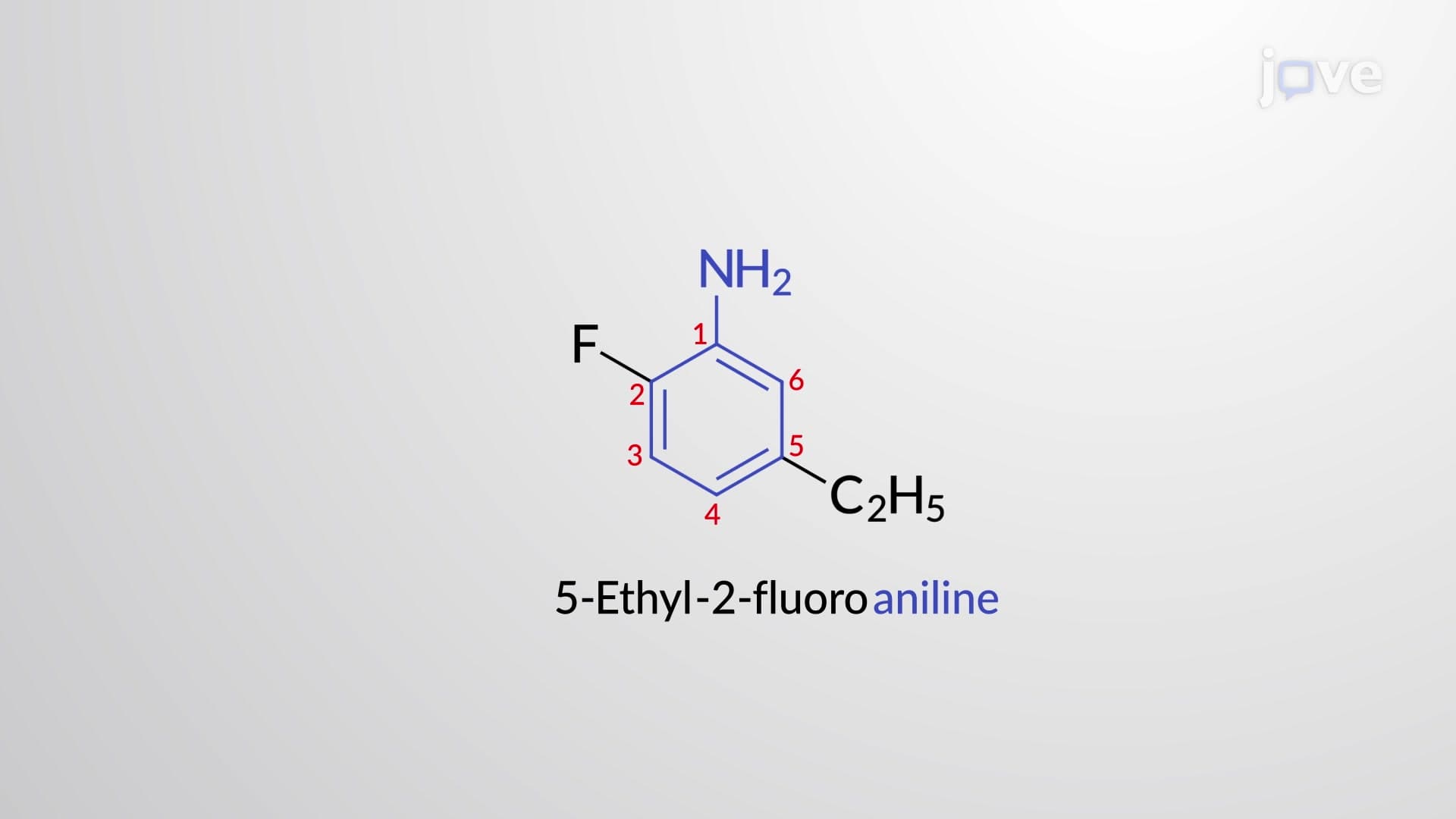

Video Summary: Nomenclature of Aryl and Heterocyclic Amines Explained
Ever wondered why pharmaceutical chemists at companies like Pfizer can instantly identify complex drug structures? The nomenclature of aryl and heterocyclic amines provides the systematic language that makes this possible. These naming rules transform confusing molecular structures into clear, standardized names that scientists worldwide understand. From simple aniline derivatives to complex heterocyclic compounds, mastering these nomenclature principles is essential for success in organic chemistry. Watch the full video on JoVE Coach to master this concept with expert-led visuals and step-by-step explanations.
The nomenclature of aryl and heterocyclic amines represents a critical junction in organic chemistry where systematic naming meets practical application. Unlike simple alkyl amines, aryl amines (aromatic amines) require special consideration due to their benzene ring structure and the electronic effects of the aromatic system. The foundational compound, aniline (phenylamine), serves as the parent structure for most aryl amine nomenclature.
Aryl amines follow two parallel naming systems that organic chemistry students encounter regularly on AP Chemistry exams and college coursework. The common name system uses familiar prefixes: ortho- (1,2-substitution), meta- (1,3-substitution), and para- (1,4-substitution). For example, para-chloroaniline describes a chlorine substituent directly opposite the amino group on the benzene ring.
The systematic IUPAC approach treats these compounds as aniline derivatives, numbering the ring starting from the carbon bearing the NH2 group. This numbering system ensures the lowest possible locants for substituents, following the fundamental principle of organic nomenclature. When multiple substituents are present, the first point of difference rule applies, and substituents are listed alphabetically in the name.
Secondary and tertiary aryl amines introduce the N-substitution concept, where additional alkyl or aryl groups attach to the nitrogen atom. These compounds are named as N-substituted anilines. For instance, N-methylaniline describes aniline with a methyl group attached to the nitrogen. This naming pattern appears frequently in MCAT organic chemistry sections and pharmaceutical chemistry contexts.
Heterocyclic amines present unique challenges due to their diverse ring structures and multiple heteroatoms. The naming system prioritizes the heteroatom with the highest atomic number for numbering purposes. Five-membered rings containing nitrogen include pyrrole, while six-membered rings include pyridine. These fundamental structures form the backbone of many pharmaceuticals manufactured by US companies like Johnson & Johnson and Merck.
The aza- prefix system provides an alternative approach, particularly useful for complex polycyclic structures. Diazine describes a six-membered ring with two nitrogen atoms, while specific positional isomers receive distinct names like pyrazine (1,4-diazine) and pyrimidine (1,3-diazine). Understanding these patterns proves essential for students pursuing careers in medicinal chemistry or preparing for graduate school entrance exams.
Related Micro-courses