Loading subject page…


119,803 views

Video Summary: What are Mass Spectrometry of Amines
Ever wonder how forensic scientists identify unknown drugs containing nitrogen compounds at crime labs across the US? Mass spectrometry amines analysis reveals the molecular fingerprint of these compounds through predictable fragmentation patterns. When pharmaceutical companies at Pfizer analyze new amine-based medications, they rely on the nitrogen rule and alpha-cleavage mechanisms to confirm molecular structures. Understanding what are mass spectrometry of amines becomes crucial for identifying these nitrogen-containing molecules in both research and clinical settings. Watch the full video on JoVE Coach to master this concept with expert-led visuals and step-by-step explanations.
Mass spectrometry of amines represents a critical analytical technique used extensively in pharmaceutical development, forensic analysis, and biochemical research across US laboratories. When amine molecules enter the mass spectrometer, they undergo ionization followed by characteristic fragmentation patterns that create unique molecular fingerprints. This process proves invaluable for identifying unknown nitrogen-containing compounds in everything from drug screening at hospitals like Johns Hopkins to quality control at pharmaceutical giants like Johnson & Johnson.
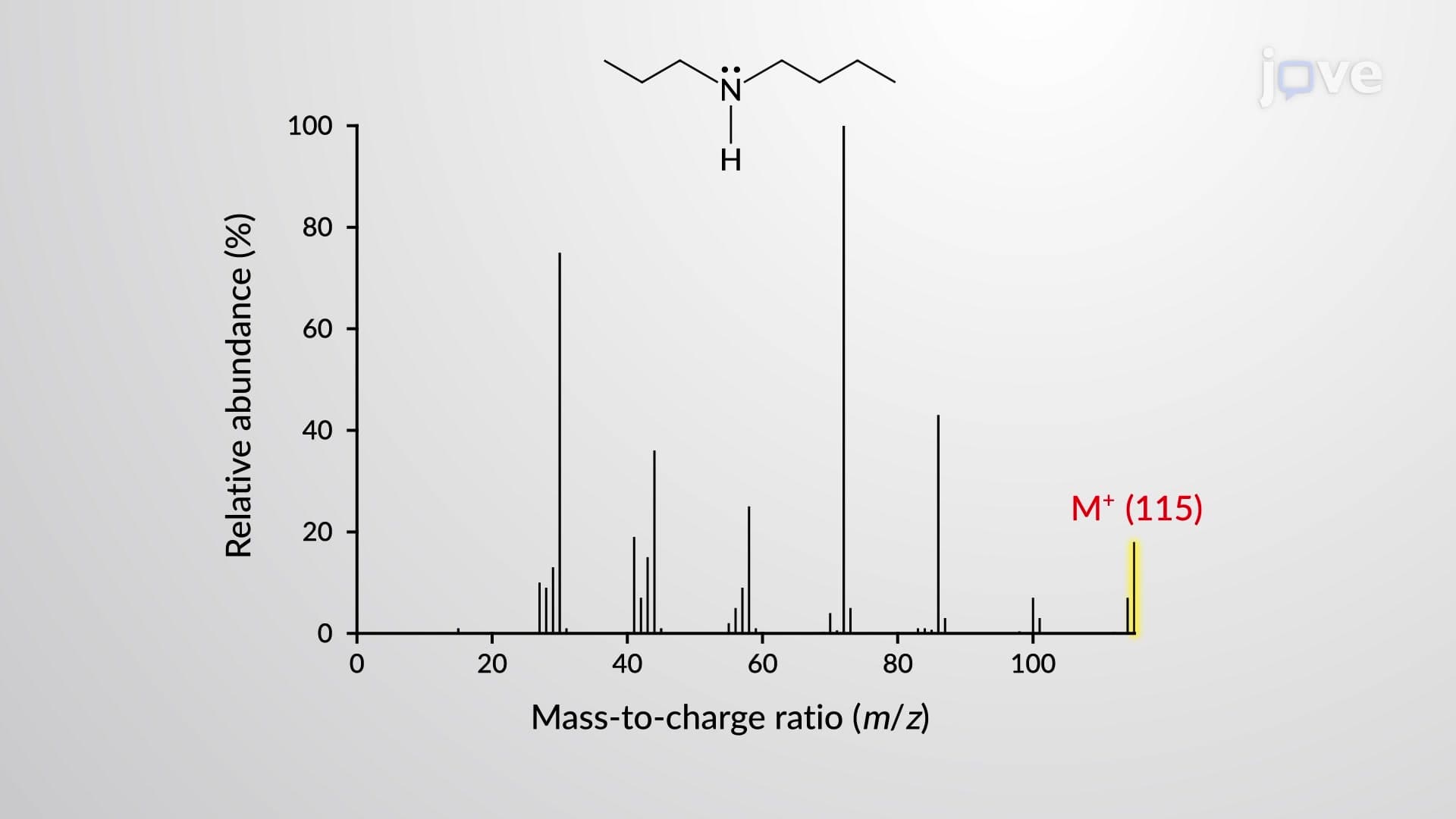
The nitrogen rule serves as a fundamental principle governing amine mass spectrometry behavior. Compounds containing an odd number of nitrogen atoms invariably produce molecular ion peaks with odd mass-to-charge (m/z) ratios. This rule becomes particularly important for AP Chemistry students and pre-med undergraduates preparing for the MCAT, as it provides a quick diagnostic tool for identifying nitrogen-containing molecules. For instance, when analyzing methylamine (CH3NH2) with molecular weight 31, the odd m/z value immediately confirms the presence of nitrogen.
Alpha-cleavage represents the predominant fragmentation pathway for amines in mass spectrometry. This process involves breaking the carbon-carbon bond adjacent to the nitrogen atom, producing stable iminium ions (R2N+=CHR) and neutral alkyl radicals. The resulting iminium ions appear as prominent peaks in the mass spectrum, often serving as base peaks due to their enhanced stability through nitrogen's lone pair resonance. Students studying for college organic chemistry exams should note that this fragmentation pattern remains consistent across primary, secondary, and tertiary amines.
Understanding amine mass spectrometry proves essential for various US standardized exams and real-world applications. MCAT test-takers frequently encounter questions involving nitrogen rule applications and fragmentation pattern interpretation. Meanwhile, forensic laboratories like those operated by the FBI rely on these principles for identifying controlled substances containing amine functional groups. Pharmaceutical companies use amine mass spectrometry for drug purity analysis and metabolite identification during clinical trials conducted at institutions like the Mayo Clinic and Cleveland Clinic.
Related Micro-courses