Loading subject page…

- Organic Chemistry
- Synthetic Polymers
- Olefin Metathesis Polymerization: Ring-Opening Metathesis Polymerization (ROMP)
Micro-course: Synthetic Polymers
58,700 views
Learn key concepts and earn your certificate.




Olefin Metathesis Polymerization: Ring-Opening Metathesis Polymerization (ROMP)


00:00
01:16
Video Summary: Olefin Metathesis Polymerization Ring Opening Explained
Ever wondered how scientists create specialized plastics that conduct electricity or serve as advanced medical devices? Olefin metathesis polymerization ring reactions power breakthrough materials used in everything from Boeing's aircraft components to MIT's flexible electronics research. This powerful chemical process breaks open strained ring molecules like cyclopentene and links them into long polymer chains, preserving their unique double-bond structures. The olefin metathesis polymerization ring opening explained process relies on metal catalysts like Grubbs catalyst to drive these transformations. Watch the full video on JoVE Coach to master this concept with expert-led visuals and step-by-step explanations.
- Understand how olefin metathesis polymerization ring opening explained mechanisms convert cyclic alkenes into linear polymers through catalyst-mediated reactions
- Identify the role of ring strain in driving ROMP reactions, recognizing that smaller, more strained rings like cyclobutene react faster than larger rings
- Analyze the step-by-step mechanism involving Grubbs catalyst, metallacyclobutane intermediates, and successive ring-opening events
- Compare the reactivity patterns of different cycloalkenes based on ring size and strain energy considerations
- Evaluate why ROMP produces polymers that retain double bonds, making them valuable for creating conjugated materials
- Apply ROMP principles to predict polymer structures and properties from given cyclic starting materials
- Recognize real-world applications of ROMP in creating specialty polymers for electronics, biomedicine, and advanced materials
- Explore how reaction conditions and catalyst choice influence polymer molecular weight and material properties
Understanding Olefin Metathesis Polymerization Ring Opening Mechanisms
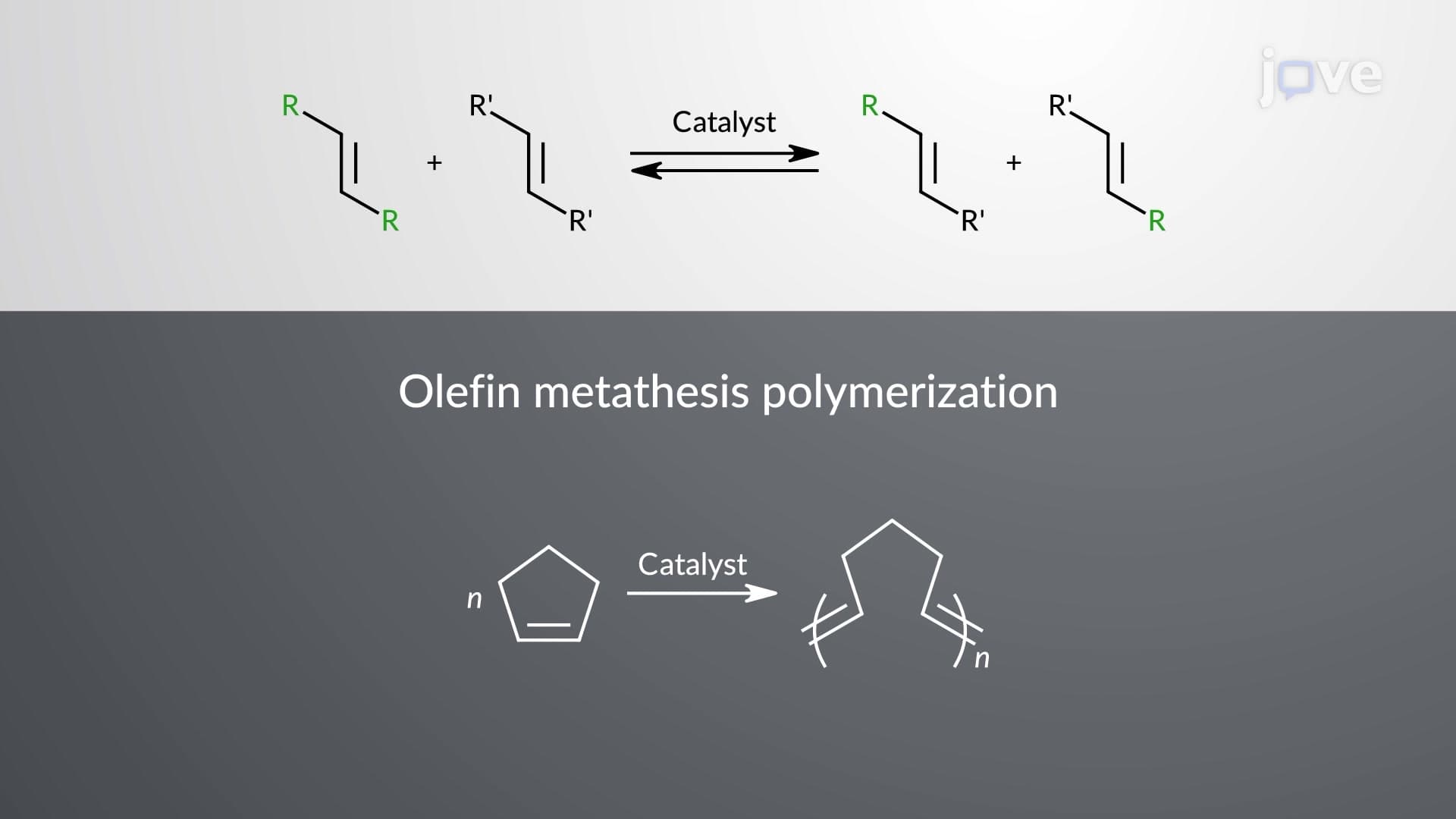
Olefin metathesis polymerization ring opening explained begins with a fundamental driving force: the relief of ring strain. When cyclic alkenes like cyclopentene, cycloheptene, or norbornene exist in their ring forms, they experience angle strain and torsional strain that makes them thermodynamically unstable. ROMP harnesses this instability by breaking these rings open and connecting the resulting fragments into polymer chains.
The Grubbs Catalyst and Metallacyclobutane Formation
The reaction mechanism centers on organometallic catalysts, most commonly Grubbs catalysts developed by Nobel laureate Robert Grubbs at Caltech. These ruthenium-based catalysts contain a metal-carbon double bond (metal carbene) that initiates the polymerization. When the catalyst encounters a strained cycloalkene, they form a four-membered metallacyclobutane intermediate-a crucial step that appears frequently on AP Chemistry and organic chemistry exams.
This intermediate immediately breaks apart, but instead of reforming the original molecules, it creates a new metal carbene attached to an open chain. This propagating species then attacks another cycloalkene molecule, extending the growing polymer chain while maintaining the catalyst's activity.
Ring Strain and Reactivity Patterns
Students preparing for the MCAT or advanced organic chemistry courses should understand that ring strain directly correlates with ROMP reactivity. Three- and four-membered rings (like cyclopropene and cyclobutene) exhibit the highest strain and react most readily. Five-membered rings show moderate reactivity, while six-membered rings like cyclohexene typically don't undergo ROMP under normal conditions due to their low strain energy.
Industrial Applications and Material Properties
ROMP's unique ability to preserve double bonds in the polymer backbone creates materials with exceptional properties. Companies like Materia Inc. (now part of ExxonMobil) use ROMP to produce DCPD-based polymers for automotive and aerospace applications. These materials appear in everything from body panels for NASCAR vehicles to components in SpaceX rockets, demonstrating ROMP's importance in advanced manufacturing sectors.
Frequently Asked Questions
Olefin metathesis polymerization ring opening is a chemical reaction that breaks open strained cyclic alkenes and connects them into polymer chains using metal catalysts. The process begins when a Grubbs catalyst forms a metallacyclobutane intermediate with a cycloalkene, which then breaks apart to create a growing polymer chain while preserving the double bonds from the original ring molecules.
ROMP questions typically focus on mechanism drawing, predicting polymer structures from cyclic monomers, and explaining the role of ring strain in reaction rates. Students should practice identifying metallacyclobutane intermediates, drawing propagation steps, and explaining why smaller rings react faster than larger ones. The concept often appears in polymer chemistry units and organometallic sections.
Unlike addition polymerization (which saturates double bonds) or condensation polymerization (which eliminates small molecules), ROMP preserves the unsaturation from cyclic monomers in the final polymer. This creates materials with conjugated systems that can conduct electricity or exhibit unique optical properties. MCAT questions often contrast these mechanisms to test understanding of polymer structure-property relationships.
ROMP produces specialized materials for diverse applications including medical devices manufactured by companies like Medtronic, protective coatings for military vehicles, and flexible electronics developed at institutions like Stanford and MIT. The automotive industry uses ROMP polymers in lightweight components, while pharmaceutical companies employ them in drug delivery systems.
ROMP concepts build on basic organic chemistry knowledge including alkene structure, ring strain, and catalysis principles typically covered in first-year college chemistry. While the mechanism involves organometallic intermediates, the fundamental ideas are accessible to students with strong foundations in chemical bonding and reaction mechanisms from AP Chemistry or equivalent courses.
Focus on drawing the complete mechanism showing catalyst initiation, metallacyclobutane formation, and chain propagation steps. Practice predicting polymer structures from different cyclic starting materials and explaining reactivity trends based on ring strain. Create concept maps linking ring size to strain energy to reaction rate, and work through problems involving molecular weight calculations.
ROMP provides an excellent foundation for studying organometallic chemistry, polymer science, and materials chemistry in advanced undergraduate courses. The concepts directly relate to other metathesis reactions, catalyst design principles, and structure-property relationships in materials science, making it valuable preparation for graduate-level chemistry studies.
Highly strained rings like norbornene, cyclopentene, and cyclooctene are ideal ROMP substrates due to their significant ring strain. Cyclobutene reacts extremely rapidly but is difficult to handle, while cyclohexene typically requires harsh conditions due to its low ring strain, making it impractical for most educational laboratory settings.
Related Micro-courses
15 Concepts

12 Concepts

14 Concepts