Loading…
Loading video…

100,000 views
Ever wondered how researchers can double the power of their studies while using fewer participants? Crossover experiments revolutionize clinical research by having each participant serve as their own control, eliminating individual differences that could skew results. Picture testing two asthma medications on patients at Johns Hopkins – instead of comparing different groups, each patient tries both treatments with a washout period between them. This elegant design is crucial for late-phase drug trials across America's leading medical centers. Watch the full video on JoVE Coach to master this concept with expert-led visuals and step-by-step explanations.
Crossover experiments represent a sophisticated research methodology where each participant receives multiple treatments in different time periods, essentially serving as their own control group. Unlike traditional parallel designs that compare separate groups, crossover studies leverage within-subject comparisons to maximize statistical efficiency while minimizing confounding variables.
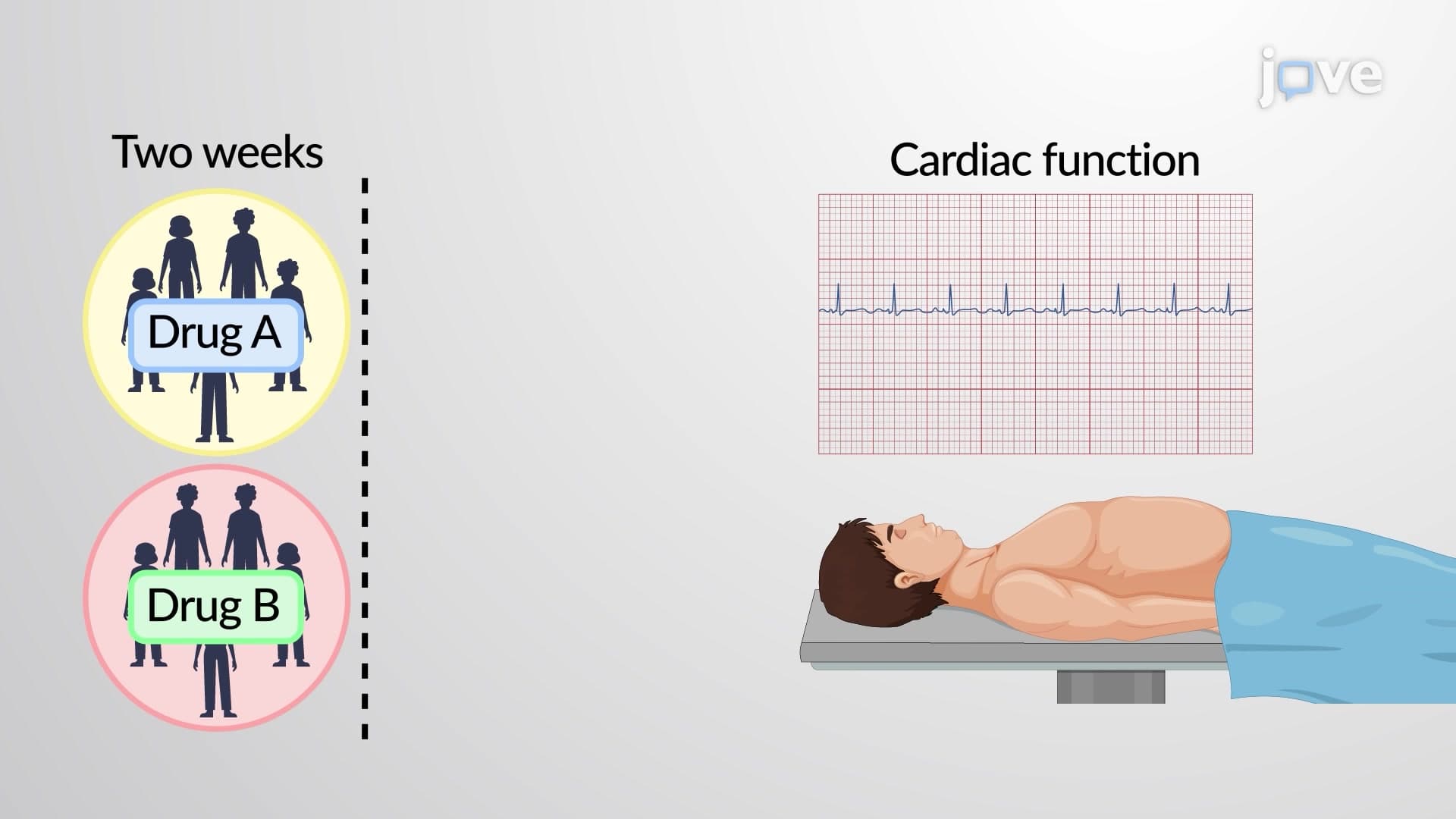
The foundation of any crossover experiment rests on three critical elements. First, treatment periods where participants receive different interventions sequentially. Second, washout periods that allow complete elimination of the previous treatment's effects before starting the next phase. Third, randomized sequences that determine the order treatments are administered, preventing systematic bias.
Consider a Mayo Clinic study comparing two blood pressure medications. Group A receives Drug X for four weeks, followed by a two-week washout, then Drug Y for four weeks. Group B follows the reverse sequence. This balanced approach ensures that time-related factors don't influence outcomes, while the washout period prevents Drug X from affecting Drug Y's performance.
Simple two-period crossover designs are most common, involving two treatments administered in AB/BA sequences. Multiple-period crossover studies examine three or more treatments, though complexity increases dramatically. Incomplete crossover designs may be necessary when certain treatment combinations are impractical or unsafe.
The pharmaceutical industry frequently employs crossover designs for chronic conditions like diabetes, hypertension, or arthritis. The FDA particularly values these studies for bioequivalence testing, where generic drugs must demonstrate comparable effectiveness to brand-name versions.
Crossover experiments appear regularly on the MCAT and AP Statistics exams, testing students' understanding of experimental design principles. College-level biostatistics courses extensively cover crossover analysis, while medical students encounter these designs in clinical research methodology classes.
Real-world applications span from comparing insulin formulations in diabetes patients at Cleveland Clinic to evaluating pain management strategies in arthritis research at Stanford Medical Center. The design's efficiency makes it particularly valuable for rare disease studies where patient recruitment is challenging.
Frequently Asked Questions
A crossover experiment is a study design where each participant receives multiple treatments in different time periods, separated by washout phases. Participants essentially serve as their own controls, eliminating individual differences that could bias results. This approach is particularly powerful for comparing treatments where permanent cures aren't expected.
The MCAT frequently tests crossover design concepts in the Psychological, Social, and Biological Foundations section. Questions focus on identifying when crossover designs are appropriate, understanding washout periods, and recognizing advantages over parallel-group studies. Students should understand both statistical benefits and practical limitations.
AP Statistics emphasizes two-period crossover designs and their analysis using paired t-tests. Students learn to identify carryover effects, understand randomization sequences, and calculate statistical power advantages. The exam often presents scenarios requiring students to choose between crossover and parallel designs.
The FDA values crossover designs because they provide more precise treatment comparisons with smaller sample sizes. They're ideal for chronic conditions where treatments manage symptoms rather than cure diseases. Major pharmaceutical companies use crossover studies for bioequivalence testing and dose-finding studies at institutions like Johns Hopkins and UCLA.
Not at all! The basic concept is quite intuitive – imagine testing two study methods by trying both yourself rather than comparing with classmates. The key insight is that people vary naturally, so comparing treatments within the same person eliminates this variation. Start with simple two-treatment examples before exploring complex designs.
Focus on identifying when crossover designs are appropriate versus inappropriate (avoid for curative treatments). Practice recognizing washout periods and their importance. Understand the statistical advantages: increased power, smaller sample sizes, and elimination of confounding variables. Work through practice problems involving treatment sequences and carryover effects.
Crossover studies aren't suitable when treatments provide permanent cures or cause irreversible changes. They require longer study durations due to multiple periods and washouts. Participant dropout can be problematic since each person must complete all treatment phases. Additionally, some conditions may progress over time, complicating interpretations.
Explore Latin square designs for multiple treatments, methods for analyzing carryover effects, and sample size calculations specific to crossover studies. Advanced biostatistics courses cover mixed-effects models for crossover analysis and adaptive crossover designs used in modern clinical trials.
Related Micro-courses
Related Subjects
 Physics 33 micro-courses›
 Math Fundamentals 11 micro-courses›