Loading…
Loading video…

100,000 views

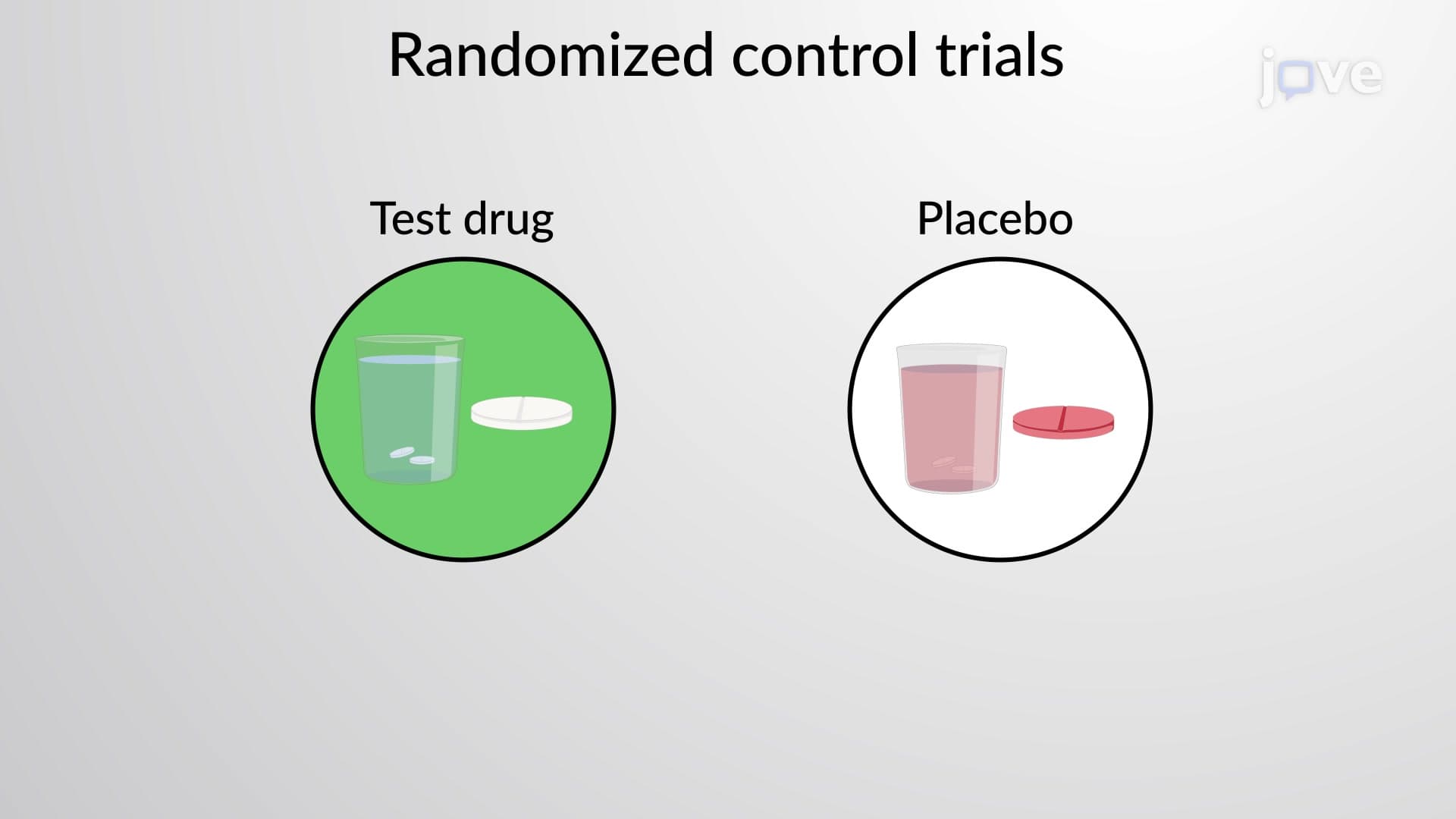
Did you know that the COVID-19 vaccine trials involved over 100,000 participants randomly assigned to receive either the vaccine or a placebo? Randomized experiments are the gold standard for determining cause-and-effect relationships in scientific research by using random assignment to eliminate bias. The FDA relies on these studies to approve new medications, ensuring treatments work effectively across diverse populations. Understanding what are randomized experiments helps students grasp how researchers draw reliable conclusions from data. Watch the full video on JoVE Coach to master this concept with expert-led visuals and step-by-step explanations.
Randomized experiments represent the most rigorous method for establishing causal relationships in scientific research. Unlike observational studies where researchers simply observe existing conditions, randomized experiments involve deliberately manipulating one variable (the treatment) while using random assignment to control for all other factors. This systematic approach allows researchers to confidently conclude that observed differences between groups result from the treatment itself, not from pre-existing differences between participants.
The power of randomization lies in its ability to create comparable groups. When the New England Journal of Medicine published results from Pfizer's COVID-19 vaccine trial, researchers could confidently attribute the 95% efficacy rate to the vaccine because participants were randomly assigned to treatment and control groups, ensuring both groups were statistically equivalent in all characteristics except vaccination status.
Simple randomization forms the foundation of experimental design, using methods like coin flips or random number generators to assign participants to groups. While straightforward, this approach can sometimes create unbalanced groups, particularly in smaller studies. For instance, a psychology experiment testing memory techniques might randomly end up with more college-educated participants in one group, potentially skewing results.
Block randomization addresses this limitation by first dividing participants into blocks based on important characteristics, then randomly assigning within each block. The landmark Framingham Heart Study used block randomization to ensure equal representation of men and women across treatment groups. This method proves especially valuable when studying medical treatments where patient characteristics like age or disease severity significantly influence outcomes.
Stratified randomization takes this concept further by creating strata based on multiple variables simultaneously. Clinical trials often use this approach, grouping participants by factors like age, gender, and disease stage before randomization. The Women's Health Initiative, which studied hormone replacement therapy's effects on over 160,000 women, employed stratified randomization to balance groups across age, ethnicity, and cardiovascular risk factors.
These concepts frequently appear on standardized exams, particularly the AP Statistics exam and MCAT. Students should understand that randomization serves two critical purposes: eliminating selection bias and allowing for valid statistical inference. The College Board emphasizes distinguishing between random sampling (selecting participants from a population) and random assignment (placing selected participants into groups).
Understanding randomized experiments proves essential for evaluating research claims encountered in academic coursework and daily life. When pharmaceutical companies claim their new drug reduces symptoms by 40%, students equipped with this knowledge can assess whether the study design supports such conclusions.
Frequently Asked Questions
A randomized experiment uses random assignment to place participants into treatment and control groups, ensuring fair comparison. Researchers manipulate one variable while controlling for others through randomization. This design eliminates bias and allows scientists to establish cause-and-effect relationships with high confidence.
The AP exam focuses on three types: simple randomization (basic random assignment), block randomization (grouping by one characteristic then randomizing), and stratified randomization (grouping by multiple characteristics). Understanding when to use each type and their advantages helps answer free-response questions about experimental design.
The MCAT tests understanding of experimental design principles, particularly distinguishing randomized experiments from observational studies. You'll need to identify confounding variables, evaluate study validity, and explain how randomization strengthens causal inferences in biological and behavioral research contexts.
The National Institutes of Health conducts randomized controlled trials to test new treatments, like the recent SPRINT trial that studied blood pressure medications in over 9,000 adults. Participants were randomly assigned to intensive or standard treatment groups, leading to new clinical guidelines that now save thousands of lives annually.
Not at all! The core concepts require only basic probability understanding and logical thinking. If you can understand why flipping a coin gives each outcome a 50% chance, you can grasp randomization principles. The mathematical complexity comes later in advanced statistics courses.
Focus on identifying the key components: random assignment, treatment and control groups, and how randomization eliminates bias. Practice with real study examples from medical journals, and work through problems asking you to design experiments or identify flaws in existing ones.
Randomized experiments form the foundation for hypothesis testing, confidence intervals, and ANOVA. They connect directly to sampling distributions and the Central Limit Theorem. Understanding experimental design helps you interpret statistical significance and make valid conclusions from data analysis.
Explore observational studies to understand when experiments aren't possible or ethical, then move to statistical inference topics like t-tests and chi-square tests. Advanced students should study meta-analysis and systematic reviews, which combine results from multiple randomized experiments.
Related Micro-courses
Related Subjects
 Physics 33 micro-courses›
 Math Fundamentals 11 micro-courses›