Loading video…


 16 Concepts
 133.2K views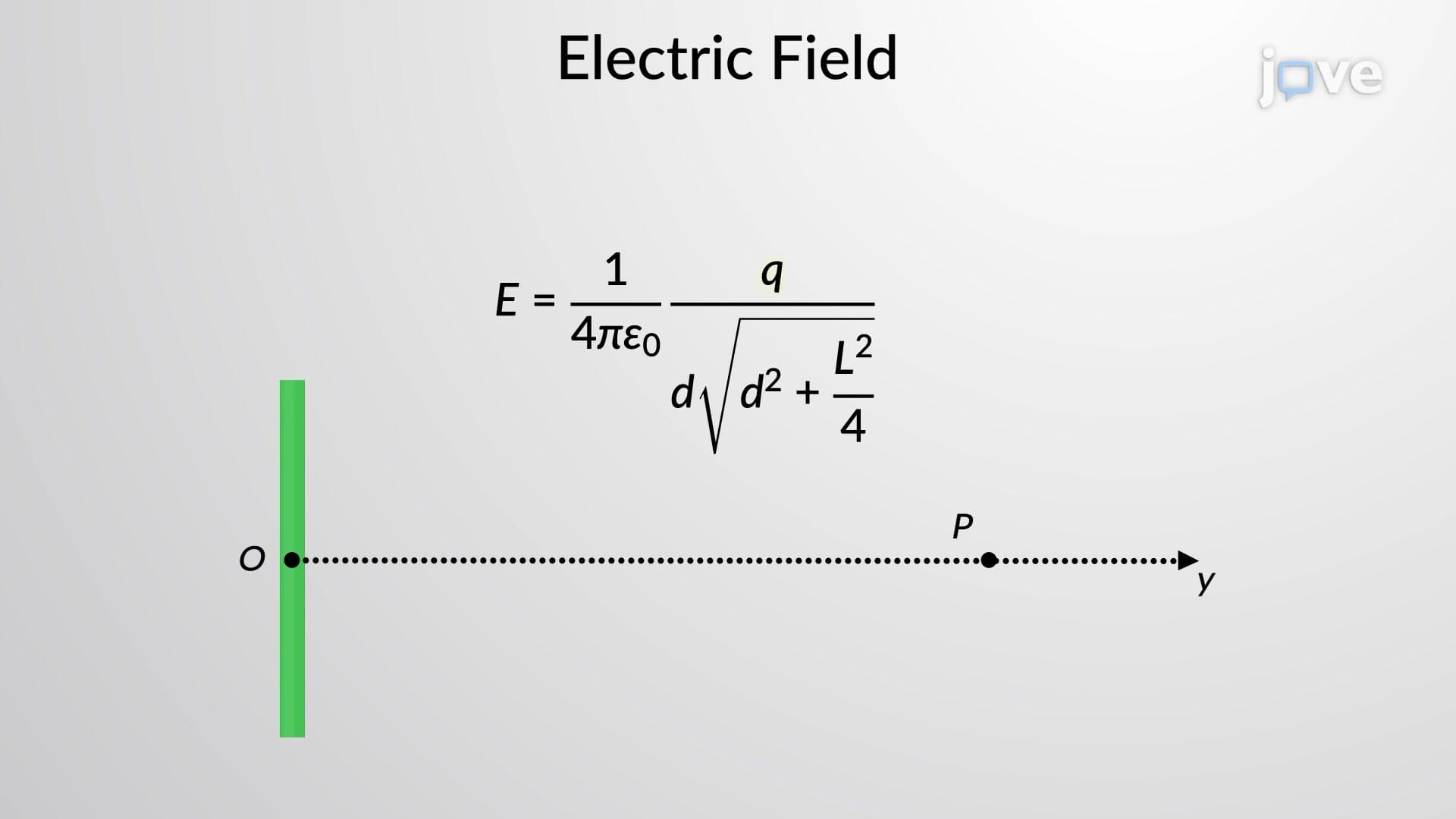

Video Summary: Electric Field Continuous Line Charge Explained
How can power lines spanning miles still generate measurable electric fields at ground level? The electric field continuous line charge concept explains this phenomenon by analyzing how uniformly charged rods create predictable field patterns. For instance, transmission lines carrying thousands of volts create electric fields that engineers must calculate to ensure safety zones around electrical infrastructure. Electric Field Continuous Line Charge Explained demonstrates how mathematical integration reveals field behavior at different distances from charged conductors. Watch the full video on JoVE Coach to master this concept with expert-led visuals and step-by-step explanations.
Electric field continuous line charge calculations represent a cornerstone of electrostatics, bridging the gap between simple point charges and complex real-world charge distributions. When engineers design power transmission systems or physicists model charged conductors, they rely on integration techniques that treat continuous charge distributions as infinite collections of infinitesimal charge elements.
The beauty of continuous line charge problems lies in exploiting symmetry to simplify complex integrations. Consider a uniformly charged rod with linear charge density λ (lambda). By positioning the coordinate origin at the rod's midpoint, we create a symmetric system where charges at positions +x and -x contribute equally to the perpendicular electric field component while their parallel components cancel exactly.
This symmetry principle appears frequently on AP Physics C: Electricity and Magnetism exams, where students must recognize that only perpendicular field components survive the integration. The mathematical elegance emerges when the three-dimensional vector problem reduces to a one-dimensional integral, making calculations manageable even for complex geometries.
The electric field continuous line charge exhibits fascinating distance-dependent behavior that reveals fundamental physics principles. At distances much larger than the rod length (d >> L), the electric field approaches that of a point charge: E = kQ/d². This limiting behavior demonstrates how charge distributions become indistinguishable from point sources when viewed from sufficient distance-a principle used in astronomical calculations and antenna design.
Conversely, at very close distances (d << L), the field behaves as if from an infinite line charge, following E ∝ 1/d. This relationship proves crucial for understanding the electric fields near power lines, where safety regulations require specific minimum distances based on voltage levels. Utility companies use these calculations to establish right-of-way requirements and worker safety protocols.
Modern technology relies heavily on continuous charge distribution analysis. Capacitor design, particularly in high-voltage applications, requires precise electric field calculations to prevent dielectric breakdown. Engineers working on particle accelerators at facilities like Fermilab use similar principles to design focusing elements that guide charged particle beams.
The integration techniques learned through electric field continuous line charge problems prepare students for advanced coursework in electromagnetic field theory, essential for electrical engineering programs at institutions like MIT, Stanford, and UC Berkeley.
Related Micro-courses