Loading video…


 12 Concepts
 642 views

Video Summary: Trigonometric Functions of Real Numbers Explained
Did you know that the GPS navigation system in your smartphone relies on trigonometric functions of real numbers to pinpoint your exact location? Trigonometric Functions of Real Numbers Explained demonstrates how the unit circle transforms any real number into precise sine, cosine, and tangent values. Engineers at Boeing use these mathematical relationships to calculate aircraft trajectories and landing angles. Watch the full video on JoVE Coach to master this concept with expert-led visuals and step-by-step explanations.
The unit circle serves as the foundation for understanding how real numbers generate trigonometric function values. Unlike traditional angle-based approaches, this method treats any real number as an arc length measurement starting from the positive x-axis and moving counterclockwise around a circle with radius 1. This revolutionary perspective transforms abstract mathematical concepts into concrete coordinate relationships that students can visualize and apply.
Each point on the unit circle corresponds to specific trigonometric values. The x-coordinate directly provides the cosine value, while the y-coordinate gives the sine value. From these fundamental functions, we derive four additional relationships: tangent equals sine divided by cosine (sin/cos), cotangent equals cosine divided by sine (cos/sin), secant equals 1/cosine, and cosecant equals 1/sine. These relationships remain consistent regardless of the input value, making calculations predictable and systematic.
Students preparing for the SAT Math Level 2 Subject Test frequently encounter problems requiring quick identification of these relationships. For example, if cos(θ) = 3/5 and sin(θ) = 4/5, then tan(θ) = (4/5)/(3/5) = 4/3, demonstrating the practical application of these fundamental ratios.
The coordinate plane's four quadrants create distinct patterns for trigonometric function signs. In Quadrant I (positive x and y), all six functions yield positive values. Quadrant II features negative cosine and secant (negative x-coordinates) but positive sine and cosecant values. Quadrant III produces positive tangent and cotangent values because both coordinates are negative, creating positive quotients. Quadrant IV shows positive cosine and secant values while sine and cosecant become negative.
This quadrant system proves essential for AP Calculus students solving optimization problems involving periodic functions. Civil engineers at firms like Bechtel Corporation use these principles when calculating structural load distributions across bridge supports.
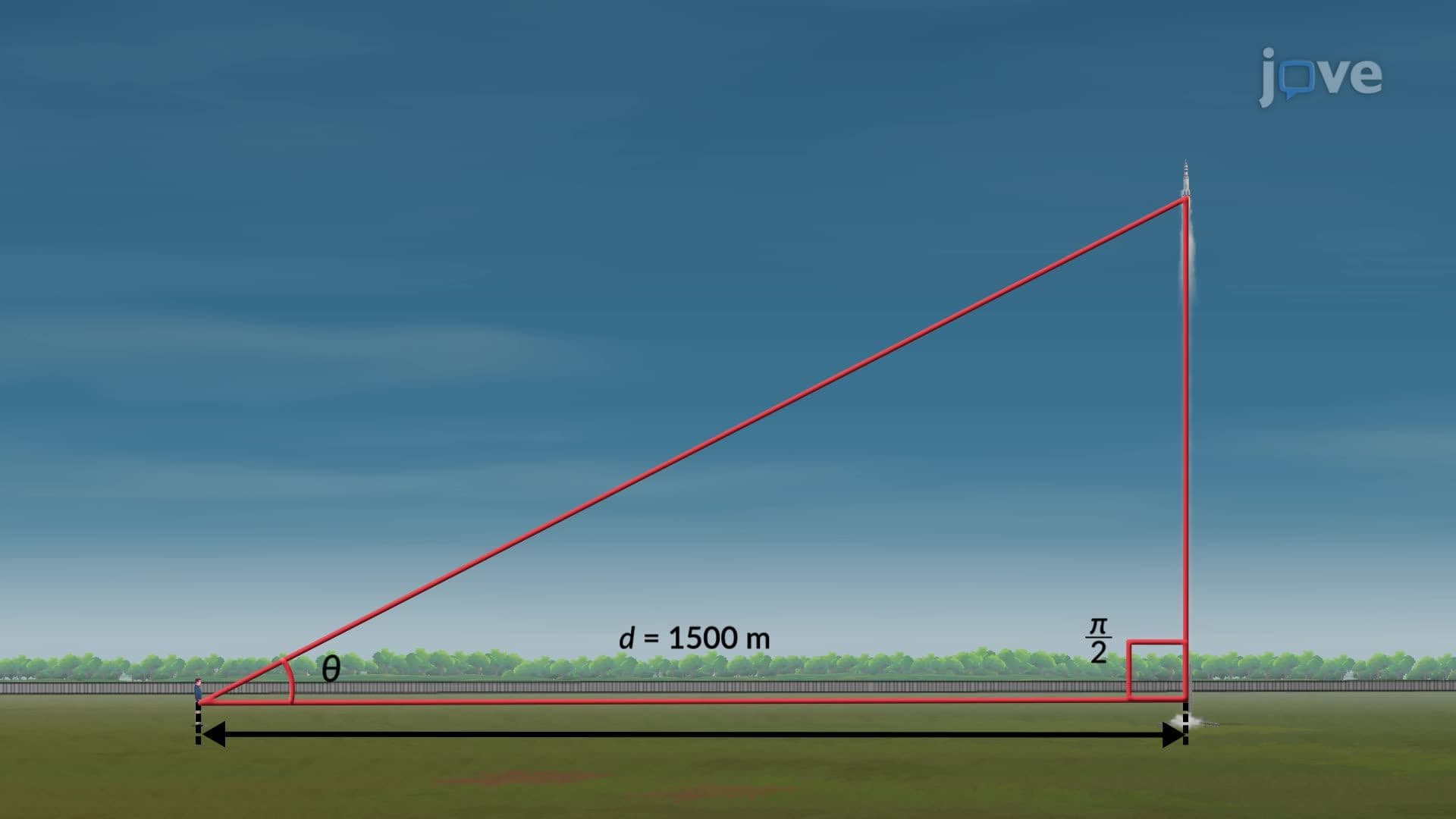
Trigonometric functions solve practical measurement challenges across multiple industries. Surveying teams use tangent ratios to determine building heights: if the horizontal distance is 50 feet and the angle of elevation is 30 degrees, the building height equals 50 × tan(30°) = 50 × (√3/3) ≈ 28.9 feet. Similarly, NASA engineers calculate spacecraft trajectories using these same mathematical principles, ensuring precise orbital insertions and planetary approach angles.
Related Micro-courses