Loading video…


 20 Concepts
 18.6K views

Video Summary: What Is Fatigue
Did you know that the average airplane wing flexes thousands of times during a single flight, yet engineers must ensure it won't crack after millions of such cycles? Fatigue is a critical failure mechanism where materials break under repeated loading at stress levels far below their normal breaking strength. This phenomenon explains why the Interstate 35W bridge in Minneapolis collapsed in 2007 despite appearing structurally sound. Understanding what is fatigue helps engineers design everything from aircraft components to medical implants that must withstand countless load cycles throughout their service life. Watch the full video on JoVE Coach to master this concept with expert-led visuals and step-by-step explanations.
Fatigue represents one of the most insidious failure mechanisms in engineering, responsible for approximately 90% of all mechanical failures in service. Unlike static loading where materials fail predictably at their ultimate tensile strength, fatigue causes unexpected failures at stress levels as low as 30-50% of the material's static strength. This phenomenon occurs when materials experience repeated or fluctuating loads over thousands to millions of cycles.
The fatigue process begins at microscopic stress concentrations-tiny surface scratches, inclusions, or grain boundaries that act as crack initiation sites. Under repeated loading, these microscopic flaws gradually propagate through the material's cross-section. The failure exhibits three distinct stages: crack initiation (which can consume 90% of the component's life), stable crack propagation, and final catastrophic fracture.
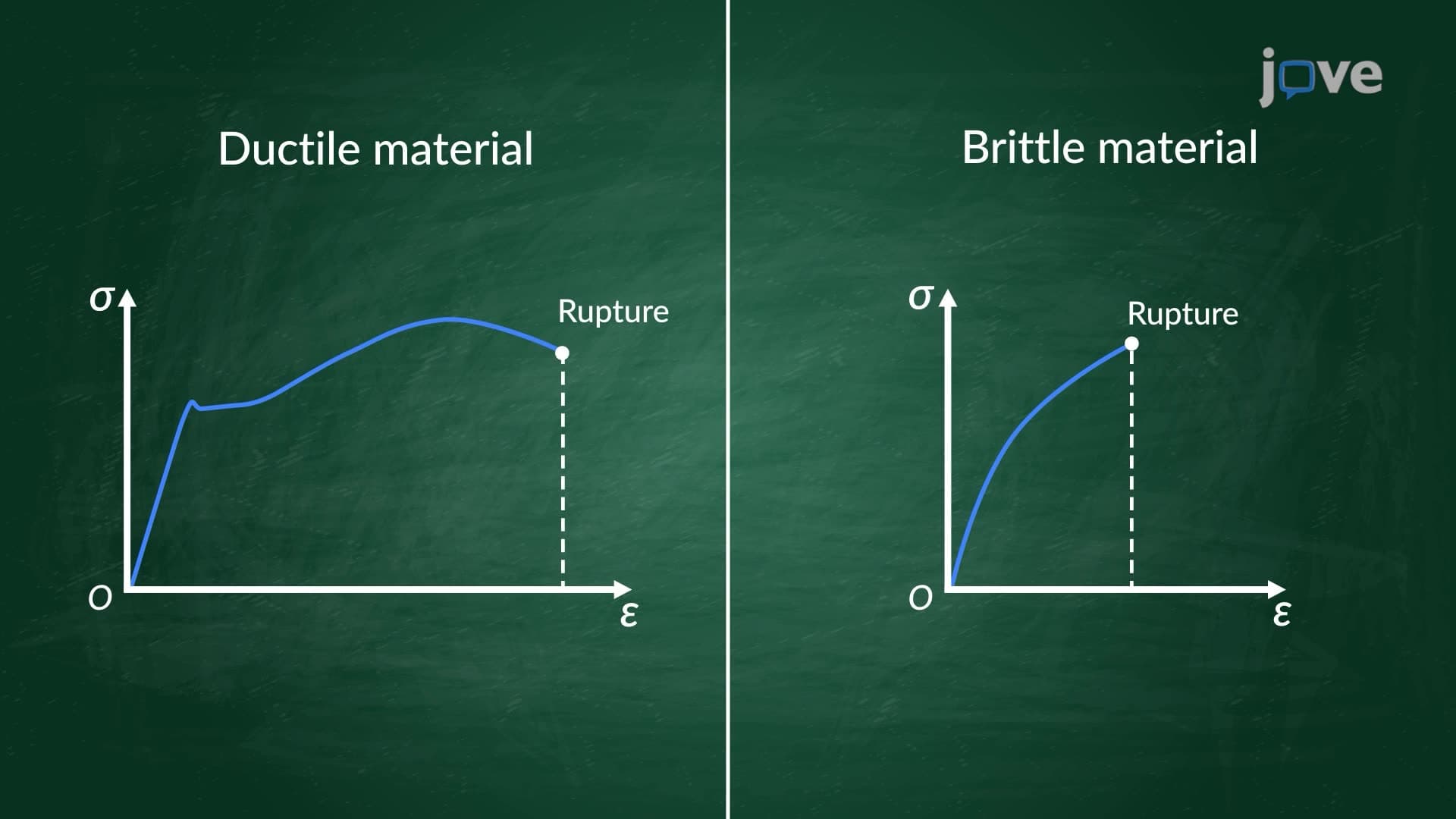
What makes fatigue particularly dangerous is its brittle nature, even in materials like steel and aluminum that are normally ductile. A fatigued component shows little to no plastic deformation before failure, making visual inspection ineffective for detecting imminent failure. This explains why the Silver Bridge collapse in West Virginia (1967) and the Aloha Airlines Flight 243 incident (1988) occurred with little warning.
Engineers use stress-life diagrams to predict fatigue behavior and design for adequate service life. These plots show the relationship between applied stress amplitude and the number of cycles to failure. For structural steels, these diagrams reveal a crucial threshold called the endurance limit-typically around 50% of the ultimate tensile strength-below which the material theoretically has infinite fatigue life.
However, nonferrous metals like aluminum exhibit different behavior with no clear endurance limit. Instead, their fatigue strength continues decreasing with increasing cycles, requiring careful analysis for aerospace applications where aluminum components must survive millions of flight cycles. The Federal Aviation Administration (FAA) requires extensive fatigue testing for aircraft certification, often involving full-scale fatigue tests lasting several aircraft lifetimes.
Students encounter fatigue concepts in AP Physics, college-level Materials Science courses, and engineering programs. The MCAT includes questions about material properties, while the Fundamentals of Engineering (FE) exam tests fatigue knowledge for future professional engineers. Understanding fatigue is essential for careers in aerospace, automotive, biomedical device manufacturing, and civil engineering-industries where component reliability directly impacts public safety.
Surface finish dramatically affects fatigue life, with machined surfaces typically outperforming rough or damaged surfaces by factors of 2-10. This principle guides manufacturing processes for critical components like aircraft engine turbine blades and medical implants, where surface treatments like shot peening can double fatigue life.
Related Micro-courses