Loading subject page…


18,577 views

Video Summary: Stress Strain Diagram Brittle Materials Guide
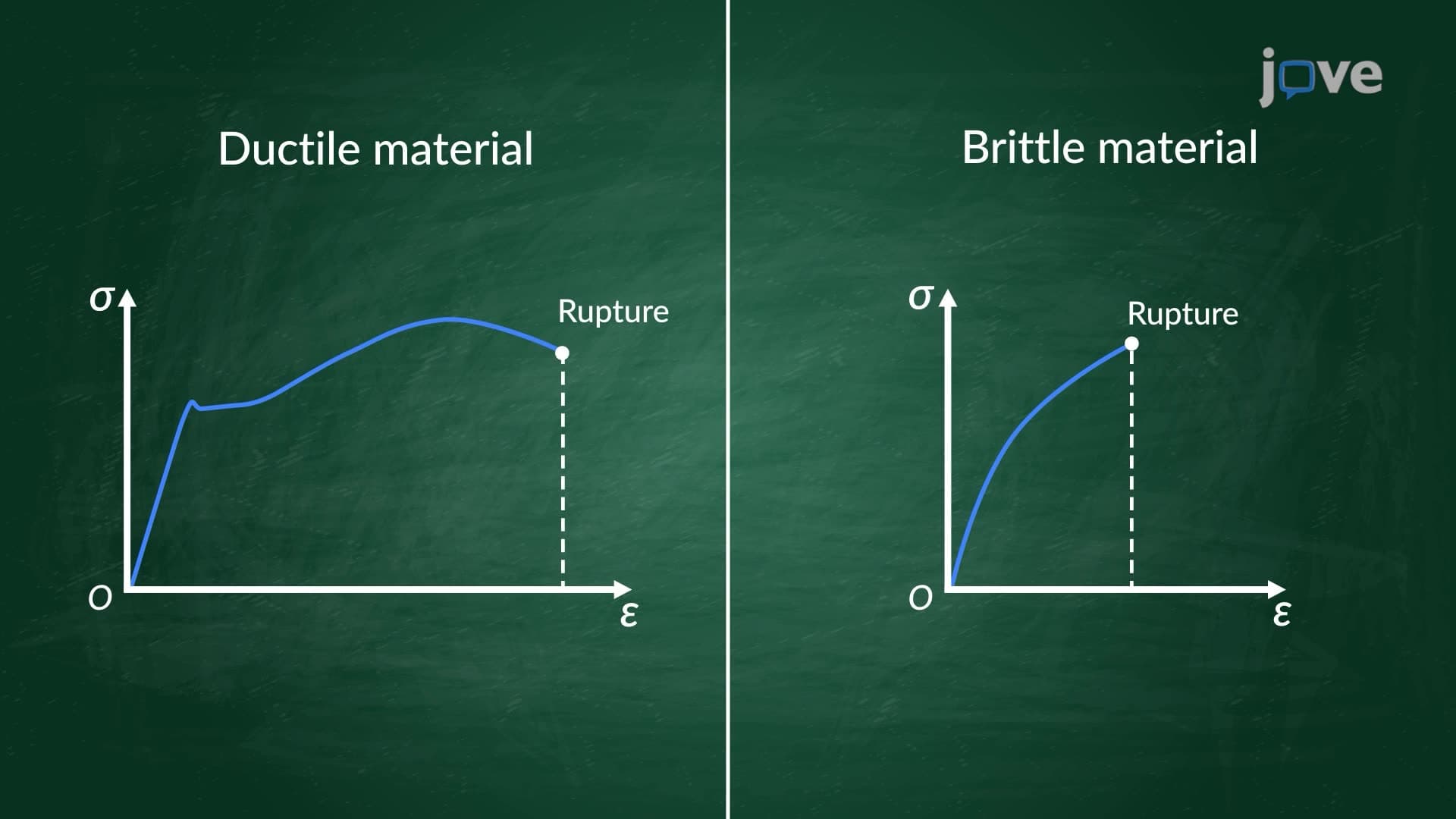
Did you know that when the concrete foundation of a skyscraper cracks, it fails along a perfectly perpendicular line to the applied force? The stress strain diagram brittle materials exhibit reveals fascinating failure patterns that differ dramatically from flexible materials like steel. Unlike ductile materials that stretch and deform gradually, brittle materials like concrete, glass, and ceramics rupture suddenly with minimal warning signs. Watch the full video on JoVE Coach to master this concept with expert-led visuals and step-by-step explanations.
Brittle materials represent a crucial category in materials science and engineering, characterized by their tendency to fracture suddenly with minimal plastic deformation. The stress strain diagram brittle materials produce tells a story of rigid behavior followed by catastrophic failure, contrasting sharply with the gradual yielding observed in ductile materials like aluminum or steel.
The most distinctive feature of brittle materials is their limited strain capacity before rupture. While a steel rod might stretch 20-30% before breaking, materials like cast iron, concrete, or glass typically fail at strains well below 1%. This behavior stems from the material's atomic structure and the presence of microscopic flaws such as micro-cracks, voids, or inclusions that act as stress concentrators.
When subjected to tensile loading, these microscopic defects propagate rapidly through the material structure, creating the characteristic straight fracture surface perpendicular to the applied load. This perpendicular fracture pattern indicates that normal stresses, rather than shear stresses, primarily drive the failure mechanism in brittle materials.
One of the most important concepts for AP Physics and college-level materials science courses is understanding why brittle materials typically exhibit much higher strength in compression than in tension. Concrete, for example, might have a compressive strength of 4,000 psi while its tensile strength rarely exceeds 400 psi-a 10:1 ratio that significantly impacts structural design.
This strength differential occurs because compressive loading tends to close microscopic cracks rather than propagate them. Under tension, these same flaws become stress risers that concentrate applied forces, leading to crack growth and eventual failure at much lower stress levels.
Understanding brittle material behavior is essential for structural engineers designing buildings, bridges, and other infrastructure across the United States. The Federal Highway Administration requires engineers to account for concrete's brittle nature when designing bridge decks, using reinforcing steel to handle tensile stresses that concrete cannot withstand alone.
Students preparing for the Fundamentals of Engineering (FE) exam or pursuing civil engineering degrees must master these concepts to successfully analyze reinforced concrete structures, where steel reinforcement compensates for concrete's tensile weakness while concrete handles compressive loads efficiently.
Related Micro-courses