Loading subject page…


18,577 views

Video Summary: What Is Poissons Ratio
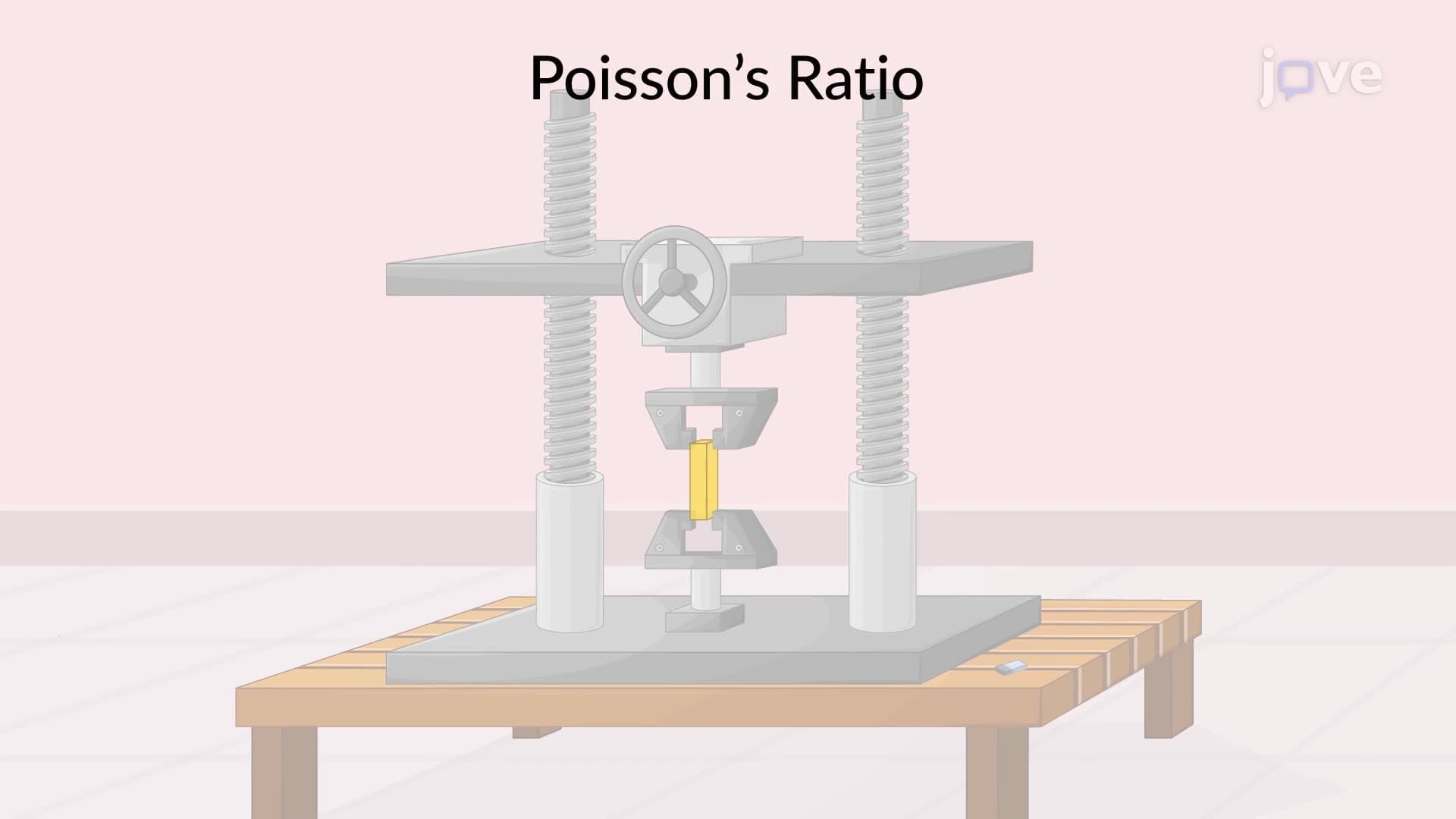
Ever wonder why a rubber band gets thinner when you stretch it? Poisson's ratio explains this fascinating material behavior that occurs in everything from the steel beams in Chicago's Willis Tower to the concrete in highway bridges. This fundamental material property describes how materials contract laterally when stretched axially, with rubber exhibiting nearly equal lateral contraction to axial elongation. Watch the full video on JoVE Coach to master this concept with expert-led visuals and step-by-step explanations.
Poisson's ratio represents one of the most important elastic constants in materials science and mechanical engineering. Named after French mathematician Siméon Denis Poisson, this dimensionless parameter quantifies how materials behave when subjected to uniaxial stress. The Poisson's ratio definition centers on the relationship between two types of strain: the lateral (transverse) strain that occurs perpendicular to an applied load, and the axial (longitudinal) strain that occurs parallel to the load direction.
The Poisson's ratio formula is expressed as: ν = -εlateral/εaxial, where ν (nu) represents Poisson's ratio, εlateral is the lateral strain, and εaxial is the axial strain. The negative sign ensures a positive value since lateral and axial strains typically have opposite signs. When a material is stretched (positive axial strain), it simultaneously contracts in the perpendicular directions (negative lateral strain). This Poisson's ratio concept forms the basis for understanding three-dimensional material behavior under load.
Understanding Poisson's ratio in detail reveals significant variations across materials. Steel typically exhibits a Poisson's ratio of approximately 0.27-0.30, while aluminum shows values around 0.33. Concrete ranges from 0.15-0.25, depending on its composition and age. Rubber approaches the theoretical maximum of 0.5 for incompressible materials, meaning it contracts laterally almost as much as it stretches axially. Cork, uniquely, has a near-zero Poisson's ratio, making it ideal for wine bottle stoppers since it maintains its diameter when compressed axially.
This Poisson's ratio overview connects directly to coursework in AP Physics, college-level mechanics of materials, and engineering programs. Students encounter these concepts in SAT Subject Test physics problems and college engineering entrance exams. Professional engineering applications include designing pressure vessels, where understanding lateral expansion prevents catastrophic failures, and aerospace components where weight optimization requires precise material property knowledge. The Golden Gate Bridge's steel cables, for instance, rely on engineers' understanding of Poisson's ratio to predict how the structure responds to thermal expansion and traffic loads.
The Poisson's ratio study guide applications extend to biomedical engineering, where understanding tissue mechanics helps design better implants and prosthetics. NASA engineers use these principles when designing spacecraft components that must withstand extreme temperature variations in space.
Related Micro-courses