Loading…
Loading video…

21,804 views

Ever wonder how NASA engineers track spacecraft moving through three-dimensional space? Cartesian vector notation provides the mathematical framework to describe any vector using perpendicular coordinate axes and unit vectors i, j, and k. This system, named after French mathematician René Descartes, allows engineers at Boeing to precisely calculate forces on aircraft wings during flight testing. What is Cartesian Vector Notation becomes clearer when you see how it separates a vector's magnitude and direction into manageable components. Watch the full video on JoVE Coach to master this concept with expert-led visuals and step-by-step explanations.
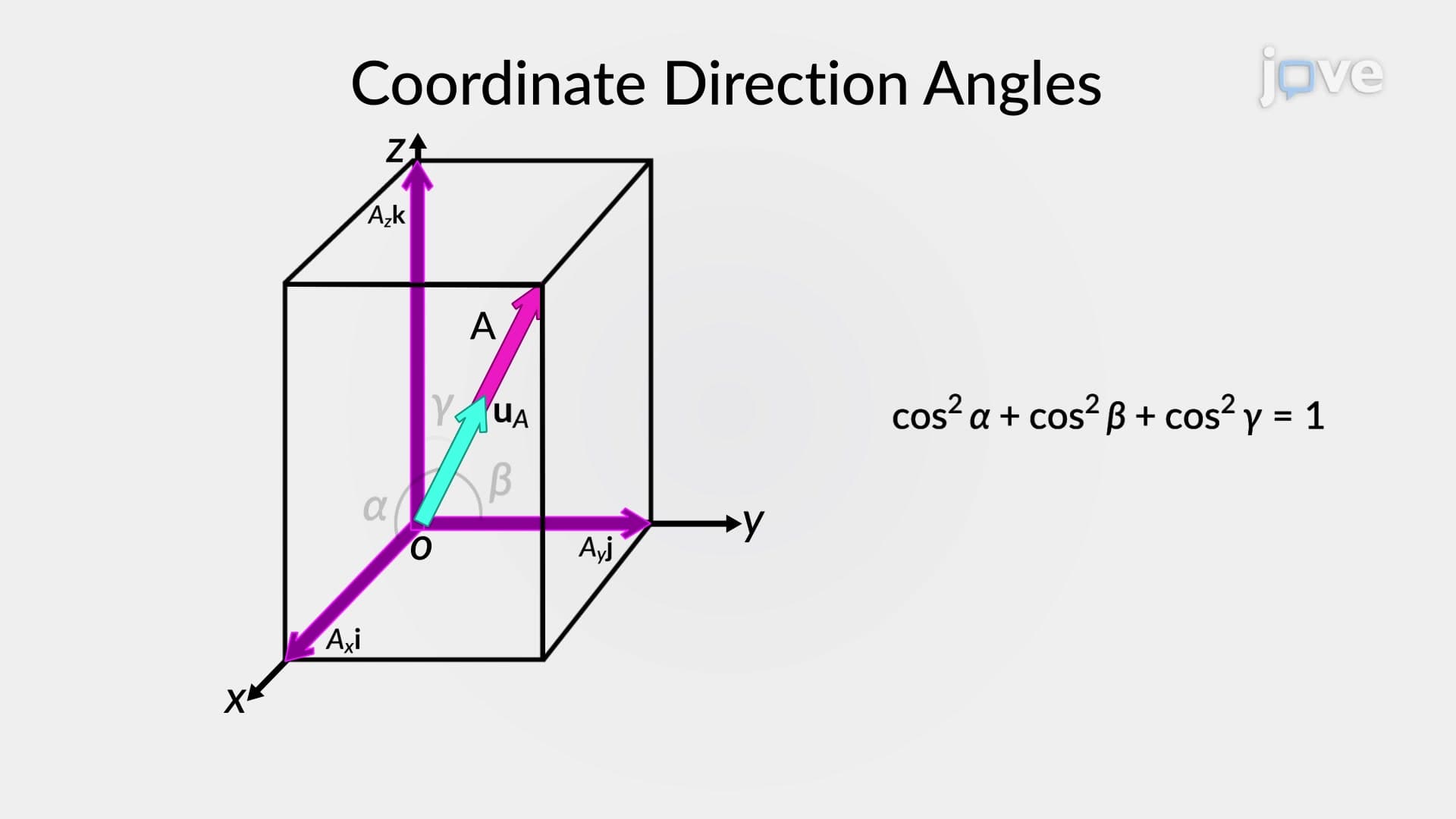
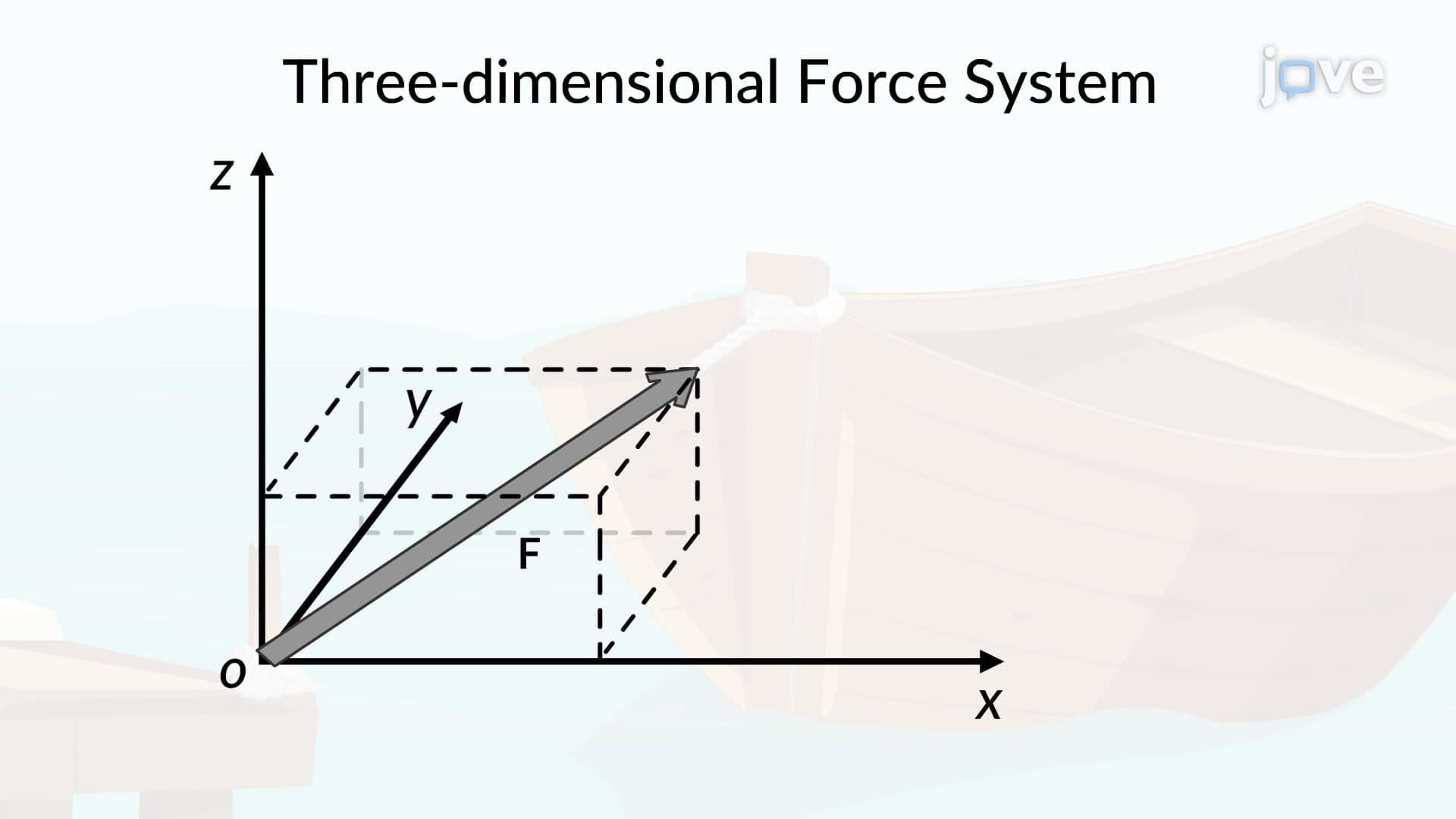
Cartesian vector notation represents one of the most powerful mathematical tools for describing physical quantities that have both magnitude and direction. Named after René Descartes, this system breaks down complex three-dimensional vectors into manageable components along perpendicular axes. The cartesian vector notation definition centers on using unit vectors i, j, and k to represent directions along the x, y, and z axes respectively.
When exploring what is cartesian vector notation in detail, we discover that any vector A can be expressed as A = Ax·i + Ay·j + Az·k, where Ax, Ay, and Az are scalar components. These unit vectors serve as building blocks—each has a magnitude of exactly one and points along its respective positive axis direction. The beauty of this system lies in its ability to separate a vector's magnitude from its directional information, making complex calculations more manageable.
For students preparing for AP Physics or SAT Subject Tests, understanding that components can be positive or negative is crucial. A negative component simply indicates the vector points in the negative direction along that particular axis. This concept frequently appears in mechanics problems involving projectile motion and force analysis.
The standard right-handed coordinate system ensures consistency in vector calculations. Point your right thumb toward the positive z-axis, and your fingers naturally curl from the positive x-axis toward the positive y-axis. This convention prevents sign errors that could otherwise plague vector calculations in engineering applications.
NASA's Jet Propulsion Laboratory relies heavily on Cartesian vectors when programming spacecraft trajectories. Similarly, structural engineers at firms like Skidmore, Owings & Merrill use these vectors to analyze forces acting on skyscrapers during wind loading scenarios. The cartesian vector notation concept proves essential for MCAT physics sections, where students encounter biomechanics problems involving joint forces and muscle tensions.
The magnitude of any Cartesian vector equals the positive square root of the sum of its squared components: |A| = √(Ax² + Ay² + Az²). This formula, derived from the Pythagorean theorem extended to three dimensions, appears frequently in college physics courses and standardized exams.
Vector algebra operations become remarkably straightforward in Cartesian form. Addition simply requires adding corresponding components, while dot and cross products follow systematic procedures. These operations form the foundation for advanced topics in multivariable calculus and differential equations courses at institutions like MIT and Stanford.
Frequently Asked Questions
Cartesian Vector Notation is a mathematical system that represents vectors using unit vectors i, j, and k along perpendicular coordinate axes. It's essential because it simplifies complex three-dimensional calculations by breaking vectors into manageable components. Engineers use this system daily for structural analysis, aerospace trajectory calculations, and robotics programming.
AP Physics frequently tests Cartesian vectors in mechanics problems involving forces, velocity, and acceleration. Students must decompose vectors into components, calculate magnitudes, and perform vector addition. Practice problems often involve projectile motion where velocity vectors change direction continuously, requiring component analysis for accurate solutions.
Cartesian notation uses perpendicular axes with unit vectors i, j, k, while polar notation uses magnitude and angle measurements. Cartesian form excels in mathematical operations and computer calculations, whereas polar form provides intuitive understanding of direction. MCAT physics sections often require converting between both systems depending on the problem context.
Basic Cartesian vector operations require minimal trigonometry since you're working directly with components. However, converting between Cartesian and polar forms does involve sine and cosine functions. Most college physics courses provide sufficient review, and the geometric interpretation using right triangles makes the trigonometry more intuitive than abstract.
Focus on practicing component decomposition and magnitude calculations using the √(Ax² + Ay² + Az²) formula. Create visual diagrams showing vectors in three-dimensional space, and work through vector addition problems step-by-step. Many students find success by relating abstract problems to real-world scenarios like analyzing forces on bridges or calculating satellite orbits.
Structural engineers at companies like Bechtel Corporation use Cartesian vectors to analyze wind loads on skyscrapers, calculate tension forces in suspension bridge cables, and design earthquake-resistant foundations. Each force acting on a structure gets decomposed into x, y, and z components for computer-aided stress analysis, ensuring buildings meet safety codes established by the American Society of Civil Engineers.
Progress to vector calculus topics including gradient, divergence, and curl operations used in electromagnetic field theory. Advanced engineering courses explore tensor notation, coordinate transformations, and applications in fluid dynamics. These concepts build directly on Cartesian vector foundations and appear in graduate-level physics and engineering programs at universities like Caltech and Georgia Tech.
Related Micro-courses

Related Subjects
 Civil Engineering 30 micro-courses›Electrical Engineering 33 micro-courses›