Loading…
Loading video…

21,804 views
Ever wondered how NASA engineers precisely navigate spacecraft through 3D space? The direction cosines vector provides the mathematical foundation for defining exact orientations in three-dimensional coordinate systems. When Boeing designs aircraft flight paths or SpaceX calculates rocket trajectories, they rely on direction cosines to specify vector directions using coordinate direction angles measured from the positive x, y, and z axes. These cosines form a fundamental relationship where their squares always sum to one. Watch the full video on JoVE Coach to master this concept with expert-led visuals and step-by-step explanations.
The direction cosines vector concept bridges the gap between geometric intuition and analytical precision in three-dimensional vector analysis. When studying vectors in AP Physics or college-level engineering courses, students encounter situations where knowing both the magnitude and precise direction of a vector becomes crucial for problem-solving.
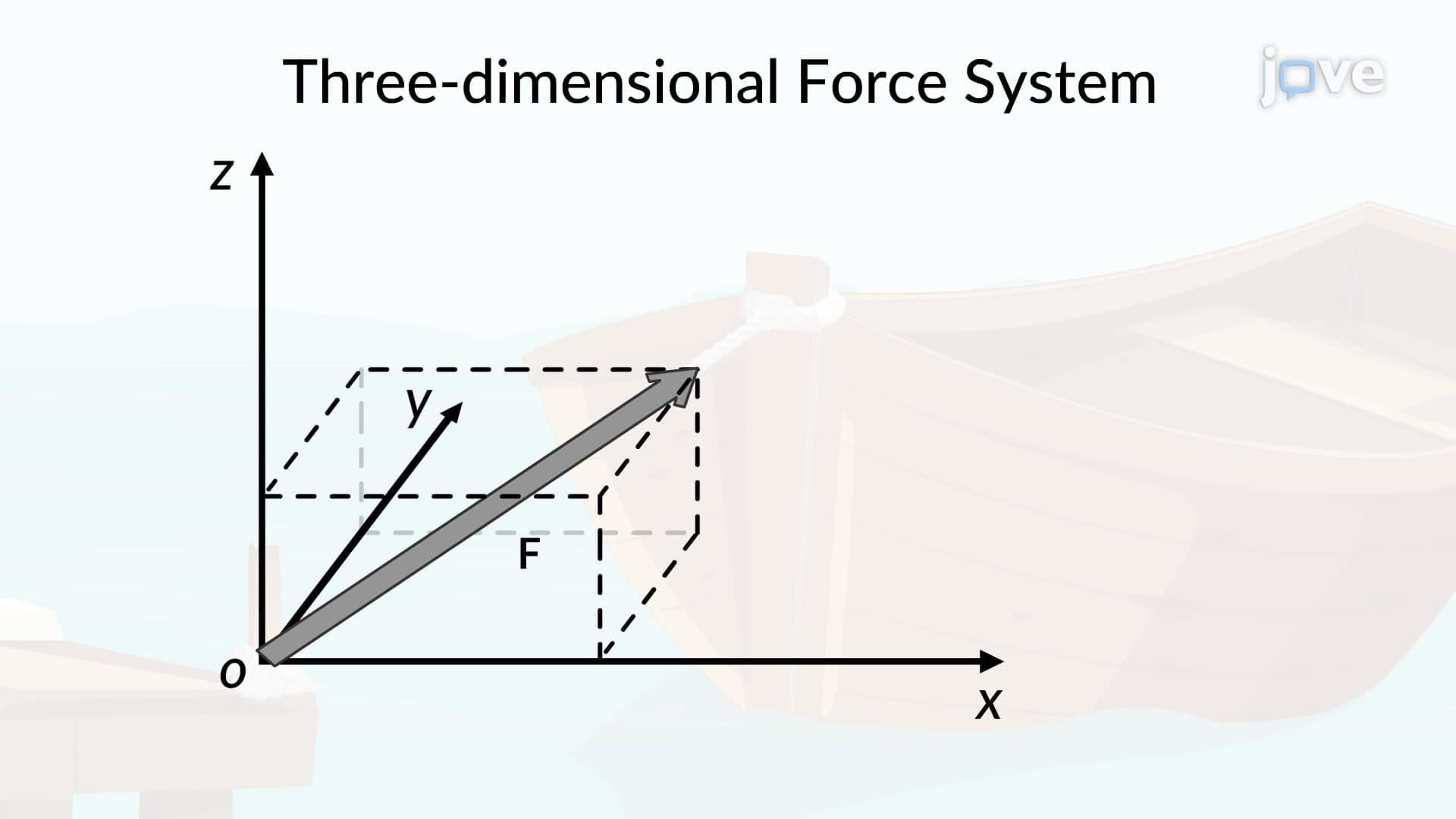
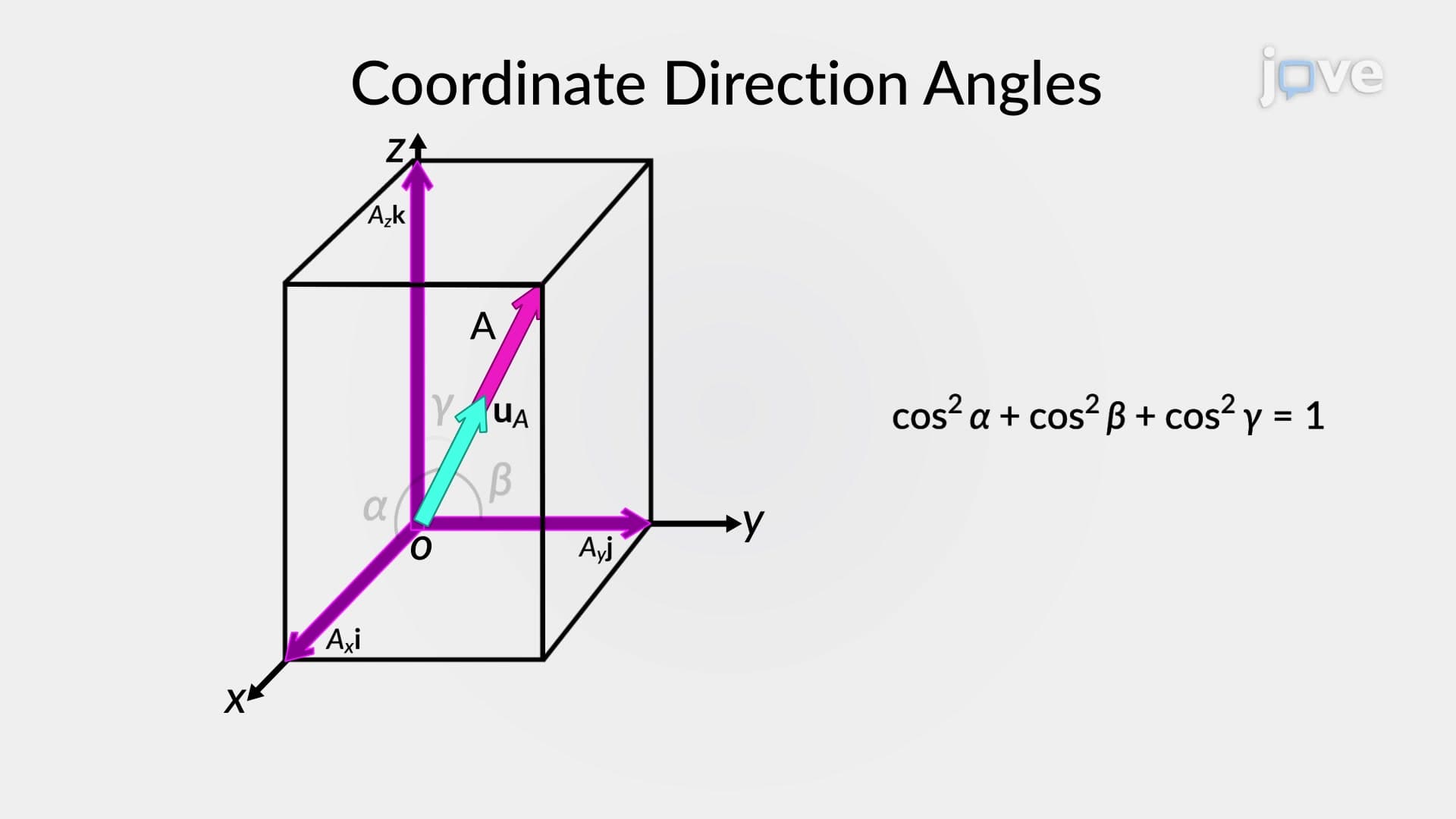
Direction cosines represent the cosines of the coordinate direction angles that a vector makes with the positive x, y, and z axes. If vector A has coordinate direction angles α (with x-axis), β (with y-axis), and γ (with z-axis), then the direction cosines are simply cos α, cos β, and cos γ. These values provide a standardized way to describe vector orientation regardless of the vector's magnitude.
The most elegant aspect of direction cosines emerges when examining unit vectors. For any vector A, its corresponding unit vector u(A) = A/|A| has components that directly equal the direction cosines. This means:
This relationship proves invaluable when solving SAT Subject Test problems or MCAT physics questions involving vector decomposition. Students can quickly identify direction cosines by normalizing any vector to unit length.
One of the most important properties states that cos²α + cos²β + cos²γ = 1. This identity stems from the fact that the magnitude of any unit vector equals one. In practical terms, if you know any two direction cosines, you can always calculate the third, making this relationship essential for completing vector problems on standardized tests.
Direction cosines find extensive application in American aerospace and defense industries. NASA's Jet Propulsion Laboratory uses direction cosines when programming spacecraft attitude control systems. Similarly, automotive engineers at companies like Ford and General Motors employ these concepts when designing suspension systems that must respond to forces from multiple directions.
In architectural engineering, firms designing skyscrapers in cities like New York or San Francisco use direction cosines to calculate wind load distributions on building surfaces, ensuring structural integrity under various environmental conditions.
Frequently Asked Questions
Direction cosines vector represents the cosines of angles that a vector makes with coordinate axes. It provides a standardized method for describing vector direction using three numerical values between -1 and 1. These cosines correspond to the components of the vector's unit vector form.
AP Physics C frequently tests direction cosines in mechanics problems involving 3D force analysis and projectile motion. Students typically encounter questions requiring conversion between angle-magnitude form and component form. The cos²α + cos²β + cos²γ = 1 relationship often appears in multiple-choice questions.
Yes, MCAT physics sections include direction cosines within vector analysis problems, particularly in passages about biomechanics or medical imaging. Test-takers should understand how to calculate resultant forces using direction cosines in 3D biological systems. Practice problems often involve joint forces or muscle tension vectors.
Civil engineers designing bridges like San Francisco's Golden Gate Bridge use direction cosines to analyze cable tensions and wind forces. Construction companies calculating load distributions in high-rise buildings rely on direction cosines to ensure structural safety. These calculations help determine optimal material placement and support positioning.
No extensive prerequisites exist beyond basic trigonometry and vector concepts typically covered in Algebra 2 or Precalculus. Students comfortable with sine, cosine functions and coordinate geometry can master direction cosines effectively. The concept builds naturally on familiar right-triangle relationships.
Practice converting between Cartesian vector form and angle-magnitude representation repeatedly. Create flashcards for the fundamental identity cos²α + cos²β + cos²γ = 1 and work through multiple 3D vector problems. Focus on visualizing vectors in 3D space using online graphing tools or physical models.
Direction cosines provide excellent preparation for advanced vector operations including dot products and cross products. Understanding how vectors relate to coordinate axes strengthens geometric intuition needed for higher-level vector calculus. Most college physics courses introduce direction cosines before diving into vector multiplication operations.
Progress to vector projections, dot products, and cross products for comprehensive vector analysis skills. Study applications in physics like work-energy calculations and rotational mechanics. Advanced students should explore vector fields and multivariable calculus applications in engineering and physics graduate programs.
Related Micro-courses

Related Subjects
 Civil Engineering 30 micro-courses›Electrical Engineering 33 micro-courses›