Loading…
Loading video…

21,804 views
Ever wonder how NASA engineers calculate the torque needed to orient spacecraft in zero gravity? The cross product is the vector operation that makes this possible, producing a perpendicular vector from two input vectors. This mathematical tool is essential in physics and engineering applications, from calculating magnetic forces in electric motors to determining rotational motion in robotic systems across US manufacturing facilities. Watch the full video on JoVE Coach to master this concept with expert-led visuals and step-by-step explanations.
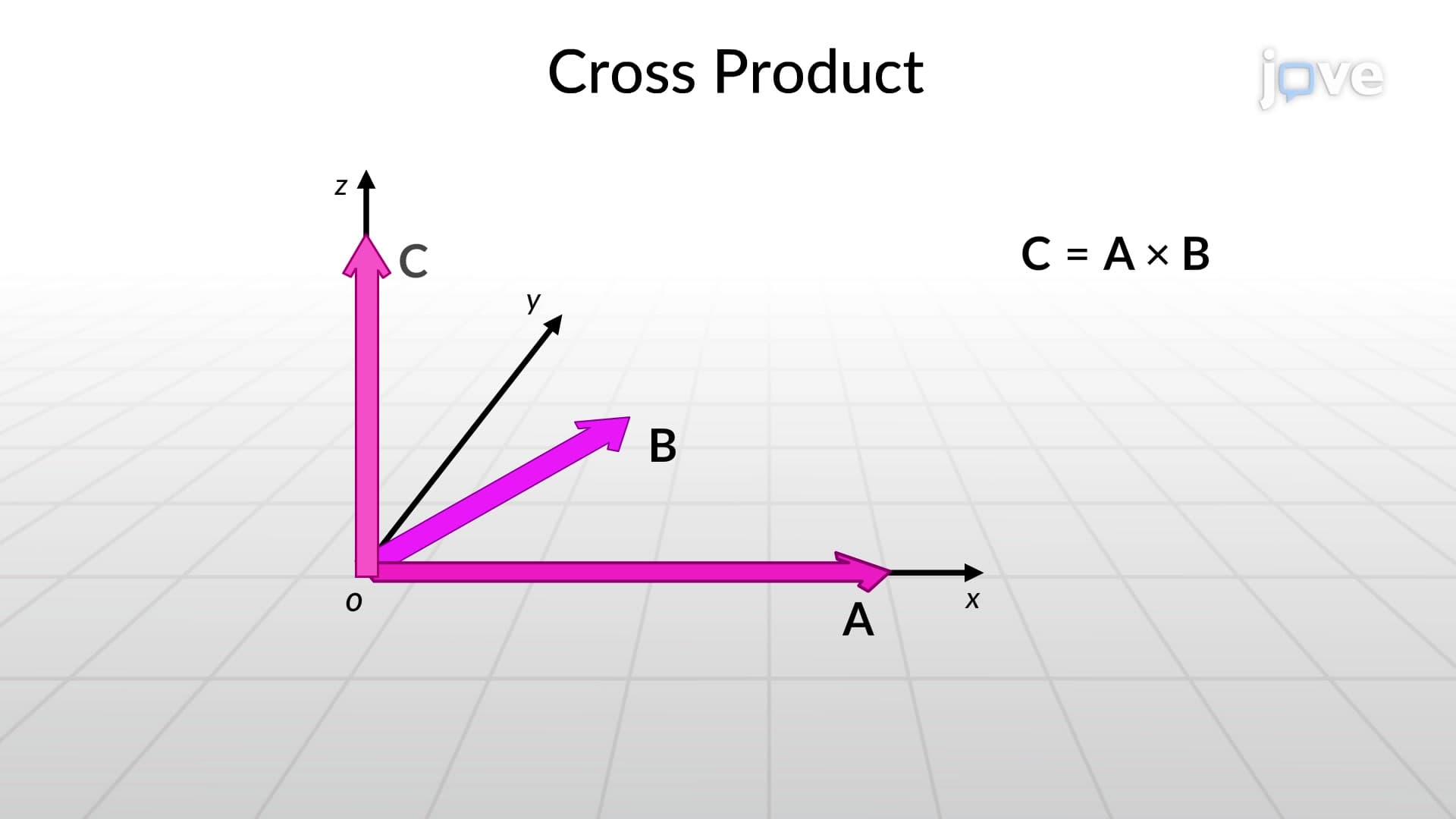
The cross product represents one of the most powerful operations in vector algebra, creating a new vector perpendicular to both input vectors. Unlike scalar multiplication or dot products that yield numbers, the cross product generates a three-dimensional vector with both magnitude and direction properties essential for physics and engineering applications.
The cross product definition involves multiplying two vectors A and B to produce vector C, where C = A × B. The magnitude equals |A| × |B| × sin(θ), with θ representing the angle between the vectors. This formula reveals why parallel vectors (θ = 0°) produce zero cross products, while perpendicular vectors (θ = 90°) yield maximum magnitude results.
US college physics courses emphasize this concept extensively, particularly in AP Physics C and undergraduate mechanics. Students encounter cross products when studying rotational dynamics, where torque calculations require understanding both force magnitude and perpendicular distance relationships.
What is cross product in detail includes mastering directional determination through the right-hand rule. Point your fingers along vector A, curl them toward vector B, and your thumb indicates the resulting vector direction. This technique proves invaluable in electromagnetic field problems common in MCAT physics sections and engineering coursework.
The perpendicular nature means cross product vectors always form 90-degree angles with both input vectors, creating orthogonal relationships crucial for coordinate system transformations in computer graphics and robotics applications used throughout US tech industries.
Cross product operations follow specific mathematical rules that distinguish them from standard multiplication. The non-commutative property means A × B = -(B × A), producing equal magnitudes but opposite directions. However, distributive and associative properties still apply, allowing complex vector calculations in multivariable calculus courses.
Engineering students at US universities regularly apply these concepts in statics and dynamics courses, calculating moments about points and determining resultant forces in structural analysis. The cross product's unique properties make it indispensable for solving three-dimensional equilibrium problems and understanding angular momentum conservation in mechanical systems.
Frequently Asked Questions
Cross product creates a perpendicular vector from two input vectors, while dot product produces a scalar value. Cross products are used for finding perpendicular directions, torque calculations, and angular momentum, whereas dot products determine angles between vectors and project one vector onto another.
AP Physics C mechanics and electricity/magnetism sections frequently test cross product applications in torque, angular momentum, and magnetic force problems. Students must demonstrate right-hand rule usage, magnitude calculations, and vector direction determination. Practice with rotational dynamics and electromagnetic field questions is essential for exam success.
MCAT physics sections include cross product concepts in electromagnetic field questions, particularly magnetic force calculations on moving charges. Understanding F = q(v × B) requires cross product knowledge to determine force direction and magnitude in magnetic fields, making this concept crucial for competitive medical school admission scores.
Aerospace engineers at Boeing and SpaceX use cross products for spacecraft orientation control and satellite positioning systems. Automotive manufacturers apply cross product calculations in suspension system design and crash test analysis, while robotics companies use them for robotic arm movement and 3D navigation algorithms.
Cross product concepts are accessible to students with solid algebra and trigonometry foundations. The visualization aspect using the right-hand rule helps many students grasp directional concepts, while systematic practice with magnitude calculations builds confidence. Most students successfully master cross products within 2-3 weeks of focused study.
Focus on memorizing the right-hand rule, practice magnitude calculations with various angle values, and work through torque and angular momentum problems systematically. Create visual diagrams for each problem, double-check vector directions, and review non-commutative property applications to avoid common sign errors during exams.
Vector calculus, electromagnetic field theory, and advanced mechanics courses extensively use cross product foundations. Students can explore differential forms, curl operations in multivariable calculus, and Maxwell's equations in physics, where cross products become essential tools for understanding field relationships and mathematical physics applications.
Related Micro-courses

Related Subjects
 Civil Engineering 30 micro-courses›Electrical Engineering 33 micro-courses›