Loading…
Loading video…

21,804 views
Ever wonder how NASA calculates the exact force needed to launch rockets at precise angles? The dot product is a fundamental vector operation that multiplies two vectors' magnitudes by the cosine of their angle. Engineers at SpaceX use dot product calculations to determine optimal thrust directions for Falcon 9 launches, ensuring spacecraft reach their intended trajectories. This mathematical concept appears everywhere from physics problems to computer graphics in video games. Watch the full video on JoVE Coach to master this concept with expert-led visuals and step-by-step explanations.
The dot product represents one of the most powerful tools in vector mathematics, bridging the gap between pure mathematical theory and practical engineering applications. Unlike regular multiplication, the dot product takes two vectors and produces a scalar (single number) result that contains crucial information about their relationship.
At its core, the dot product formula is: A · B = |A| × |B| × cos(θ), where |A| and |B| represent the magnitudes of vectors A and B, and θ is the angle between them. This elegant equation reveals that the dot product measures how much two vectors "agree" in direction—parallel vectors yield maximum positive values, perpendicular vectors give zero, and opposing vectors produce negative results.
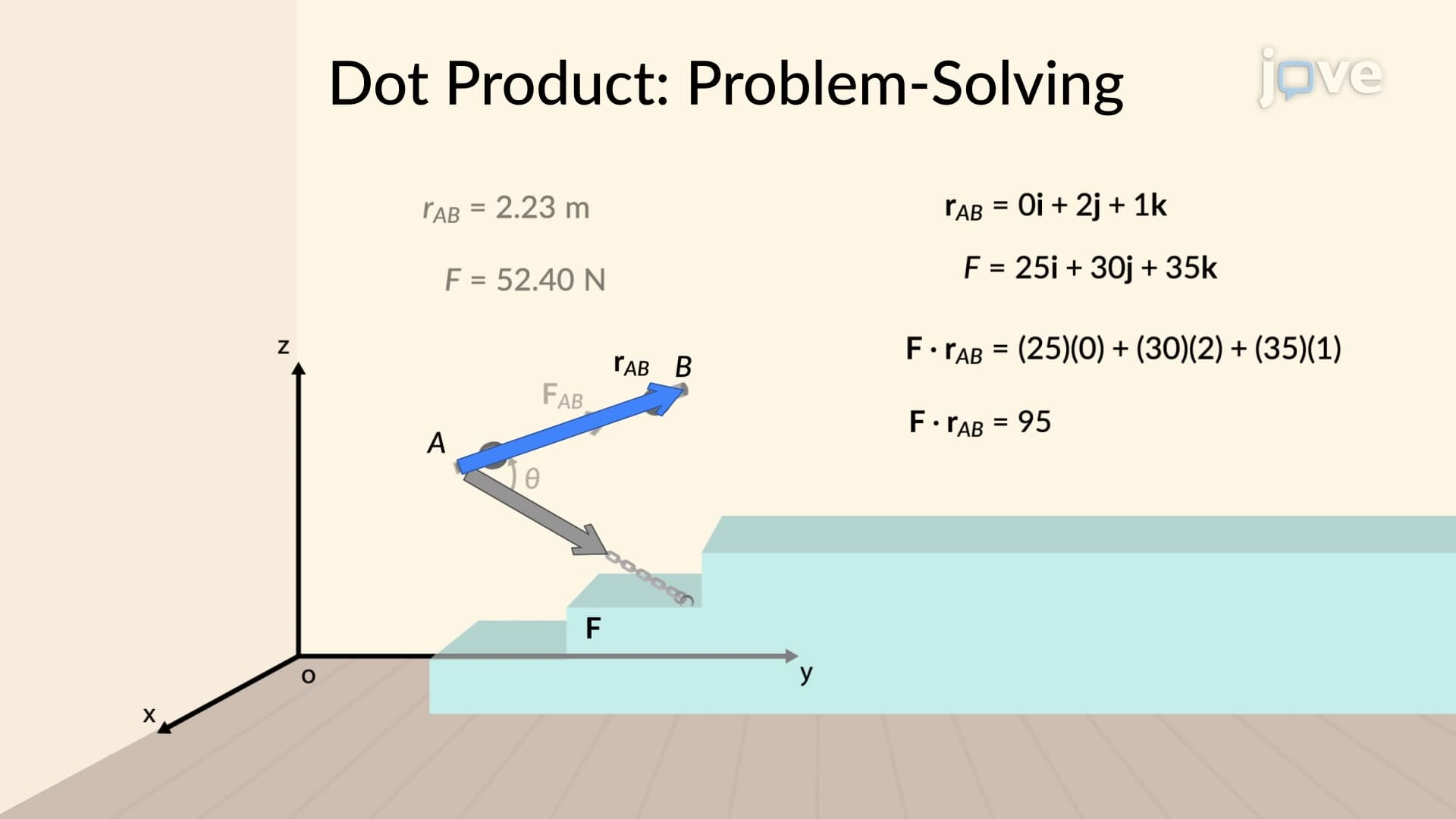
For vectors expressed in Cartesian coordinates, the dot product definition becomes remarkably straightforward. If vector A = (Ax, Ay, Az) and vector B = (Bx, By, Bz), then their dot product equals: A · B = Ax×Bx + Ay×By + Az×Bz. This component method proves invaluable for students tackling AP Physics C problems or college-level engineering courses.
Consider a practical example from structural engineering: When analyzing forces on the Golden Gate Bridge, engineers calculate dot products to determine how wind forces project onto different structural elements. A 50-pound force at 30 degrees to a cable creates a component of 50 × cos(30°) = 43.3 pounds along the cable's direction.
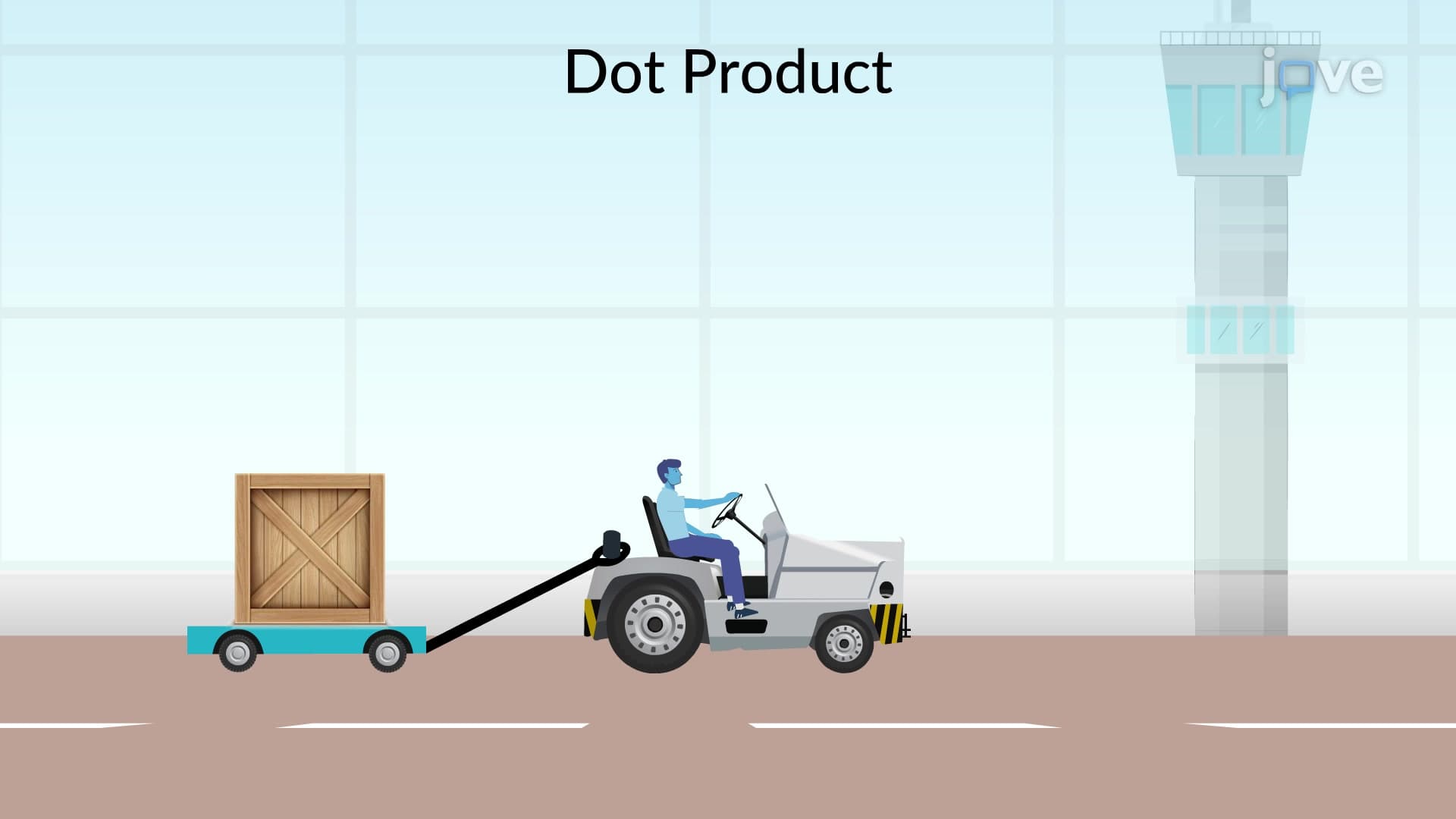
The dot product's most famous application involves calculating work done by forces. When a Tesla Model S accelerates, the work performed equals the dot product of the applied force and displacement vectors. This concept appears frequently on SAT Subject Tests and AP Physics exams, where students must determine work done by forces acting at various angles.
Professional applications extend far beyond academic exercises. Boeing engineers use dot product calculations to optimize wing designs, ensuring lift forces align optimally with aircraft motion. Video game developers at Electronic Arts employ dot products for lighting calculations, determining how light rays interact with 3D surfaces to create realistic shadows and reflections.
The dot product obeys fundamental mathematical laws that simplify complex calculations. The commutative property (A · B = B · A) and distributive property (A · (B + C) = A · B + A · C) enable students to break down complicated vector problems into manageable steps. These properties prove essential when solving systems of equations in multivariable calculus courses at universities like MIT or Stanford.
Frequently Asked Questions
The dot product is a way to multiply two vectors that gives you a single number (scalar) representing how much the vectors point in the same direction. It equals the product of their lengths times the cosine of the angle between them, making it zero when vectors are perpendicular and maximum when they're parallel.
AP Physics C frequently tests dot product in work-energy problems, asking students to calculate work done by forces at angles. SAT Subject Test in Physics includes dot product applications in momentum and energy conservation problems. Most questions involve calculating work using W = F · d or finding components of forces along specific directions.
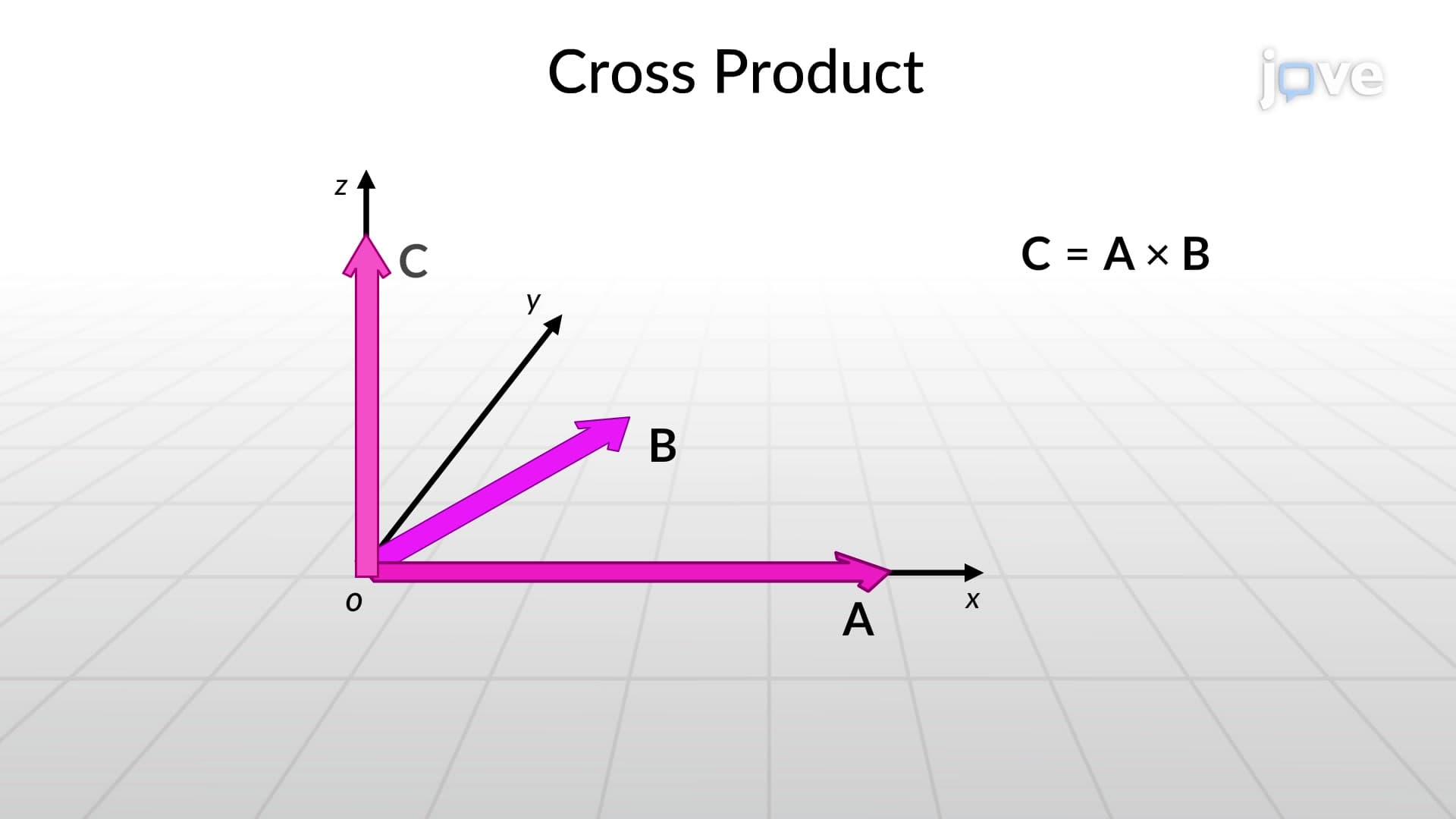
The dot product produces a scalar and measures parallel alignment between vectors, while cross product produces a vector perpendicular to both original vectors. College physics and engineering courses use dot products for work and energy calculations, while cross products appear in torque and magnetic field problems. Many university calculus courses cover both operations extensively.
Aerospace engineers calculate lift and drag components by taking dot products of air velocity vectors with wing surface normal vectors. This determines how efficiently wings generate lift at different angles of attack. Structural engineers also use dot products to analyze stress distributions in aircraft frames and optimize material placement for weight reduction.
Not at all! If you understand basic trigonometry (sine, cosine) and can multiply numbers, you can master dot product. Start with the component formula (multiply corresponding parts and add), then connect it to the geometric interpretation. Most students find it easier than cross product because it produces familiar scalar results rather than new vectors.
Practice component calculations first, then work on angle problems using inverse cosine functions. Focus on work-energy applications since these appear most frequently on standardized tests. Create a formula sheet with both geometric (A·B = |A||B|cos θ) and component forms, and practice switching between them quickly during timed practice sessions.
Explore vector projections and orthogonal decomposition, which build directly on dot product foundations. Then progress to applications in physics (electric fields, magnetic flux) and engineering (stress tensors, optimization). Linear algebra courses at the college level extensively use dot products for eigenvalue problems and matrix operations.
Dot product forms the foundation for inner product spaces in linear algebra, gradient calculations in multivariable calculus, and optimization problems in engineering mathematics. Students who master dot product concepts in high school typically excel in university courses like differential equations, mathematical modeling, and applied mathematics programs at schools like Caltech and Georgia Tech.
Related Micro-courses

Related Subjects
 Civil Engineering 30 micro-courses›Electrical Engineering 33 micro-courses›