Loading video…


 17 Concepts
 56.3K views

Video Summary: Speed of Sound in Gases Theory and Applications
Why does a NASA engineer's voice sound dramatically different when breathing helium during spacecraft testing? The speed of sound in gases: theory and applications reveals how gas composition and temperature fundamentally control acoustic wave propagation. At 0°C, sound travels at 331 m/s through air but rockets to 1,254 m/s through hydrogen-a difference critical for aerospace engineering calculations. Watch the full video on JoVE Coach to master this concept with expert-led visuals and step-by-step explanations.
The speed of sound in gases: theory and applications represents a cornerstone concept bridging thermodynamics, fluid mechanics, and wave physics. Unlike sound in solids or liquids, gaseous sound transmission involves complex molecular interactions that depend heavily on temperature and gas composition.
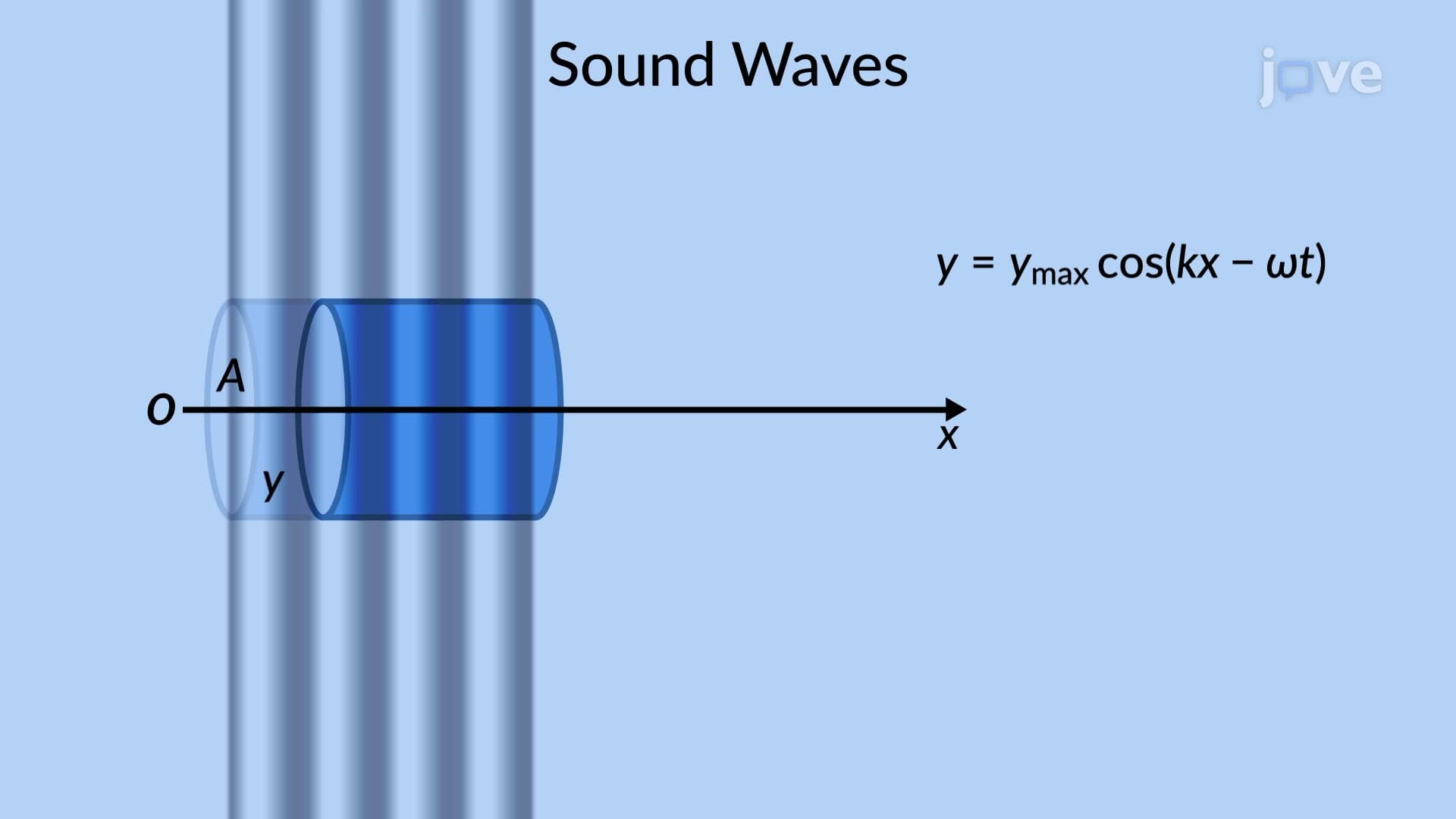
Sound waves in gases propagate as adiabatic compressions and rarefactions-meaning no heat exchange occurs between the wave and surrounding gas molecules. This adiabatic condition is crucial because it determines that sound speed depends on the ratio of specific heats (gamma) rather than isothermal properties. The fundamental equation v = √(γRT/M) shows that velocity increases with temperature and decreases with molecular mass.
For AP Physics and college-level thermodynamics courses, students must recognize that this adiabatic assumption breaks down only at extremely high frequencies or in specialized laboratory conditions. The National Weather Service relies on these principles when calculating acoustic ranging for atmospheric measurements.
Different gases exhibit dramatically different sound speeds due to molecular weight variations. At standard conditions, hydrogen's low molecular mass (2 g/mol) produces sound speeds nearly four times faster than air, while carbon dioxide's higher mass (44 g/mol) reduces speed significantly. This explains why helium-breathing demonstrations create higher-pitched voices-the formant frequencies shift upward due to increased sound velocity in the vocal tract.
Temperature affects sound speed through molecular kinetic energy changes. The relationship v ∝ √T means that temperature increases create proportional velocity increases. Aviation weather services use these calculations for aircraft navigation, while acoustic engineers designing concert halls must account for temperature-dependent reverberation times.
For MCAT preparation, understanding these gas-phase acoustic principles connects to respiratory physiology and medical imaging applications. Ultrasound technology in medical diagnostics relies on similar wave propagation principles, though in liquid and tissue media.
Related Micro-courses