Loading video…


 17 Concepts
 56.3K views

Video Summary: Deriving the Speed of Sound Explained
Why can you hear thunder after seeing lightning, and how do scientists calculate exactly how fast sound travels through different materials? Deriving the speed of sound involves understanding how mechanical waves propagate through fluids using fundamental physics principles like the impulse-momentum theorem and bulk modulus. For example, sound travels at approximately 343 meters per second through air at room temperature, but this speed can be calculated from first principles rather than simply measured. Watch the full video on JoVE Coach to master this concept with expert-led visuals and step-by-step explanations.
Deriving the speed of sound from first principles represents a cornerstone achievement in wave mechanics, connecting fundamental fluid properties to observable phenomena. This derivation elegantly demonstrates how seemingly abstract concepts like bulk modulus and impulse-momentum relationships govern everyday experiences, from hearing conversations to medical ultrasound imaging.
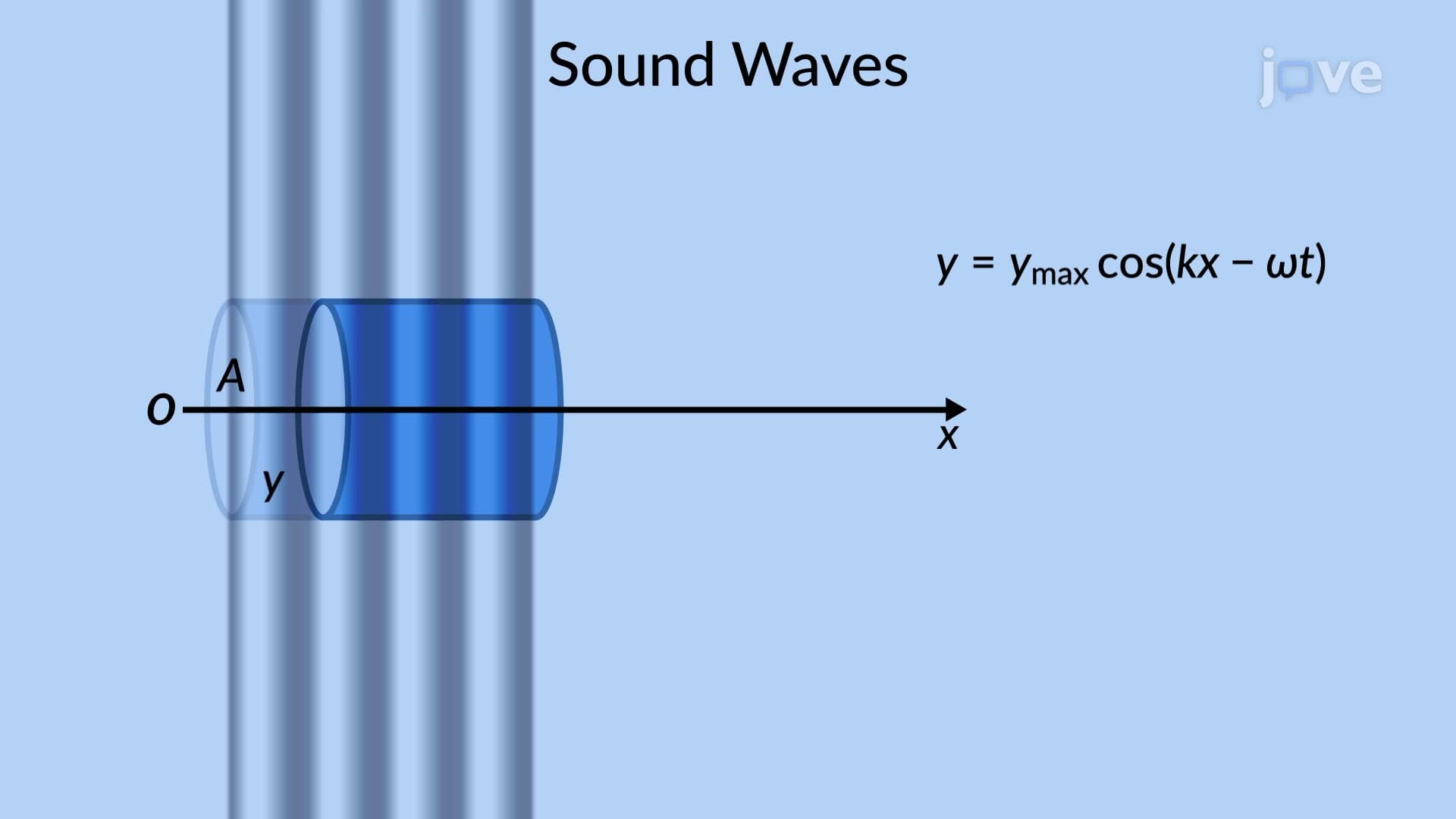
The derivation begins by modeling a fluid medium experiencing a mechanical disturbance. When a wave propagates through a fluid at speed v, it affects a cylindrical column of material extending distance vt from the source after time t. This geometric approach allows us to quantify exactly how much material participates in the wave motion.
The key insight involves tracking both the volume changes and momentum transfer within this affected column. As the wave compresses the fluid, the original volume decreases according to the material's bulk modulus - a measure of resistance to compression. This volume change creates gauge pressure differences that drive the wave forward, establishing the fundamental mechanism of sound propagation.
The mathematical elegance emerges when applying the impulse-momentum theorem. The gauge pressure change, multiplied by the cross-sectional area and duration, equals the impulse delivered to the fluid column. This impulse exactly equals the momentum change experienced by the material as it begins moving with the wave.
Setting these equal and simplifying reveals that wave speed depends only on the square root of the ratio between bulk modulus and density: v = √(K/ρ). This relationship explains why sound travels faster in stiffer materials (higher K) and slower in denser materials (higher ρ).
This derivation appears frequently on AP Physics exams and college-level mechanics courses, particularly in problems involving wave speeds through different media. Students at MIT and Stanford regularly encounter variations asking them to calculate sound speeds in gases, liquids, and solids using tabulated bulk modulus values.
In practical applications, this relationship enables engineers to design acoustic systems, from concert hall acoustics to sonar equipment used by the US Navy. Medical professionals rely on these principles for ultrasound imaging, where different tissue densities create the contrast needed for diagnostic imaging.
Related Micro-courses