Loading video…


 17 Concepts
 56.3K views

Video Summary: What Is Sound Intensity Level
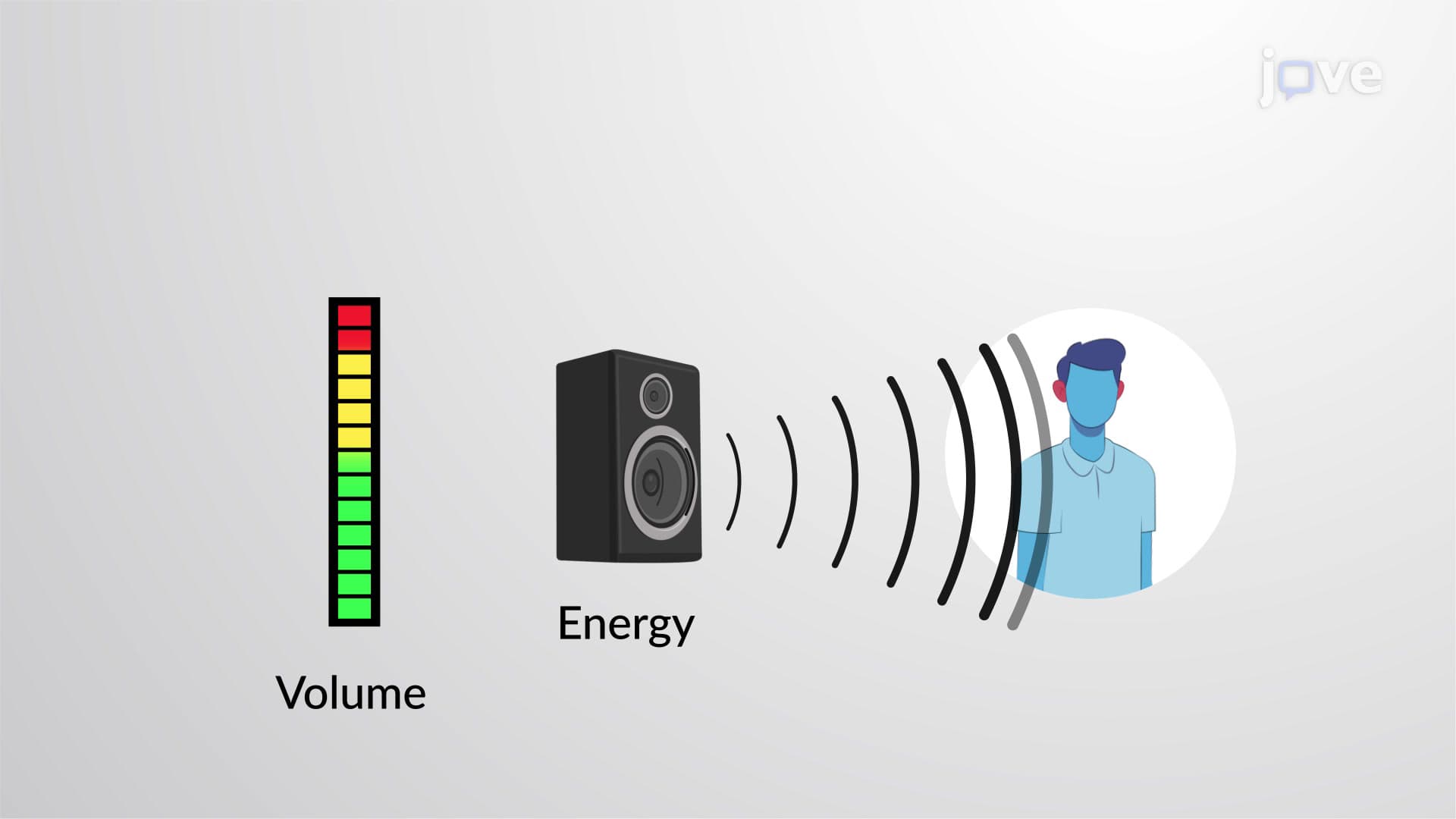
Ever wonder why a motorcycle seems impossibly loud while rustling leaves barely register? Sound intensity level measures the vast range of sounds our ears detect, from whispers to rock concerts at Madison Square Garden. This logarithmic scale transforms the enormous range of sound intensities into manageable decibel units, making it easier to compare everyday sounds. Understanding what is sound intensity level helps explain why a 120-decibel jet engine causes pain while 40-decibel household noise feels comfortable. Watch the full video on JoVE Coach to master this concept with expert-led visuals and step-by-step explanations.
Sound intensity level represents one of physics' most practical applications of logarithmic scaling. When dealing with sound waves, physicists encounter an enormous range of intensities-from the faintest whisper detectable by human ears to the overwhelming roar of a space shuttle launch. The human ear can perceive sounds spanning 12 orders of magnitude in intensity, making linear scales impractical for meaningful comparisons.
The sound intensity level definition centers on the decibel (dB) scale, which uses 10^-12 watts per meter squared as its reference point. This reference intensity, designated as 0 decibels, corresponds to the threshold of human hearing at 1000 Hz-the frequency where our ears demonstrate maximum sensitivity. The logarithmic relationship means each 10-decibel increase represents a tenfold increase in actual sound intensity, though our perception doesn't scale linearly with this mathematical relationship.
Understanding what is sound intensity level in detail requires examining familiar scenarios. A typical classroom discussion registers around 50-60 decibels, while Times Square during rush hour reaches approximately 80-90 decibels. The Federal Aviation Administration mandates hearing protection for airport workers because jet engines produce sound levels exceeding 130 decibels at close range. These practical examples help students grasp the concept's relevance beyond theoretical calculations.
Sound intensity level concepts appear frequently on Advanced Placement Physics exams, particularly in wave mechanics sections. College-level physics courses explore the mathematical relationships between intensity, power, and distance in acoustic systems. Pre-med students encounter these principles again on the MCAT, where understanding logarithmic scales proves essential for data interpretation questions. Engineering students apply sound intensity measurements in designing concert halls, recording studios, and noise-reduction systems for urban planning projects.
The concept also connects to occupational health regulations established by the Occupational Safety and Health Administration (OSHA), which mandates hearing protection for workers exposed to sound levels above 85 decibels during 8-hour shifts. This real-world application demonstrates how theoretical physics principles directly impact workplace safety standards and public health policy.
Related Micro-courses