Loading video…


 12 Concepts
 70.9K views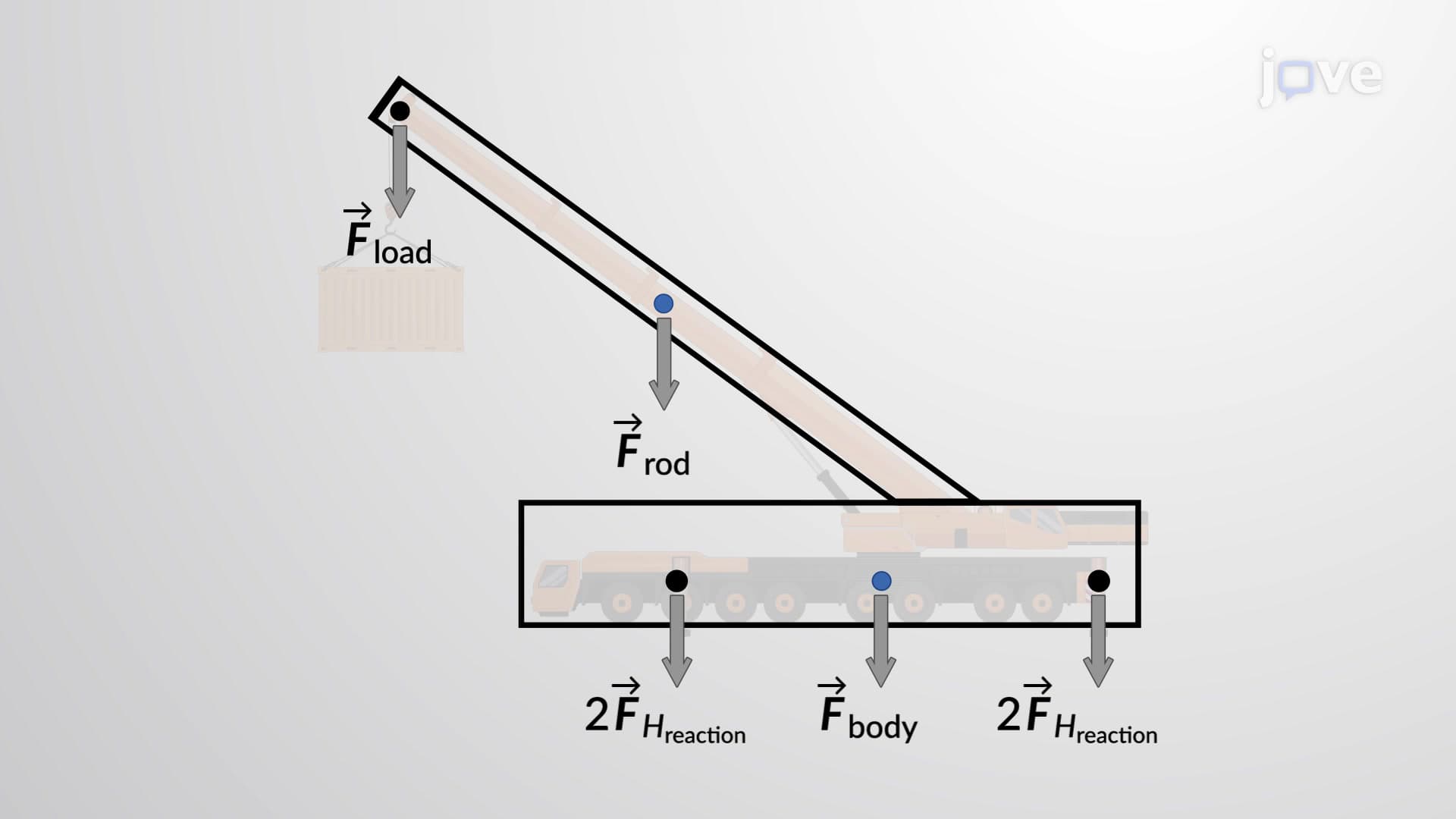

Video Summary: Rigid Body Equilibrium Problems I Explained
Ever wonder how Golden Gate Bridge engineers ensure their massive structures won't topple over? Rigid body equilibrium problems I form the foundation of such calculations, requiring both zero net force and zero net torque on an object. From analyzing the stability of construction cranes in Manhattan to calculating support forces on highway overpasses, these problems appear everywhere in engineering and physics coursework. Watch the full video on JoVE Coach to master this concept with expert-led visuals and step-by-step explanations.
Rigid body equilibrium problems I represent a cornerstone topic in introductory physics and engineering mechanics courses across American universities. Unlike particle equilibrium, which only considers translational motion, rigid body analysis must account for both linear and rotational effects. This dual requirement makes these problems particularly valuable for developing spatial reasoning skills essential in STEM fields.
The concept builds upon Newton's first law but extends it to rotational motion. For complete equilibrium, two conditions must be satisfied simultaneously: the vector sum of all forces equals zero (ΣF = 0), and the vector sum of all torques about any point equals zero (Στ = 0). This dual requirement distinguishes rigid body problems from simpler force analysis typically covered in introductory mechanics.
American physics curricula, from AP Physics courses to college-level statics, emphasize a systematic approach to rigid body equilibrium problems I tutorial scenarios. The first step involves creating an idealized model by isolating the object from its environment-a process called "cutting" the system in engineering mechanics. This abstraction helps students focus on relevant forces while ignoring unnecessary complexity.
Step two requires constructing comprehensive free-body diagrams that capture every force acting on the system. Unlike particle diagrams, rigid body representations must show where forces act on the object since location affects torque calculations. Students often struggle with this transition from point-particle thinking to extended-object analysis.
The final step involves strategic coordinate selection and reference point choice. While torque calculations remain consistent regardless of reference point selection, choosing points where unknown forces act can eliminate variables from torque equations, significantly simplifying solutions.
Understanding how rigid body equilibrium problems I works proves essential for success on standardized exams including AP Physics 1, AP Physics C: Mechanics, and college engineering coursework. These problems frequently appear on MCAT physics sections, testing pre-med students' mechanical reasoning abilities.
Consider analyzing a construction crane at a New York City building site. Engineers must ensure the crane's boom remains stable while lifting materials to upper floors. This scenario perfectly illustrates rigid body equilibrium: the crane experiences gravitational forces (its weight plus lifted load), support reactions from its base, and potentially wind forces. All these forces and their associated torques must balance for safe operation.
Similarly, biomechanics applications appear in MCAT contexts, such as analyzing forces in human joints during physical therapy exercises. A patient performing arm raises creates a lever system where muscle forces, joint reactions, and limb weights must achieve equilibrium for controlled movement.
Rigid body equilibrium problems I concept extends beyond simple beam analysis to include complex systems like trusses, frames, and machine components. Students progressing through engineering curricula encounter increasingly sophisticated scenarios involving friction forces, distributed loads, and multiple connected bodies.
The transition from two-dimensional to three-dimensional analysis represents a significant conceptual leap, typically encountered in sophomore-level statics courses at universities like MIT, Stanford, or Georgia Tech. Three-dimensional problems require vector notation and often involve computer-aided solutions for complex geometries.
Related Micro-courses