Loading subject page…


224,217 views

Video Summary: What Is Instantaneous Velocity I
Ever wondered how NASCAR drivers know their exact speed at the precise moment they cross the finish line at Daytona International Speedway? Instantaneous velocity i reveals an object's exact speed and direction at any specific moment in time, unlike average velocity which only shows overall motion trends. This fundamental physics concept uses calculus to find the limit as time intervals approach zero, giving us the derivative of position with respect to time. Understanding what is instantaneous velocity i is crucial for analyzing everything from rocket launches at Kennedy Space Center to baseball pitches at Yankee Stadium. Watch the full video on JoVE Coach to master this concept with expert-led visuals and step-by-step explanations.
Instantaneous velocity i represents the precise speed and direction of an object at any specific moment in time, making it fundamentally different from average velocity calculations. While average velocity tells us about motion over an extended period, instantaneous velocity provides a snapshot of an object's motion characteristics at exactly one instant. This concept becomes essential when analyzing complex motion patterns where speed and direction constantly change, such as a roller coaster navigating turns at Six Flags Magic Mountain or a satellite orbiting Earth.
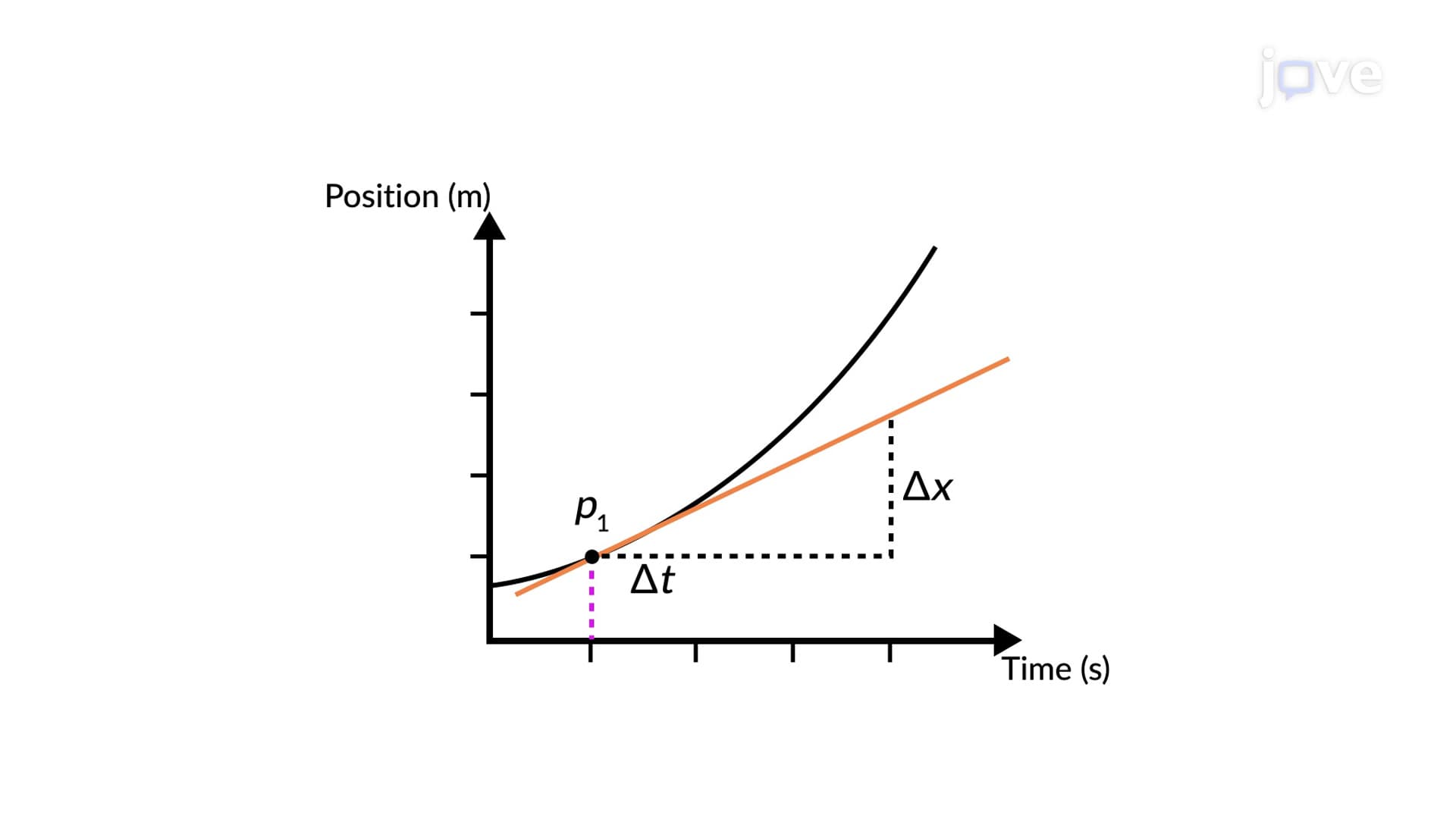
The instantaneous velocity i definition relies on calculus principles, specifically the concept of limits and derivatives. Mathematically, instantaneous velocity equals the limit of average velocity as the time interval approaches zero: v = lim(Δt→0) [Δx/Δt] = dx/dt. This derivative relationship means we're finding the slope of the position-time graph at any specific point. Students preparing for AP Physics or college-level mechanics courses must master this derivative concept, as it forms the foundation for understanding acceleration and more advanced kinematics principles.
Instantaneous velocity i basics emphasize its vector nature, meaning it possesses both magnitude (speed) and direction. The sign of instantaneous velocity directly correlates with the direction of motion along the chosen coordinate axis. When an object moves in the positive x-direction, instantaneous velocity carries a positive value; motion in the negative x-direction produces negative instantaneous velocity values. This sign convention proves crucial for solving physics problems on standardized tests like the SAT Subject Test in Physics or MCAT physics sections.
Understanding instantaneous velocity i becomes practical when analyzing situations requiring precise moment-by-moment motion analysis. Consider a SpaceX Falcon 9 rocket during launch from Cape Canaveral-engineers need instantaneous velocity data at specific altitudes to ensure proper trajectory adjustments. Similarly, automotive crash test engineers at facilities like the Insurance Institute for Highway Safety analyze instantaneous velocities during millisecond-long collision events. These applications demonstrate why the instantaneous velocity i concept extends far beyond textbook problems into critical real-world engineering and safety applications.
Related Micro-courses