Loading video…


 15 Concepts
 61.9K views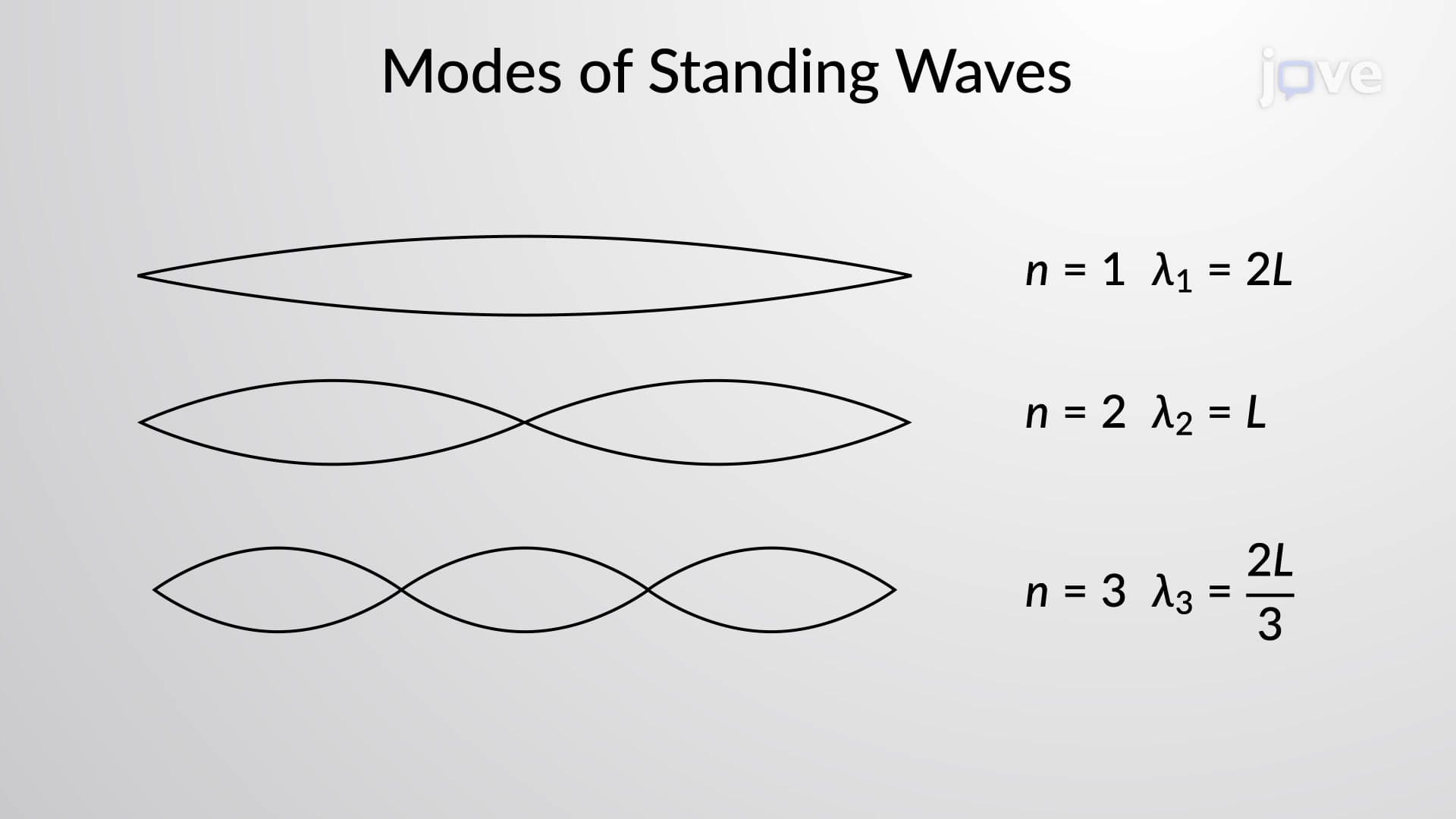

Video Summary: Modes of Standing Waves I Explained
Ever wonder why a guitar string produces different pitches when plucked at various points? Modes of standing waves I reveal the fascinating physics behind this phenomenon, where interference patterns create distinct frequency patterns called harmonics. When MIT's physics demonstrations team plucks a taut wire, they're showcasing how boundary conditions at fixed endpoints determine which wave patterns can exist-with the fundamental frequency occurring when the string's length equals half a wavelength. Watch the full video on JoVE Coach to master this concept with expert-led visuals and step-by-step explanations.
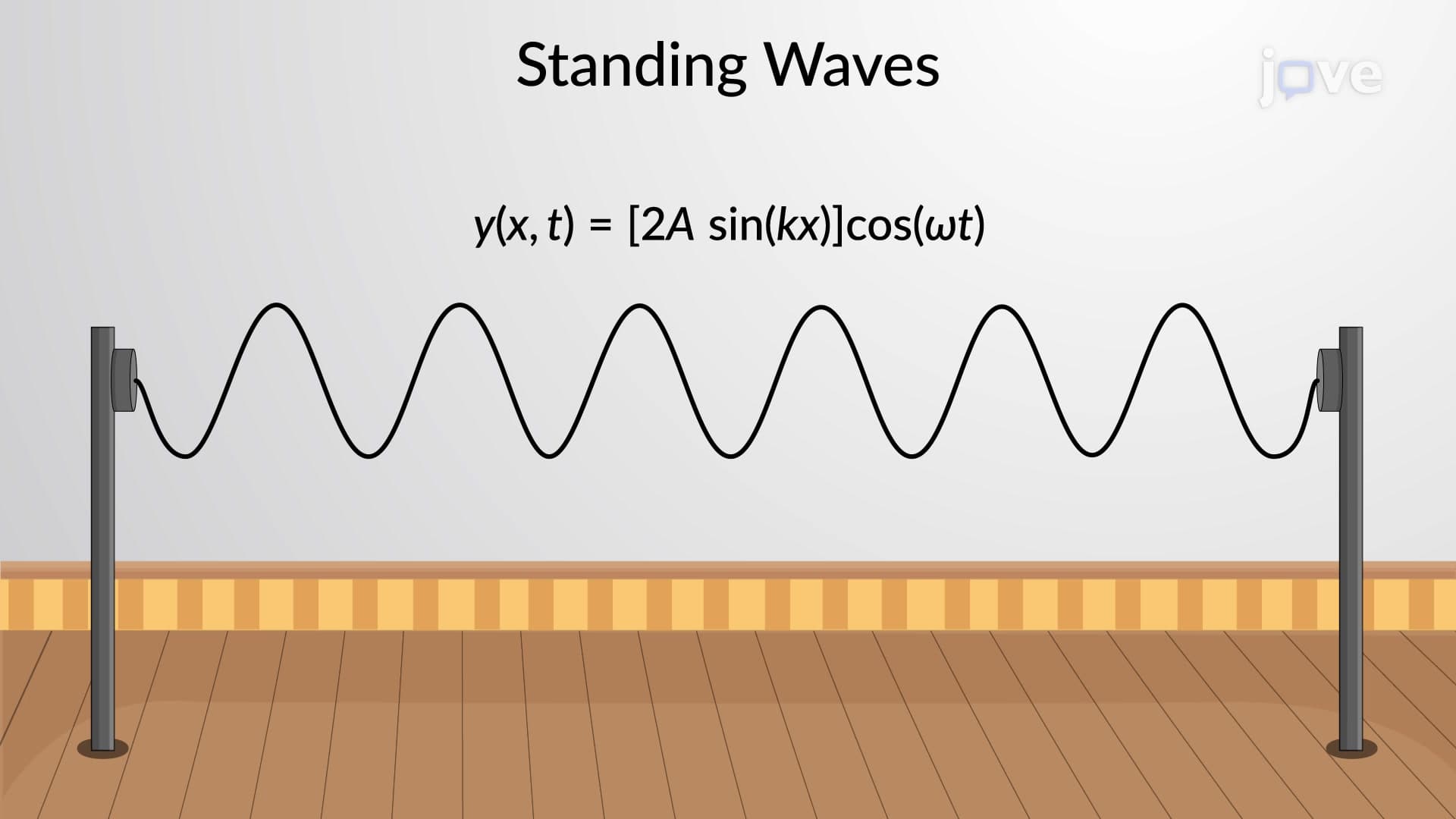
Modes of standing waves I represent one of physics' most elegant phenomena, where two identical waves traveling in opposite directions create stationary interference patterns. Unlike traveling waves that move energy from point to point, standing waves appear motionless with energy oscillating between kinetic and potential forms at fixed locations.
When analyzing standing wave formation, the key principle involves superposition of two sinusoidal waves. Consider a string of length L with fixed endpoints-the boundary conditions demand zero displacement at x = 0 and x = L. This constraint means only specific wavelengths can exist: λ = 2L/n, where n represents positive integers (1, 2, 3...). The fundamental mode (n = 1) produces the longest allowable wavelength at λ = 2L, while higher harmonics create shorter wavelengths with proportionally higher frequencies.
Standing wave patterns exhibit alternating regions of zero displacement (nodes) and maximum oscillation (antinodes). The fundamental mode contains exactly one antinode at the string's center, with nodes only at the endpoints. Second harmonic introduces an additional node at the midpoint, creating two antinodes. This pattern continues systematically-the nth harmonic contains (n-1) internal nodes and n antinodes.
For US students preparing for AP Physics or college examinations, understanding this node-antinode relationship proves crucial for problem-solving. Many standardized tests, including the MCAT, feature questions requiring students to sketch standing wave patterns or calculate harmonic frequencies using f(n) = nf(1), where f(1) represents the fundamental frequency.
Standing wave principles appear throughout American engineering applications. Boeing's aircraft design teams utilize standing wave analysis when studying wing vibrations during flight testing. Similarly, Steinway piano manufacturers rely on standing wave theory to optimize soundboard resonance, ensuring each piano key produces precise harmonic frequencies. Even telecommunications companies like Verizon apply these concepts when designing antenna arrays, where standing wave ratios determine signal transmission efficiency.
Understanding these applications helps students connect theoretical physics to practical career paths in aerospace, acoustics, and telecommunications-industries with significant presence across American universities and research institutions.
Related Micro-courses