Loading subject page…


5,325 views


Video Summary: What are Rates of Change
Rates of change are everywhere, but did you know calculus uses them to predict how fast a drug dissolves in your bloodstream? Rates of change basics describe how one quantity shifts in response to another, like temperature rising and falling throughout a Chicago afternoon. Average rates measure change over an interval; instantaneous rates capture a single moment precisely. Watch the full video on JoVE Coach to master this concept with expert-led visuals and step-by-step explanations.
Rates of change are one of the most powerful ideas in mathematics. At the simplest level, a rate of change answers the question: *how fast is something changing?* Whether you are tracking the speed of a car on a California highway, monitoring a patient's heart rate in a hospital ICU, or analyzing stock price shifts on Wall Street, you are working with rates of change. This concept sits at the very heart of differential calculus and appears across AP Calculus AB, AP Calculus BC, college-level Calculus I, and standardized tests like the MCAT.
The average rate of change of a function f(x) over an interval [a, b] is calculated as:
Average Rate of Change = ( f(b) − f(a) ) / ( b − a )
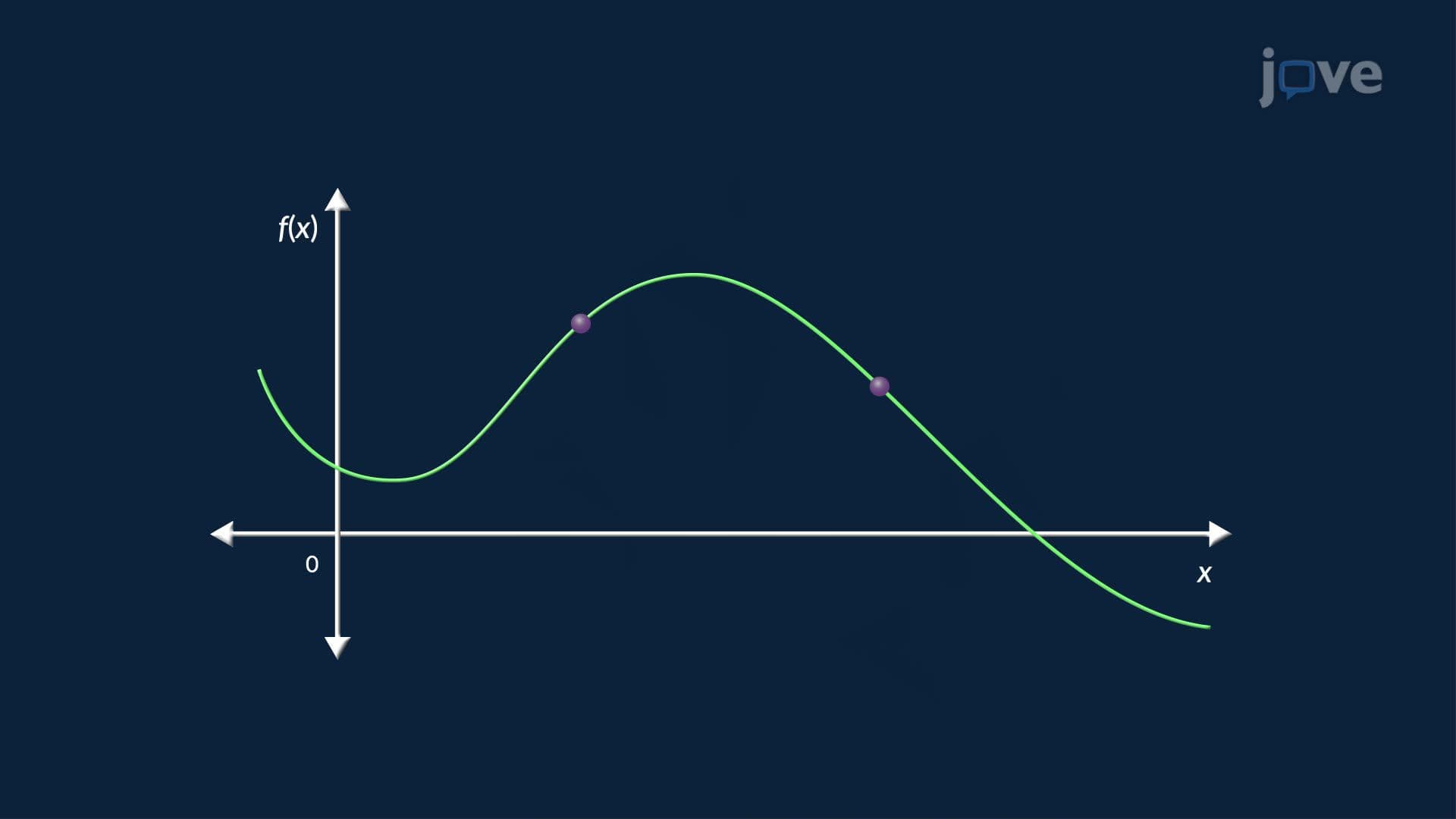
Geometrically, this is the slope of the secant line, the straight line connecting two points on the curve. Think of it like driving from Los Angeles to San Francisco: your average speed over the entire trip doesn't tell you how fast you were going at any specific moment, but it gives a useful overall picture. On an AP Calculus exam, you will frequently be asked to compute this value from a table, graph, or equation, making it one of the most tested entry-level skills in the course.
While the average rate of change captures a broad interval, the instantaneous rate of change zooms in on a single moment. It is defined using the limit definition of the derivative:
f'(x) = lim [h → 0] ( f(x + h) − f(x) ) / h
As the interval h shrinks toward zero, the secant line rotates and approaches the tangent line at that point. The slope of this tangent line *is* the instantaneous rate of change. Physically, this is what your car's speedometer reads, not your average speed over an hour, but your exact speed right now. This limit-based definition is foundational for understanding instantaneous velocity, a concept heavily tested in both AP Physics and Calculus courses.
Beyond textbooks, rates of change drive real decisions. In chemistry, the instantaneous rate of a reaction tells researchers at a pharmaceutical company exactly how fast a drug compound is breaking down at a particular moment, critical for dosage timing and shelf-life calculations. In environmental science, the average rate of change in CO2 concentration over a decade informs climate models used by agencies like NOAA. Medical professionals also use rates of change when interpreting how quickly a patient's blood glucose rises after a meal, helping endocrinologists at US hospitals fine-tune insulin therapy.
An important concept connected to rates of change is differentiability. A function can only have an instantaneous rate of change at a point if it is differentiable there, and differentiability requires continuity. However, continuity alone does not guarantee differentiability. Sharp corners and vertical tangents are examples where a function is continuous but not differentiable. Understanding this distinction, differentiability vs. continuity, is a critical topic on AP Calculus free-response questions and college midterms, where students are often asked to justify whether a derivative exists at a given point.
Related Micro-courses