Loading video…


 6 Concepts
 5.3K views

Video Summary: What Is Tangent Line
Ever wondered what a car's speedometer is actually measuring at any single instant? That's exactly what a tangent line reveals. Understanding tangent line basics starts with recognizing how a straight line can capture the precise direction of a curve at one specific point, a foundation of calculus used everywhere from NASA trajectory modeling to US epidemiologists tracking disease spread. Watch the full video on JoVE Coach to master this concept with expert-led visuals and step-by-step explanations.
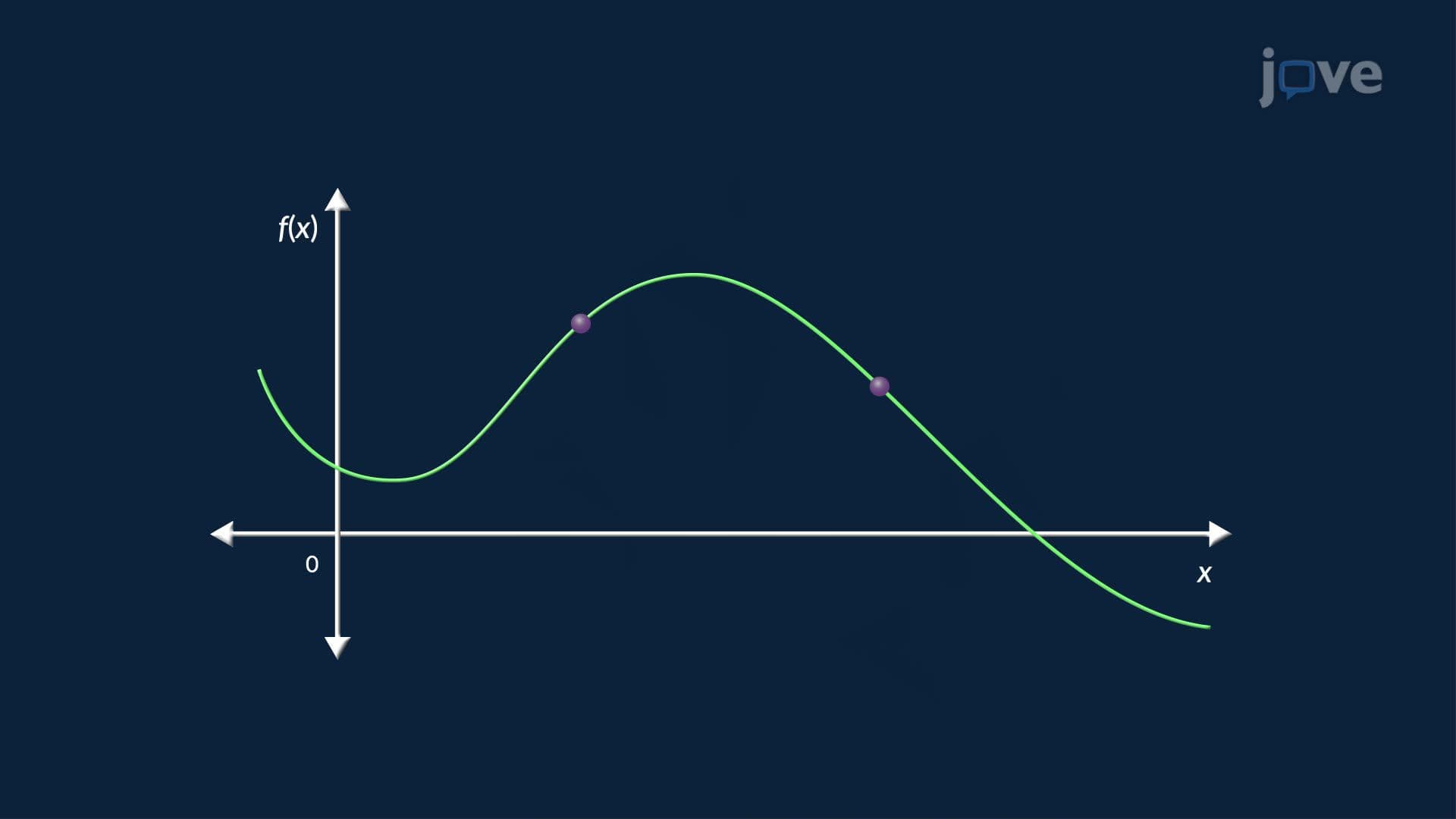
A tangent line is a straight line that touches a curve at exactly one point and has the same slope as the curve at that precise location. Unlike a line that cuts through a curve at two or more points, the tangent line captures the curve's instantaneous direction, making it one of the most powerful ideas in all of calculus. Far from being an abstract geometric curiosity, the tangent line is the visual and conceptual backbone of the derivative, the central tool of differential calculus.
To build intuition, start with a secant line, a straight line connecting two points on a curve. If you plot position versus time for a car on a highway, the secant line between two moments gives the average velocity over that interval: the total change in position divided by the total change in time.
But what if you want to know the car's exact speed at one single moment, say, at 2:00:00 PM precisely? You shrink the time interval. Move the two points closer and closer together. As the change in time (Δt) approaches zero, the secant line rotates and settles into a single position: the tangent line. Mathematically, this is expressed through the limit definition of the derivative:
f'(x) = lim [h → 0] of [f(x + h) − f(x)] / h
This formula is not just symbolic, it encodes the entire logical process of moving from average change to instantaneous change. It's the formal definition tested on the AP Calculus AB and BC exams and covered in virtually every college Calculus I course across the United States.
The slope of the tangent line at any point on a curve equals the instantaneous rate of change of the function at that point. In a position-time graph, this slope is instantaneous velocity. In a population-time graph, used widely by US public health researchers at the CDC, the slope at any point represents the instantaneous growth rate of a population.
This physical interpretation is critical for the AP Physics C: Mechanics exam and undergraduate physics and biology courses, where students must read graphs and interpret slopes meaningfully. A steeper tangent line means a faster rate of change; a horizontal tangent line (slope = 0) indicates a maximum, minimum, or momentary pause in change.
A tangent line can only exist at a point where a function is differentiable, meaning the limit that defines the derivative must actually exist. A function can be continuous (no breaks or jumps) but still fail to be differentiable. Sharp corners, cusps, and vertical tangent lines are classic examples where continuity holds but differentiability breaks down.
For instance, the absolute value function f(x) = |x| is continuous everywhere but has no tangent line at x = 0 because the slope abruptly changes direction. Understanding this distinction, differentiability vs. continuity, is a high-priority topic on AP Calculus exams and college midterms nationwide. Recognizing where tangent lines exist (and where they don't) is essential for mastering curve analysis, optimization problems, and related rates, all staple topics in US calculus curricula.
Related Micro-courses