Loading subject page…


2,477 views


Video Summary: What are Differential Equations
Ever wonder how engineers design roller coasters or how doctors model drug absorption in the body? Differential equations are the mathematical backbone behind these real-world systems. What are differential equations? They're equations linking an unknown function to its derivatives, capturing how things *change*. A classic US example: NASA uses them to calculate spacecraft trajectories. Watch the full video on JoVE Coach to master this concept with expert-led visuals and step-by-step explanations.
A differential equation is any equation that contains an unknown function together with one or more of its derivatives. Unlike a standard algebraic equation, where you solve for an unknown *number*, a differential equation asks you to find an unknown *function* that satisfies the relationship described. This distinction is fundamental: the solution is not a single value but an entire function (or family of functions) that describes how a quantity evolves.
Differential equations are the language scientists and engineers use to model the physical world. Wherever there is change, in position, temperature, population, voltage, or concentration, a differential equation is likely at work.
The order of a differential equation is determined by the highest-order derivative it contains. If only the first derivative appears, it is a first-order differential equation. If the second derivative is the highest present, it is second-order, and so on. This classification matters because it determines which solution methods apply and how many initial conditions are needed to find a unique solution.
Ordinary differential equations (ODEs) involve functions of a single variable and their derivatives. These are the type most commonly encountered in AP Calculus BC, college Calculus II, and introductory physics courses across US universities. When multiple independent variables are involved, the equations become partial differential equations, a more advanced topic typically covered in upper-division coursework.
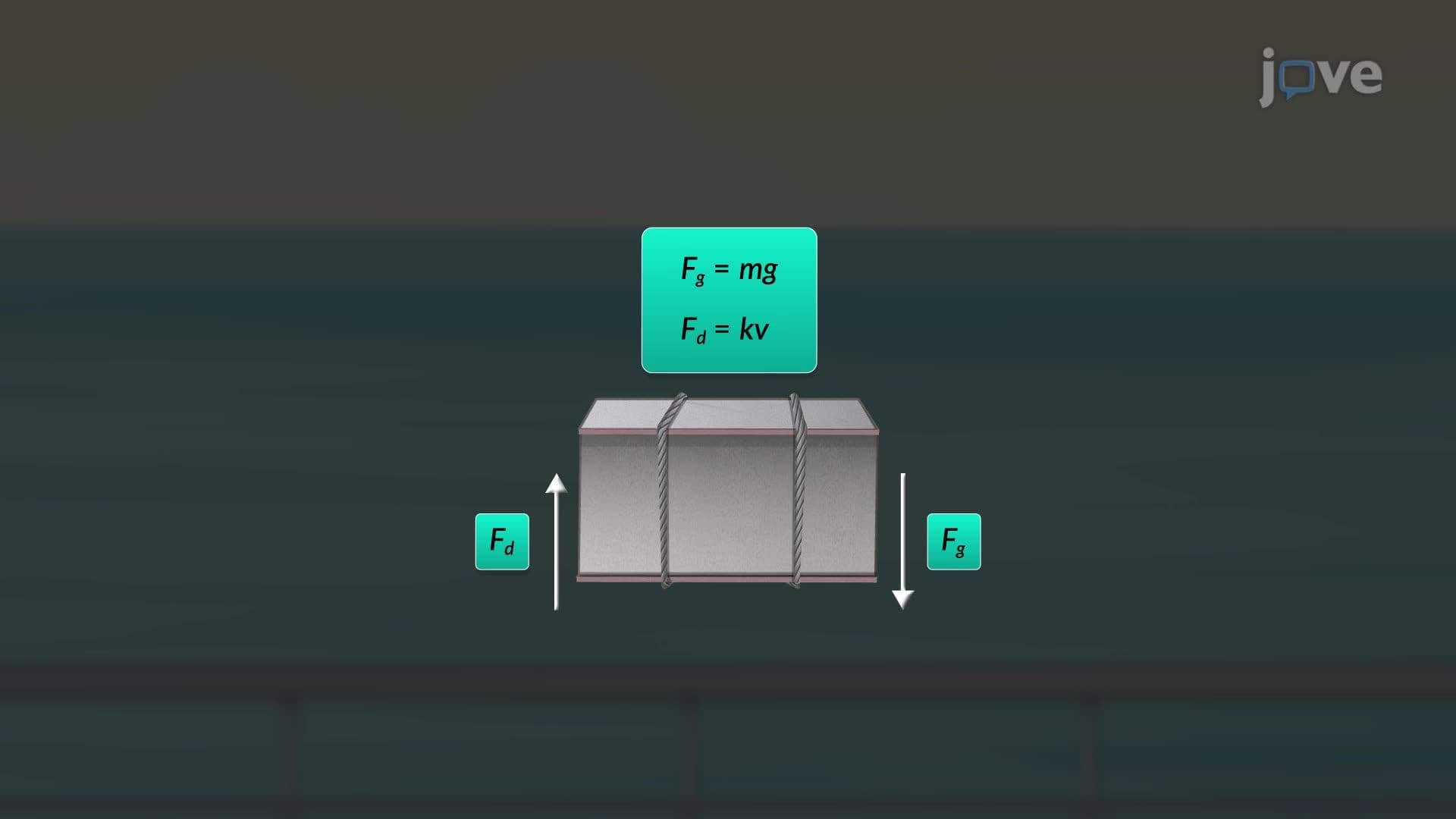
One of the most instructive examples of a differential equation in action is the spring-mass system, a model for simple harmonic motion. Here's how the equation is built from first principles:
This is a second-order ordinary differential equation. It governs everything from the vibration of guitar strings to the suspension systems in US-manufactured vehicles and the motion of seismic sensors used in earthquake monitoring.
Two foundational solution methods appear frequently in coursework and exams:
1. Separable Equations A differential equation is separable if it can be rewritten so that all terms involving y (and dy) are on one side and all terms involving x (and dx) are on the other. Once separated, both sides are integrated independently. For example, dy/dx = ky separates to dy/y = k·dx, integrating to give ln|y| = kx + C, and ultimately y = Ae^(kx), the exponential growth or decay model used in biology and finance courses nationwide.
2. Integrating Factors for Linear First-Order Equations A linear first-order equation takes the form dy/dx + P(x)·y = Q(x). Multiplying through by an integrating factor, e^(integral of P(x) dx), transforms the left side into the derivative of a product, making the equation directly integrable. This method is a staple topic in college ODE courses and appears in AP Calculus BC free-response questions.
General vs. Particular Solutions: A general solution contains an arbitrary constant (C) and represents a whole *family* of curves. A particular solution is obtained by applying an initial condition, a known value of the function at a specific point, to solve for C. Initial value problems (IVPs) are the standard format on college exams, AP tests, and MCAT quantitative reasoning sections.
Related Micro-courses