Loading video…


 10 Concepts
 7.3K views

Video Summary: What Is Irrotational Flow
Did you know that the smooth airflow around an airplane wing at cruising altitude behaves almost like it has no spinning motion at all? This phenomenon relates directly to the velocity potential concept in fluid mechanics. When studying irrotational flow, understanding velocity potential becomes crucial for analyzing how fluids move without rotating particles. Consider how air flows over NASA's wind tunnel models during aircraft testing-this represents classic irrotational flow behavior. Watch the full video on JoVE Coach to master this concept with expert-led visuals and step-by-step explanations.
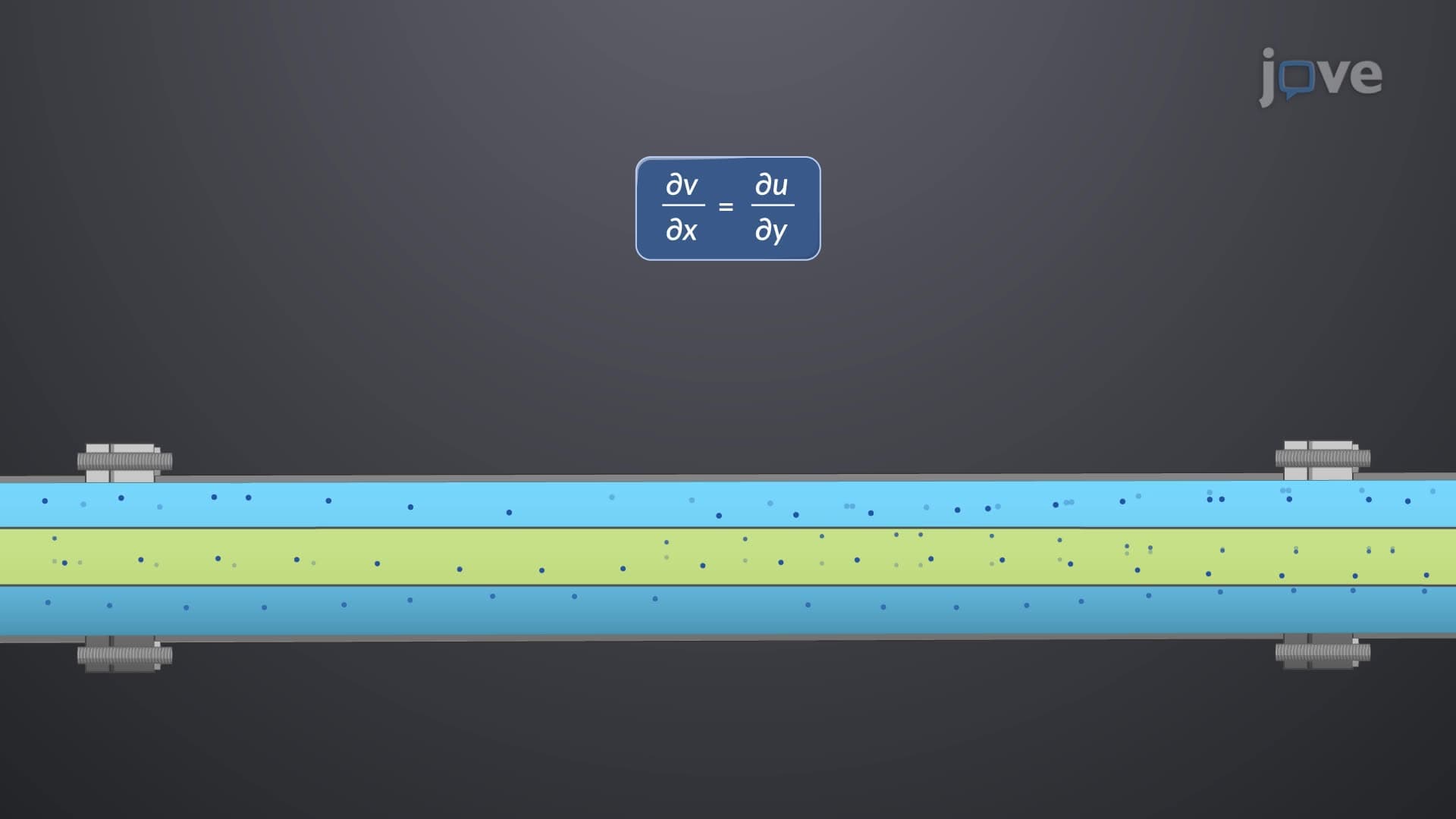
Irrotational flow represents one of the most elegant concepts in fluid mechanics, where fluid particles move without rotating about their own axes. The velocity potential serves as the mathematical foundation for describing this motion. When we say a flow has velocity potential, we mean there exists a scalar function φ (phi) such that the velocity vector V equals the negative gradient of φ: V = -∇φ. This relationship ensures the flow remains irrotational since the curl of any gradient field equals zero.
The velocity potential definition extends beyond simple mathematics into practical applications. In aerospace engineering, Boeing and Lockheed Martin engineers routinely use velocity potential theory to design aircraft wings. The concept allows engineers to predict lift generation and pressure distributions around airfoils. For students preparing for AP Physics C or college-level fluid mechanics courses, understanding that velocity potential exists only when ∇ × V = 0 (curl equals zero) becomes essential for problem-solving success.
What is velocity potential in detail becomes clear when examining practical scenarios. Consider water flow around the supports of San Francisco's Golden Gate Bridge or air movement through NASA's wind tunnels at Ames Research Center. These situations demonstrate how velocity potential theory predicts flow patterns accurately away from solid boundaries. However, near surfaces where viscosity matters-like in the boundary layer around a submarine hull-the irrotational assumption breaks down, requiring more complex analysis methods.
Students encountering velocity potential problems on the MCAT Physics section or engineering fluid mechanics exams should remember that irrotational flow simplifies calculations significantly. When Bernoulli's equation applies (steady, incompressible, inviscid, irrotational flow), complex three-dimensional problems become manageable. Universities like MIT and Stanford emphasize this concept in their mechanical engineering curricula because it bridges theoretical physics with practical engineering design, particularly in aeronautics and hydraulics coursework.
Related Micro-courses