Loading subject page…

- Physics
- Fluid Mechanics
- Laminar and Turbulent Flow
Micro-course: Fluid Mechanics
201,012 views
Learn key concepts and earn your certificate.








Laminar and Turbulent Flow

00:00
01:07
Video Summary: What Is Laminar and Turbulent Flow
Ever wonder why the Mississippi River flows smoothly in some sections but churns violently near dam spillways? Understanding laminar and turbulent flow reveals the hidden patterns governing all fluid motion around us. In laminar flow, fluids move in orderly, parallel layers, while turbulent flow creates chaotic, swirling patterns that change continuously. From the smooth water stream from your kitchen faucet at low pressure to the choppy wake behind a speedboat on Lake Michigan, these flow patterns shape everything from blood circulation to aircraft design. Watch the full video on JoVE Coach to master this concept with expert-led visuals and step-by-step explanations.
- Understand what is laminar and turbulent flow and distinguish between these two fundamental fluid motion patterns
- Identify the key characteristics that define smooth, layered laminar flow versus chaotic, irregular turbulent flow
- Analyze how flow speed, surface roughness, and fluid density determine whether flow remains laminar or becomes turbulent
- Compare real-world examples of both flow types, from household water fixtures to natural waterways
- Evaluate the factors that cause flow transitions, such as velocity changes and obstacle interference
- Apply flow pattern recognition to predict fluid behavior in engineering and biological systems
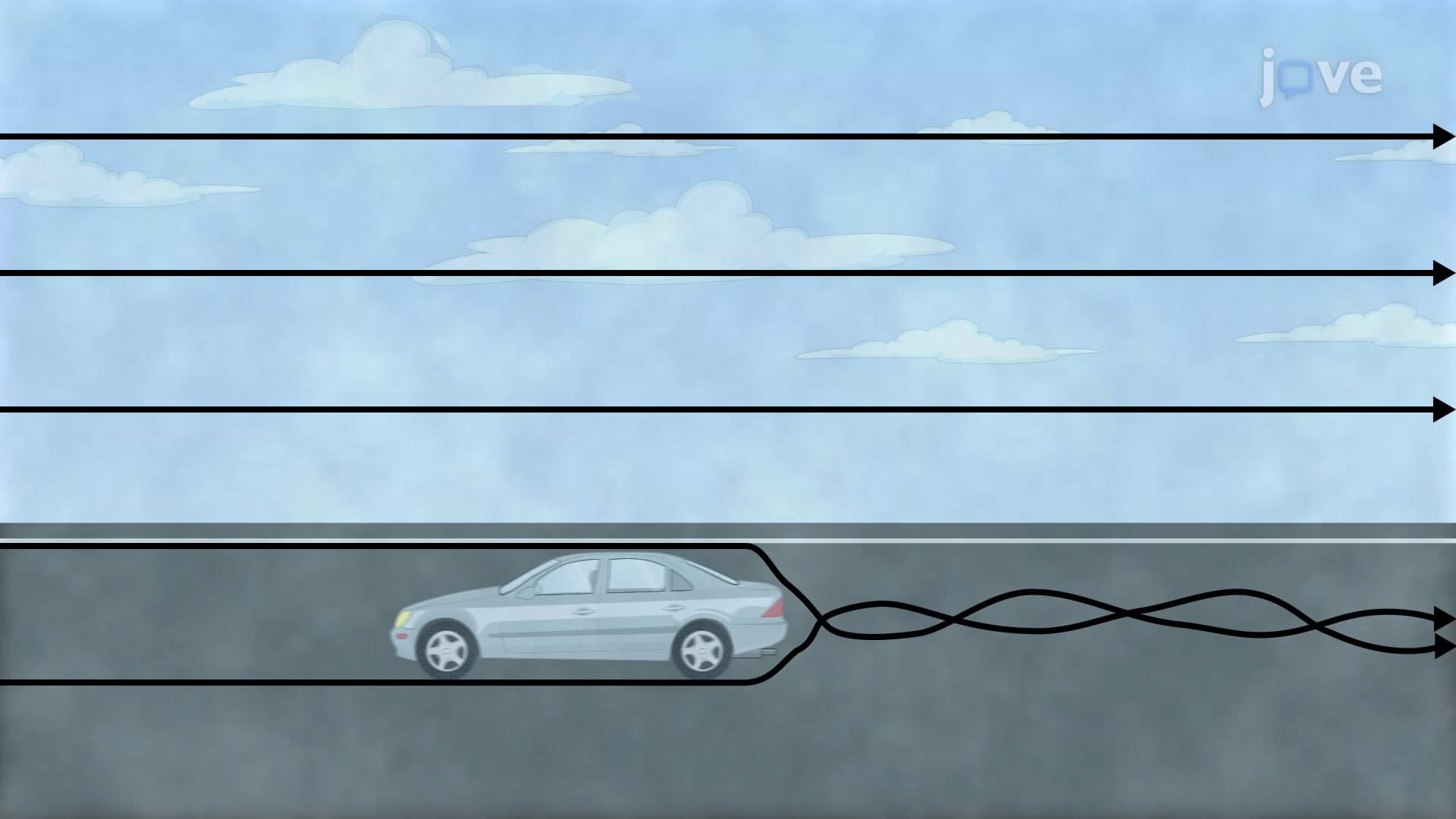
- Recognize the role of streamlines and velocity vectors in visualizing fluid motion
- Explore the practical implications of flow types in design applications and natural phenomena
Understanding What is Laminar and Turbulent Flow
Laminar and turbulent flow represent the two fundamental patterns of fluid motion that govern everything from blood circulation in your arteries to the aerodynamics of commercial aircraft. These flow patterns determine energy efficiency, heat transfer rates, and mixing characteristics in countless applications across engineering, medicine, and natural systems.
Laminar flow occurs when fluid particles move in smooth, parallel layers with minimal mixing between adjacent layers. Picture honey pouring from a jar-the fluid maintains orderly, predictable motion with each layer sliding smoothly past its neighbors. In contrast, turbulent flow features chaotic, irregular motion with rapid changes in velocity and direction, creating eddies, swirls, and unpredictable mixing patterns.
Key Factors Controlling Flow Patterns
Three primary factors determine whether fluid flow remains laminar or transitions to turbulent: flow velocity, surface roughness, and fluid properties. As velocity increases, the likelihood of turbulent flow rises dramatically. This explains why water from your bathroom faucet flows smoothly at low speeds but becomes chaotic and splashes when you turn the handle fully open.
Surface roughness also plays a crucial role. Smooth pipes maintain laminar flow at higher velocities than rough surfaces, which is why engineers carefully finish pipeline interiors in critical applications. Fluid density and viscosity (thickness) further influence flow patterns-thick fluids like motor oil tend to maintain laminar flow more easily than thin fluids like water or air.
Real-World Applications and Examples
Understanding flow patterns proves essential for numerous US industries and applications. In biomedical engineering, laminar flow cabinets protect sensitive pharmaceutical manufacturing at companies like Pfizer and Johnson & Johnson. The smooth, parallel airflow prevents contamination during drug production and sterile procedures.
Automotive engineers at Ford and General Motors optimize vehicle aerodynamics by managing airflow patterns around car bodies. Laminar flow over smooth surfaces reduces drag and improves fuel efficiency, while turbulent flow increases energy consumption and noise.
In the aerospace industry, Boeing and Lockheed Martin design wing surfaces to maintain laminar flow as long as possible before transitioning to turbulent flow. This careful management of flow patterns directly impacts aircraft performance, fuel consumption, and passenger comfort.
Academic and Exam Relevance
Flow pattern concepts frequently appear on standardized exams including the MCAT physics section, AP Physics courses, and college-level fluid mechanics assessments. Students should master the ability to predict flow transitions, analyze velocity vector diagrams, and interpret streamline patterns. Understanding these concepts provides crucial foundation knowledge for advanced engineering coursework and professional applications in mechanical, chemical, and biomedical engineering programs at universities nationwide.
Frequently Asked Questions
Laminar flow occurs when fluid moves in smooth, parallel layers like honey pouring from a jar, while turbulent flow involves chaotic, swirling motion like water rushing over rocks in a stream. The key difference lies in whether the fluid maintains orderly, predictable motion (laminar) or exhibits irregular, mixing patterns (turbulent). Understanding this distinction helps explain everything from blood flow in arteries to air movement over airplane wings.
For AP Physics and MCAT preparation, define laminar flow as fluid motion in parallel layers with minimal cross-mixing, characterized by smooth streamlines and predictable velocity patterns. Turbulent flow features irregular, time-dependent velocity fluctuations with significant cross-mixing and chaotic streamlines. These definitions form the foundation for solving fluid dynamics problems involving Reynolds numbers, pressure drops, and energy calculations in standardized test questions.
MCAT physics sections frequently test flow pattern recognition, especially in biological contexts like blood circulation and respiratory airflow. Questions often involve analyzing factors that cause flow transitions, calculating pressure differences, or predicting mixing efficiency in physiological systems. Students should practice identifying flow types from given scenarios and understanding how velocity, viscosity, and pipe diameter affect flow characteristics in medical applications.
Laminar flow examples include smooth water streams from faucets at low pressure, honey or syrup pouring slowly, and gentle river flow in straight channels. Turbulent flow appears in fast-moving tap water that splashes, rough ocean waves, smoke rising from chimneys, and airflow around moving vehicles. These everyday observations help students connect theoretical concepts to practical experiences and improve pattern recognition skills.
Flow pattern concepts are very accessible to high school students with basic physics background, requiring only understanding of velocity, force, and energy concepts. The visual nature of fluid motion makes these topics easier to grasp than many abstract physics principles. Starting with familiar examples like water flow and gradually building to more complex applications provides a natural learning progression that builds confidence and understanding.
Focus on recognizing flow types from visual descriptions, understanding the three key factors (velocity, surface roughness, fluid properties) that determine flow patterns, and practicing calculations involving flow transitions. Create comparison charts highlighting differences between laminar and turbulent characteristics, then work through practice problems from AP Physics or college textbooks. Drawing streamline diagrams and analyzing real-world scenarios strengthens both conceptual understanding and problem-solving skills.
Advanced fluid dynamics topics include Reynolds number calculations for predicting flow transitions, Bernoulli's equation applications, boundary layer theory, and computational fluid dynamics principles. Students interested in engineering should explore pipe flow calculations, pump systems, and heat transfer applications. Pre-med students might focus on cardiovascular fluid mechanics and respiratory airflow patterns that appear in advanced physiology and medical school coursework.
Related Micro-courses


