Loading subject page…


201,024 views

Video Summary: What Is Variation of Atmospheric Pressure
Ever wonder why your ears pop during airplane takeoffs or why Denver's "Mile High City" nickname affects cooking times? The variation of atmospheric pressure explains how air pressure decreases predictably with altitude due to gravity's pull on our atmosphere's layers. At sea level in Miami, atmospheric pressure measures about 14.7 psi, but atop Colorado's Mount Elbert at 14,440 feet, it drops to roughly 8.5 psi. Watch the full video on JoVE Coach to master this concept with expert-led visuals and step-by-step explanations.
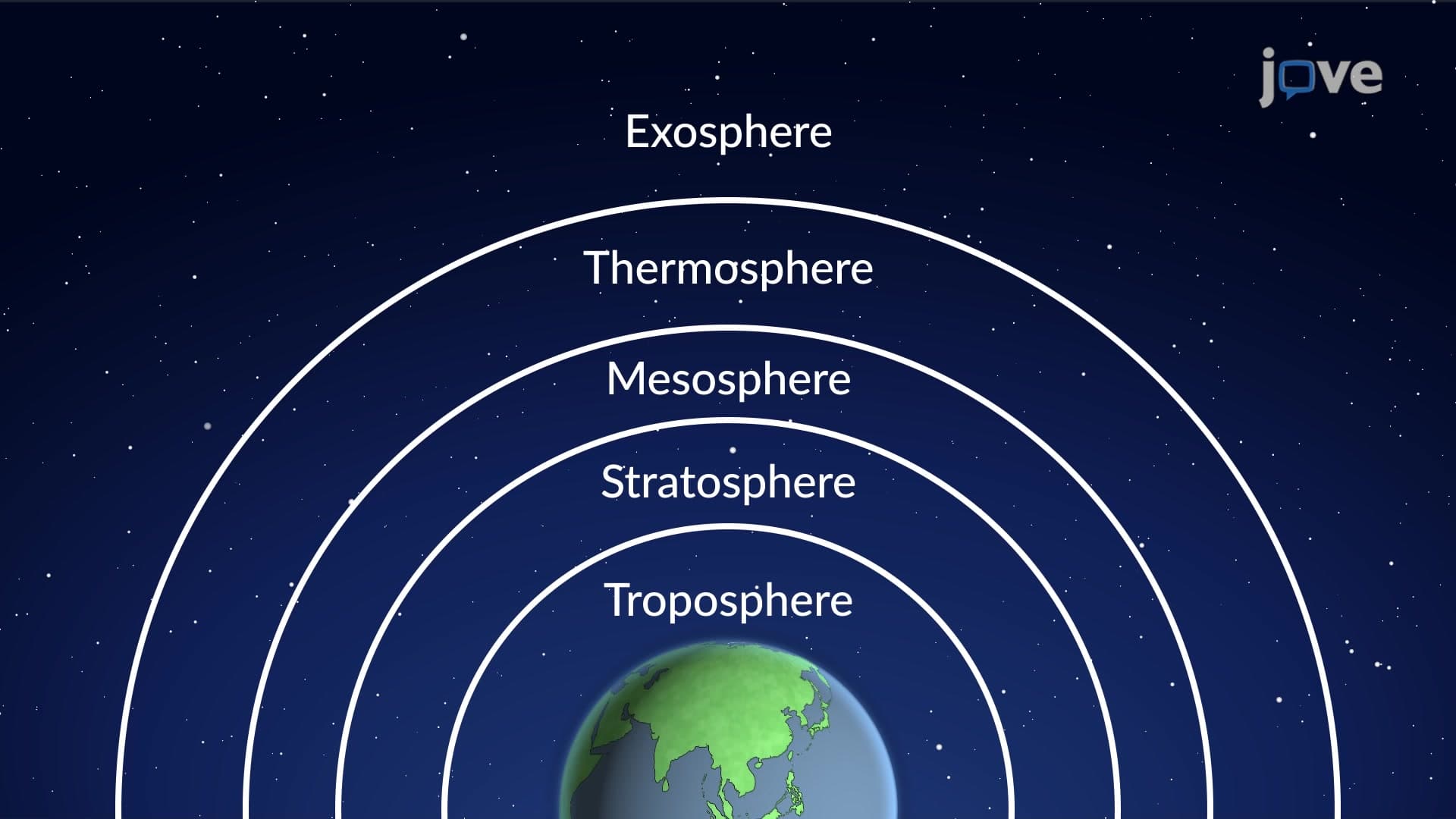
The variation of atmospheric pressure describes how air pressure changes systematically with altitude above Earth's surface. This phenomenon occurs because our planet's atmosphere-composed of nitrogen (78%), oxygen (21%), and trace gases-experiences gravitational pull that compresses air molecules more densely near the surface. Understanding this concept is crucial for AP Physics students and appears frequently on standardized tests like the SAT Subject Tests.
The relationship between pressure and altitude follows an exponential decay pattern derived from the ideal gas law. When we assume constant temperature and gravitational acceleration, the rate of pressure change with height becomes:
dP/dh = -ρg
Where P represents pressure, h indicates height, ρ denotes air density, and g equals gravitational acceleration. Through integration and mathematical manipulation, scientists developed the barometric formula:
P(h) = P(0) × e^(-h/H)
Here, P(0) represents sea-level pressure, h indicates altitude, and H represents the pressure scale height-approximately 8,800 meters or 28,870 feet under standard conditions.
The pressure scale height concept proves essential for understanding atmospheric behavior. This characteristic length of 8,800 meters represents the altitude where atmospheric pressure drops by a factor of 1/e (approximately 37% of its original value). For example, Denver International Airport sits at 5,431 feet elevation, where atmospheric pressure measures roughly 12.1 psi compared to sea level's 14.7 psi-a reduction following this exponential pattern.
Commercial aviation relies heavily on atmospheric pressure variation principles. Pilots must understand pressure altitude calculations for flight planning, while aircraft cabin pressurization systems maintain comfortable conditions equivalent to 6,000-8,000 feet altitude even when flying at 35,000 feet. Weather forecasters use barometric pressure readings to predict storm systems, and the National Weather Service maintains extensive pressure monitoring networks across the United States. Students preparing for MCAT physics sections encounter atmospheric pressure problems, particularly in fluid mechanics and thermodynamics contexts.
Related Micro-courses