Loading…
Loading video…
154,401 views

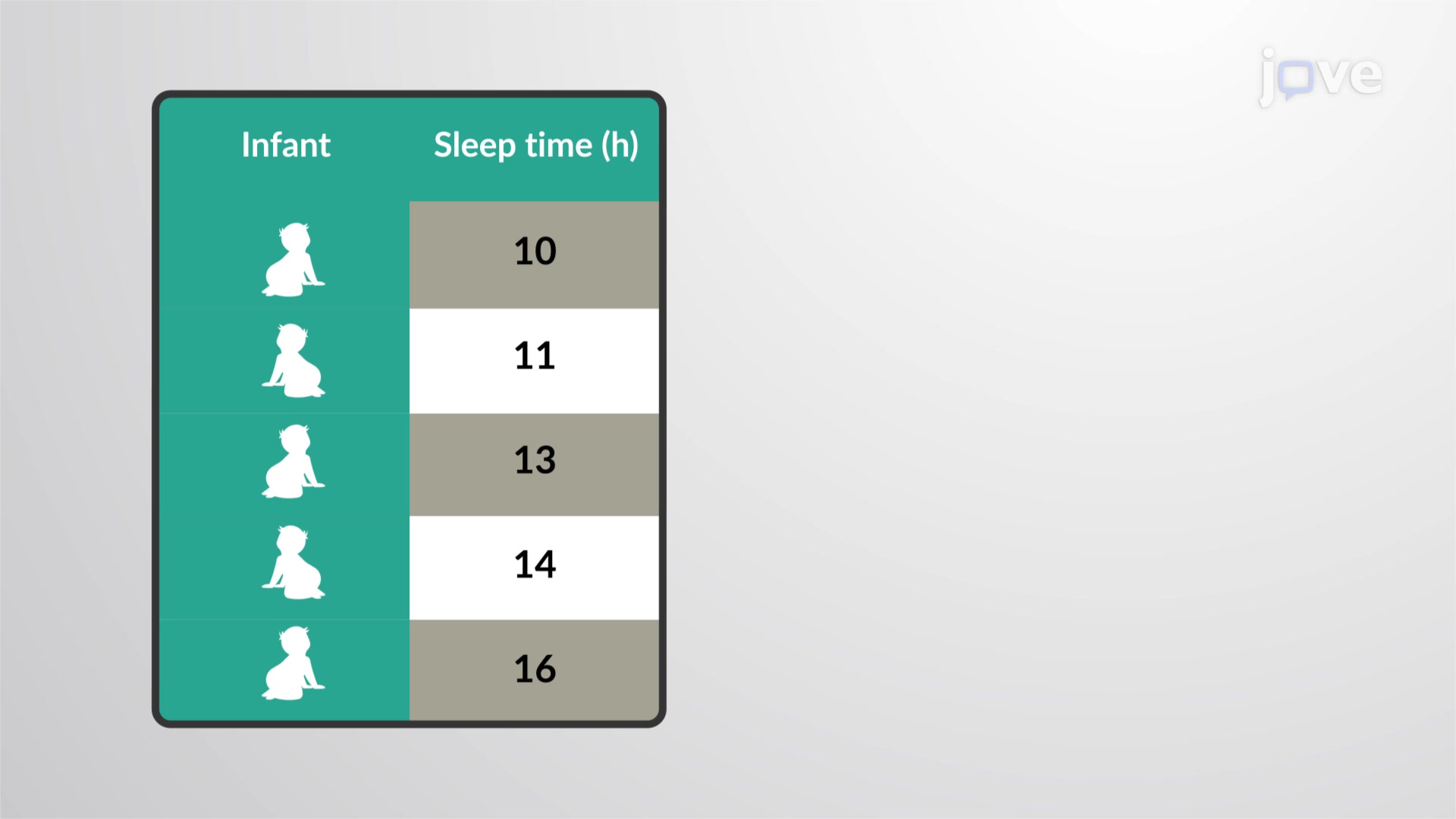
Ever wonder how statisticians find the center point between the highest and lowest SAT scores in your graduating class? The midrange provides a quick snapshot by averaging just the maximum and minimum values in any dataset. For example, if students in a US high school sleep between 5 and 10 hours nightly, the midrange would be 7.5 hours. Watch the full video on JoVE Coach to master this concept with expert-led visuals and step-by-step explanations.
The midrange represents one of the simplest measures of central tendency, calculated as the arithmetic mean of a dataset's maximum and minimum values. Unlike the mean, which considers every data point, or the median, which focuses on positional values, midrange provides a quick estimate of the center using only the two extreme values.
The midrange formula is straightforward: Midrange = (Maximum Value + Minimum Value) ÷ 2. Consider SAT scores from a sample of US students ranging from 950 to 1450. The midrange would be (1450 + 950) ÷ 2 = 1200. This calculation takes seconds compared to finding the mean of hundreds of individual scores, making it useful for rapid preliminary analysis.
While computationally simple, midrange has significant limitations that restrict its use in serious statistical analysis. It completely ignores all intermediate values, potentially misrepresenting the data's true center. For instance, if most students scored between 1100-1200 on the SAT, but one student scored 950, the midrange would be artificially lowered despite the majority clustering at higher scores. This sensitivity to outliers makes midrange unreliable for datasets with extreme values.
In AP Statistics and college-level courses, students encounter midrange primarily as an introductory concept before learning more robust measures. Healthcare professionals might use it for quick temperature range assessments, while business analysts could apply it for preliminary market research. However, standardized tests like the SAT, ACT, and college placement exams rarely test midrange calculations, focusing instead on mean, median, and mode.
Midrange pairs naturally with range (the difference between maximum and minimum values). Knowing both measures allows reconstruction of the extreme values: if midrange equals 75 and range equals 30, the maximum is 90 and minimum is 60. This relationship proves useful in reverse-engineering datasets and understanding data spread in conjunction with central tendency.
Frequently Asked Questions
Midrange is the average of a dataset's maximum and minimum values, calculated as (max + min) ÷ 2. Unlike mean, which uses all data points, or median, which finds the middle value, midrange only considers the two extreme values, making it less representative of the overall data distribution.
AP Statistics exams rarely test midrange calculations directly, instead focusing on mean, median, and mode. College statistics courses typically introduce midrange as a basic concept before moving to more robust measures. When it appears on exams, it's usually in comparison questions about central tendency measures.
SAT math sections occasionally include midrange problems within data analysis questions, typically asking students to find missing values when given the midrange and range. These problems test understanding of the relationship between extreme values and central tendency measures.
Weather services use midrange for quick daily temperature summaries, averaging the day's high and low temperatures. For example, if Phoenix reaches 105°F and drops to 75°F, the midrange of 90°F gives a rough sense of the day's overall temperature, though it ignores fluctuations throughout the day.
Midrange is one of the easiest statistical concepts to master, requiring only basic addition and division skills taught in elementary school. Students typically grasp the concept within minutes, making it an excellent introduction to statistical thinking before tackling more complex measures.
Remember midrange as the "middle of the extremes" - simply add the highest and lowest values, then divide by 2. Create the mental image of a seesaw balanced at its midpoint between the heaviest and lightest weights to visualize this concept during test situations.
Students should progress to mean, median, and mode, followed by measures of variability like standard deviation and variance. Understanding midrange's limitations prepares students to appreciate why statisticians prefer more comprehensive measures that account for all data points rather than just extremes.
Related Micro-courses


Related Subjects
 Physics 33 micro-courses›
 Math Fundamentals 11 micro-courses›