Loading subject page…

1,121 views

Video Summary: What Is Viscosity
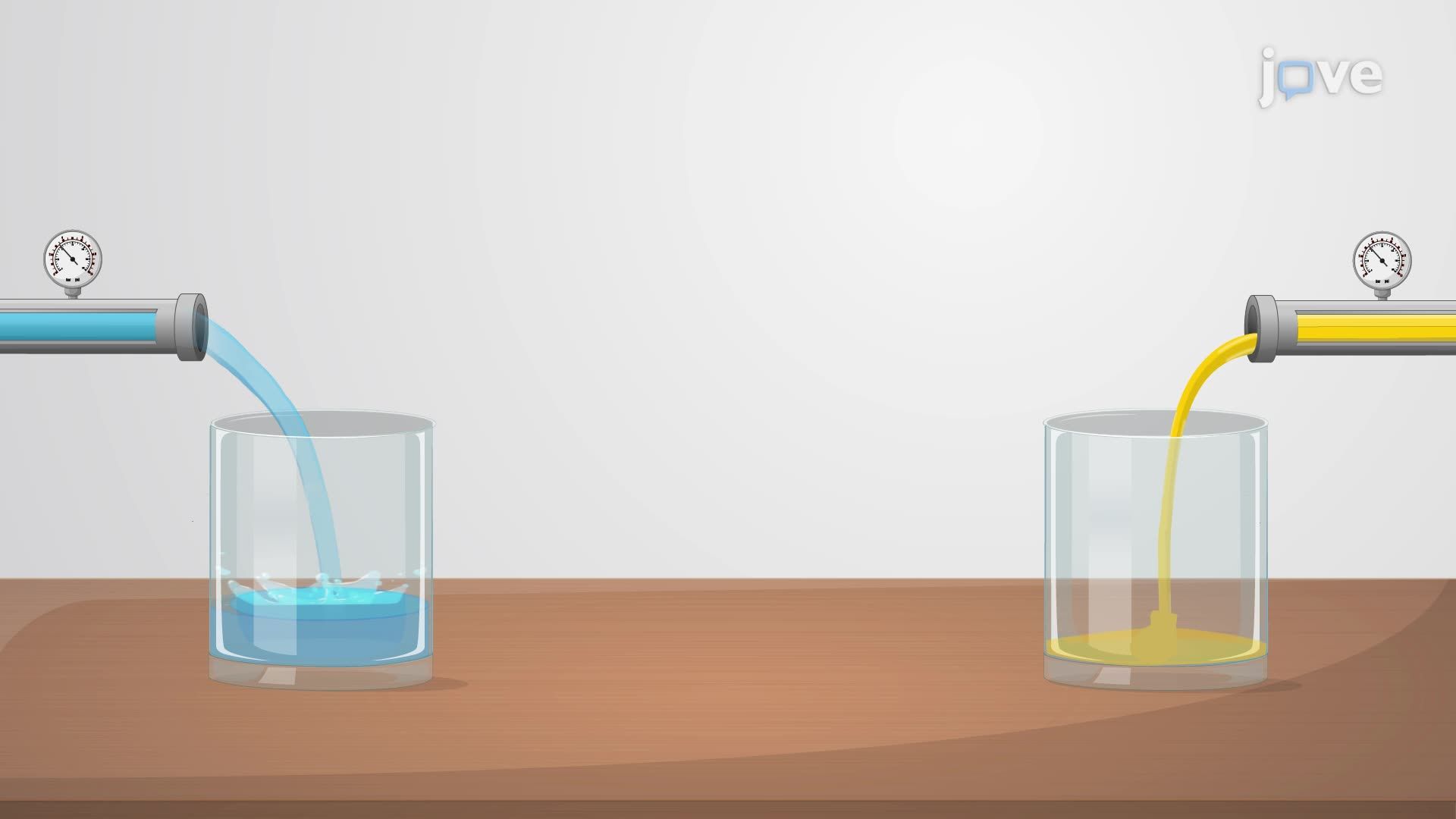
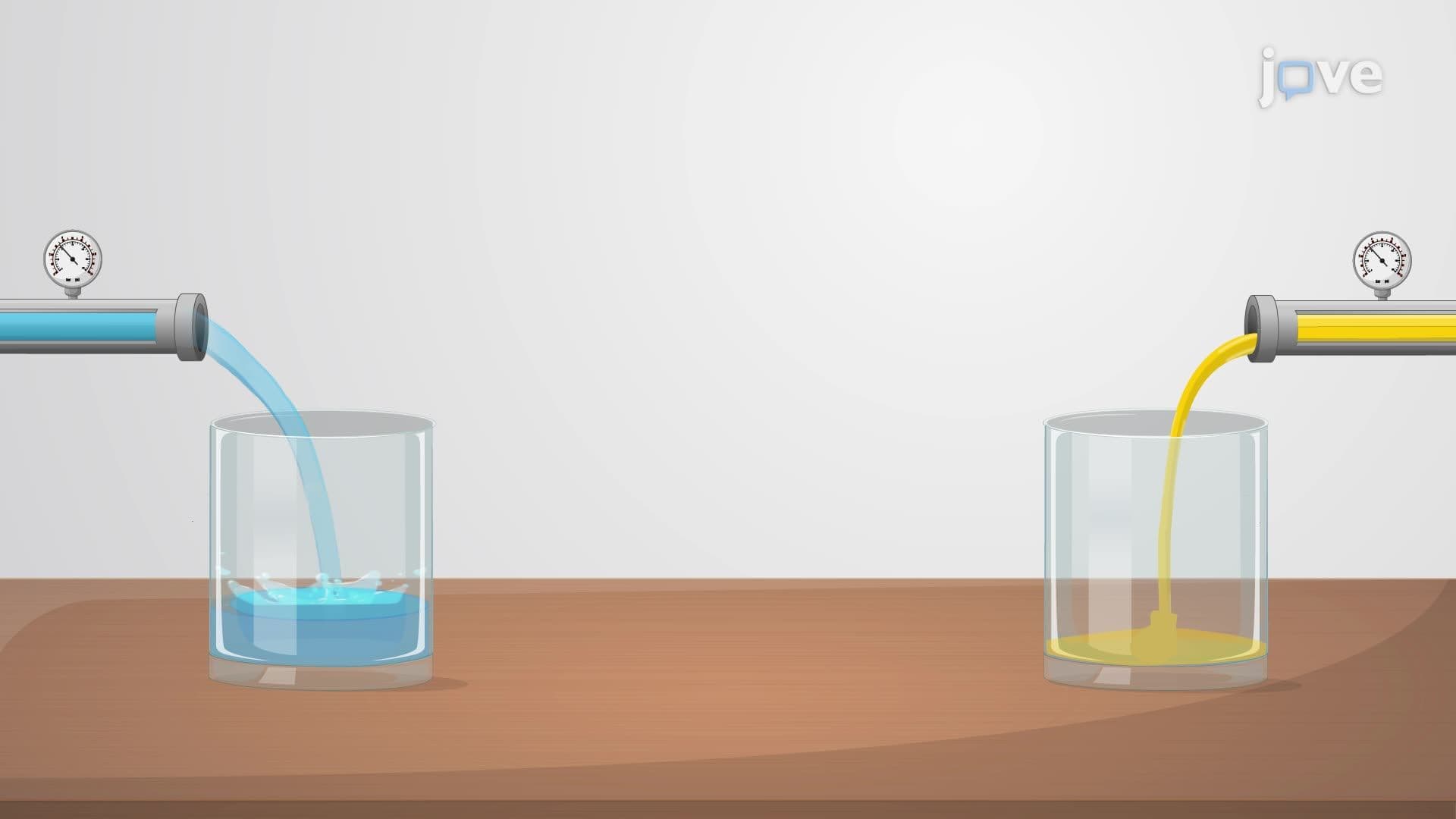
Why does honey pour so slowly while water flows instantly? That difference comes down to viscosity, the internal resistance to flow in a fluid. Understanding viscosity basics explains everything from how blood moves through arteries in a hospital setting to how engineers design fuel pipelines across the US. Watch the full video on JoVE Coach to master this concept with expert-led visuals and step-by-step explanations.
Viscosity is defined as a fluid's internal resistance to flow, essentially, the "thickness" or stickiness that determines how easily one layer of fluid slides past another. Think of the difference between pouring maple syrup and pouring water at your breakfast table. The syrup resists flow because its molecules interact strongly with each other, creating friction between adjacent layers. This internal friction is what scientists and engineers call viscosity.
At the molecular level, viscosity arises from intermolecular forces between neighboring fluid layers moving at different speeds. When a fluid moves through a pipe, the layer touching the pipe wall is essentially stationary, while layers toward the center move progressively faster. This creates a velocity gradient, a smooth change in speed across the fluid's cross-section. Maintaining this gradient requires an applied external force. According to Newton's Law of Viscosity, that force is directly proportional to both the contact area and the velocity gradient. The proportionality constant in this relationship is the coefficient of viscosity (often symbolized as η, or "eta"), measured in Pascal-seconds (Pa·s) in SI units. Fluids that follow this relationship are called Newtonian fluids, water and most simple liquids qualify, while substances like ketchup or blood plasma do not always behave this way.
Two external conditions dramatically affect viscosity and are frequently tested in US science courses:
The Reynolds number (Re) is a dimensionless value that predicts whether flow will be smooth or chaotic. It represents the ratio of inertial forces to viscous forces in a moving fluid. A high Reynolds number (typically Re > 4000) signals turbulent flow, where inertial forces dominate and fluid moves in irregular, swirling patterns. A low Reynolds number (Re < 2100) indicates laminar flow, where viscous forces keep fluid moving in smooth, parallel layers.
When flow is laminar, the volume of fluid passing through a pipe can be calculated using Poiseuille's equation:
V = [π × R⁴ × (P1 − P2) × t] / (8 × η × L)
Where R is pipe radius, P1 and P2 are inlet and outlet pressures, t is time, η is viscosity, and L is pipe length. Notice that radius has a fourth-power relationship, doubling a pipe's radius increases flow volume by a factor of 16. This principle is critical in medicine: a physician treating a patient with narrowed arteries at a US hospital understands that even small decreases in vessel radius dramatically reduce blood flow.
On the AP Physics 2 exam and in college-level general chemistry or physics courses, viscosity problems commonly involve identifying flow type using Reynolds numbers, applying Poiseuille's equation, or predicting how changing temperature affects fluid behavior. Pre-med students preparing for the MCAT encounter viscosity in the context of cardiovascular physiology and fluid dynamics passages. Mastering these relationships, not just memorizing formulas, is what earns points on exam day.
Related Micro-courses