Loading video…


 8 Concepts
 85 views

Video Summary: Integration Applied to Polar Coordinates to Find Arc Lengths Explained
Did you know that search-and-rescue drone operators must calculate exact flight paths to avoid running out of battery mid-mission? Integration applied to polar coordinates to find arc lengths, also called arc length in polar coordinates, makes this possible. When a drone spirals outward from a hiker's last known location in a US national forest, calculus determines the total distance traveled. Watch the full video on JoVE Coach to master this concept with expert-led visuals and step-by-step explanations.
Most students first encounter arc length in a rectangular (Cartesian) setting, but many real-world paths, spirals, circles, rose curves, are described far more naturally in polar coordinates. Integration applied to polar coordinates to find arc lengths is the technique that lets you measure the total distance along any such curve using a definite integral. This method appears in AP Calculus BC, college-level Calculus II courses across the US, and has direct applications in physics, engineering, and navigation.
The starting point is the relationship between polar and rectangular coordinates:
Here, r is the radial distance from the origin (the pole), and θ is the angle measured counterclockwise from the positive x-axis. When r itself is a function of θ, written r(θ), both x and y become functions of θ as well. This transforms the curve into something resembling a parametric equation, where θ plays the role of the parameter. Understanding how to convert from polar to rectangular coordinates is therefore the essential first step before deriving any arc length formula.
To find the total length of a polar curve from θ = a to θ = b, differentiate x and y with respect to θ using the product rule:
Square both expressions and add them together. When you expand and collect terms, the Pythagorean identity, sin²(θ) + cos²(θ) = 1, collapses the cross terms and trigonometric clutter into a dramatically simpler expression:
(dx/dθ)² + (dy/dθ)² = (dr/dθ)² + r²
The arc length formula then becomes:
L = integral from a to b of sqrt( r² + (dr/dθ)² ) dθ
This is the core result. Notice how elegantly the Pythagorean identity does the heavy lifting, a key insight that AP Calculus BC exam questions frequently test.
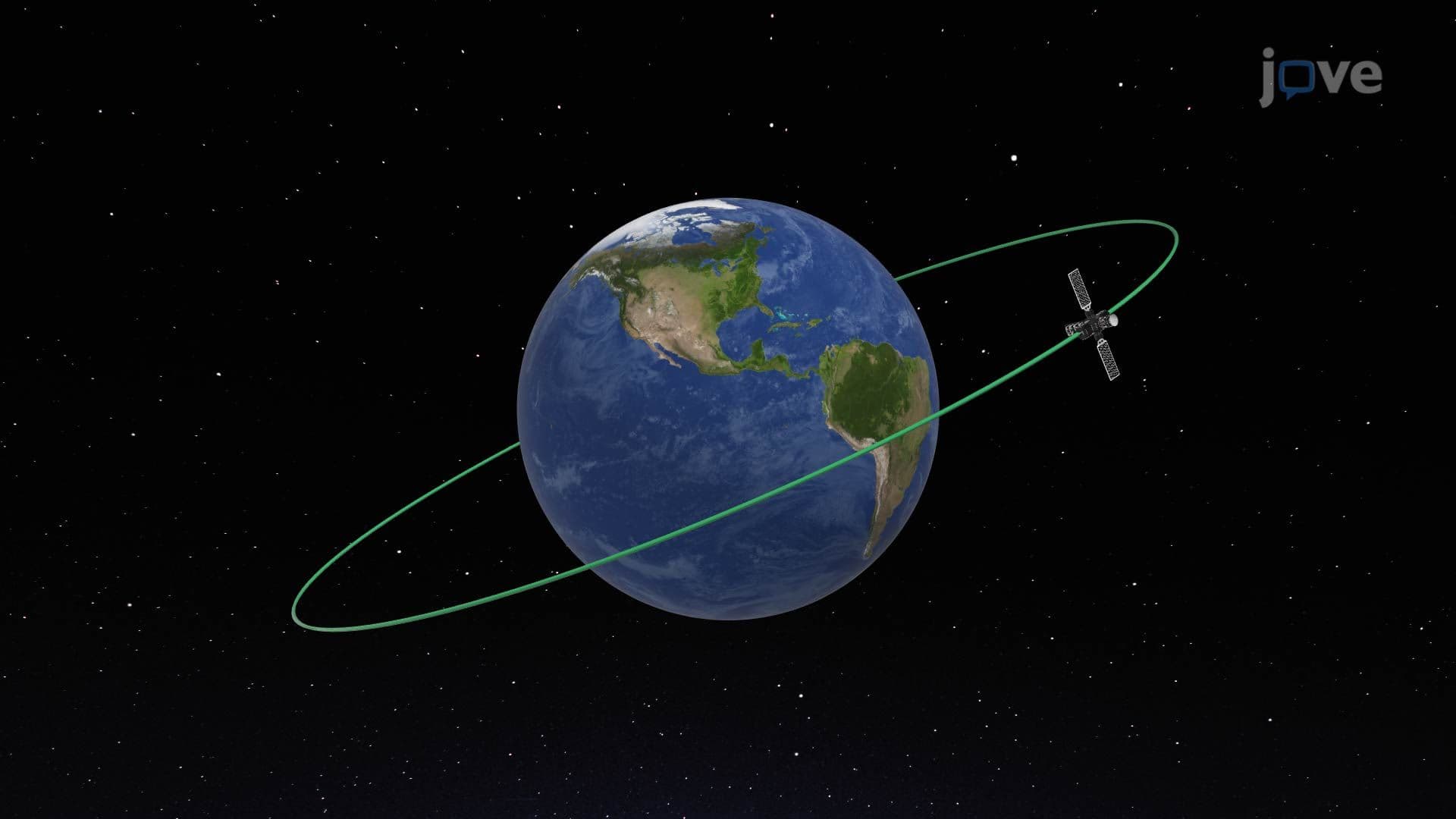
This formula is not abstract. NASA mission planners use polar arc length calculations when mapping satellite orbital paths. In the US Air Force and civilian search-and-rescue operations, drone flight software computes spiral coverage paths using exactly this kind of integral, ensuring the drone's battery capacity matches the mission's required range before takeoff. Radar systems that sweep in circular arcs also rely on polar coordinate geometry to calculate antenna travel distances. Graphing polar equations like the Archimedean spiral (r = aθ) gives a vivid visual for why a standard rectangular arc length formula would be nearly impossible to apply here, while the polar formula handles it cleanly.
Mastering this technique builds a strong bridge to several related ideas you'll encounter in Calculus II and beyond:
Understanding how these topics interconnect helps students approach exam problems with confidence and flexibility.
Related Micro-courses