Loading video…

 8 Concepts
 85 views

Video Summary: Surface Areas in Calculus with Parametric Curves
Ever wonder how engineers calculate the exact surface area of a rubber O-ring sealing a hydraulic system? Surface areas in calculus with parametric curves unlocks that answer. This concept, surface areas in calculus with parametric curves basics, involves rotating a parametric curve around an axis to create a 3D surface of revolution. The torus is a perfect real-world example. Watch the full video on JoVE Coach to master this concept with expert-led visuals and step-by-step explanations.
When a curve is described not by a single equation y = f(x) but by two separate functions, x(t) and y(t), it is called a parametric curve. The independent variable t, often thought of as time, ranges over an interval from alpha to beta. Parametric equations unlock the ability to describe complex paths, such as circles, spirals, and loops, that a standard Cartesian equation cannot cleanly capture. Calculus with parametric curves extends classical integration concepts, area, arc length, and surface area, into this richer framework.
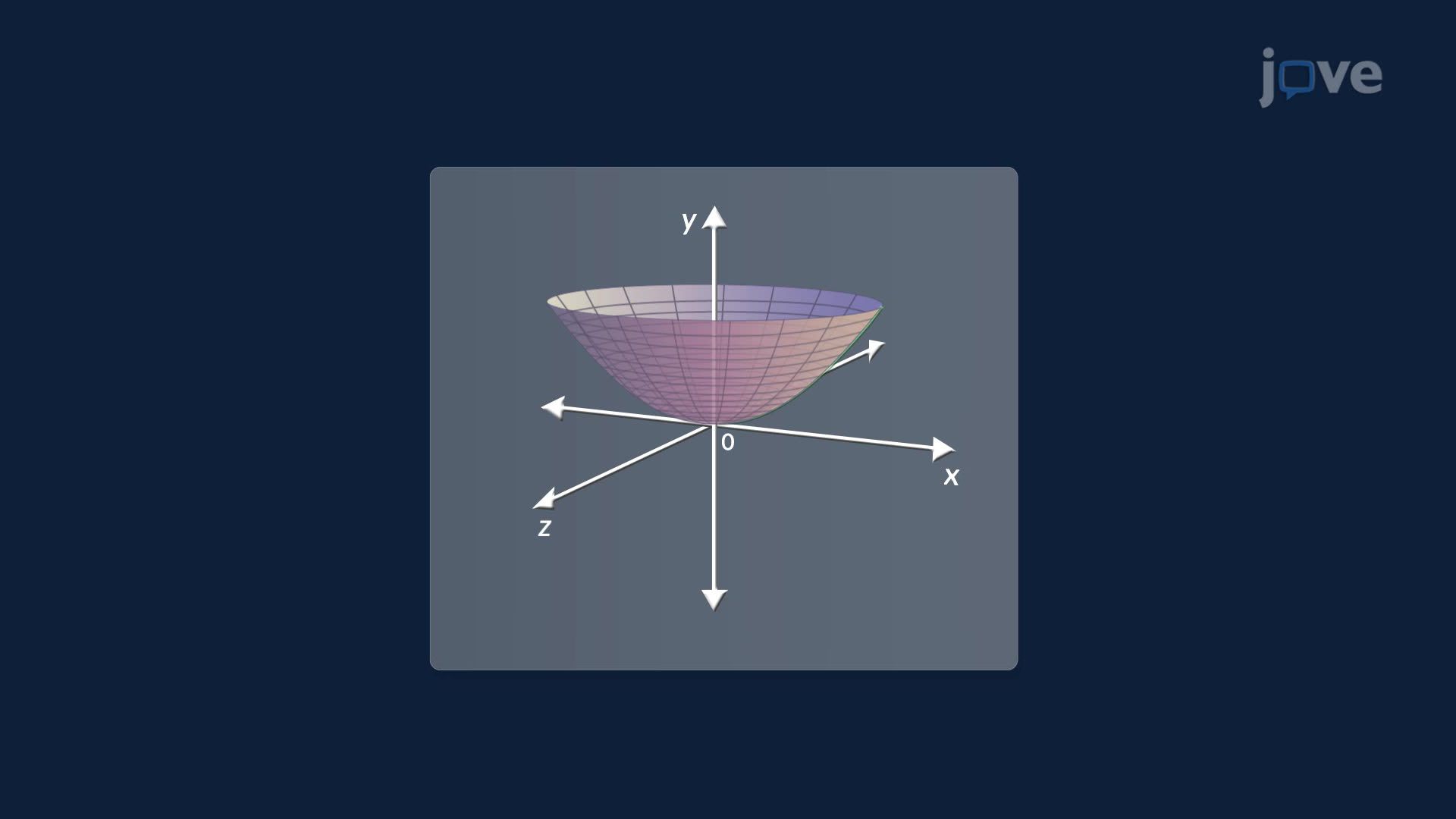
When a parametric curve is rotated around an axis, typically the x-axis or y-axis, every point on the curve traces a circular path. The collection of all those circles forms a smooth three-dimensional shell called a surface of revolution. The surface area of this shell depends on two things: how far each point sits from the axis of rotation, and how the curve bends and stretches along its length. This is where the arc-length differential becomes essential. For a parametric curve, the arc-length differential ds is given by ds = sqrt[(dx/dt)^2 + (dy/dt)^2] dt, which captures the true geometric length of an infinitesimal segment of the curve.
To find the total surface area, imagine slicing the surface into thin circular strips. Each strip's width equals ds, the arc-length differential. Each strip's circumference equals 2π times the distance from the axis of rotation, typically 2π·x(t) for rotation around the y-axis or 2π·y(t) for rotation around the x-axis. Multiplying these two quantities gives the differential surface area element: dS = 2π·r(t) · sqrt[(dx/dt)^2 + (dy/dt)^2] dt. Integrating dS from t = alpha to t = beta yields the total surface area in parametric form. This setup mirrors how AP Calculus BC exam problems are structured, where students must correctly identify the axis of rotation, set up the integrand, and evaluate, often using substitution or numerical methods.
A torus, the donut-shaped solid familiar in US math competitions and engineering courses, provides an ideal case study. A circle of radius r, centered at distance R from the y-axis, is parameterized as x(t) = R + r·cos(t) and y(t) = r·sin(t) for t in [0, 2π]. Rotating this circle around the y-axis sweeps out a torus. Applying the surface area formula and evaluating the integral yields a clean closed-form result: S = 4π²·R·r. This elegant answer is a staple in college Calculus II courses across US universities and demonstrates the power of parametric methods over Cartesian alternatives.
Beyond textbook problems, this concept has direct industrial relevance. O-rings, circular rubber seals used in everything from NASA rocket engines to everyday plumbing, are essentially cross-sections of a torus. Engineers at US aerospace firms and manufacturing plants calculate surface area precisely to determine contact pressure, material volume, and leak-prevention performance. On the academic side, surface areas via parametric curves appear regularly on AP Calculus BC free-response questions, college Calculus II midterms, and placement exams. Mastering the arc-length differential, correctly identifying the axis of rotation, and confidently setting up the definite integral are the three skills that separate strong performers from struggling students on these assessments.
Related Micro-courses