Loading video…


 16 Concepts
 10.9K views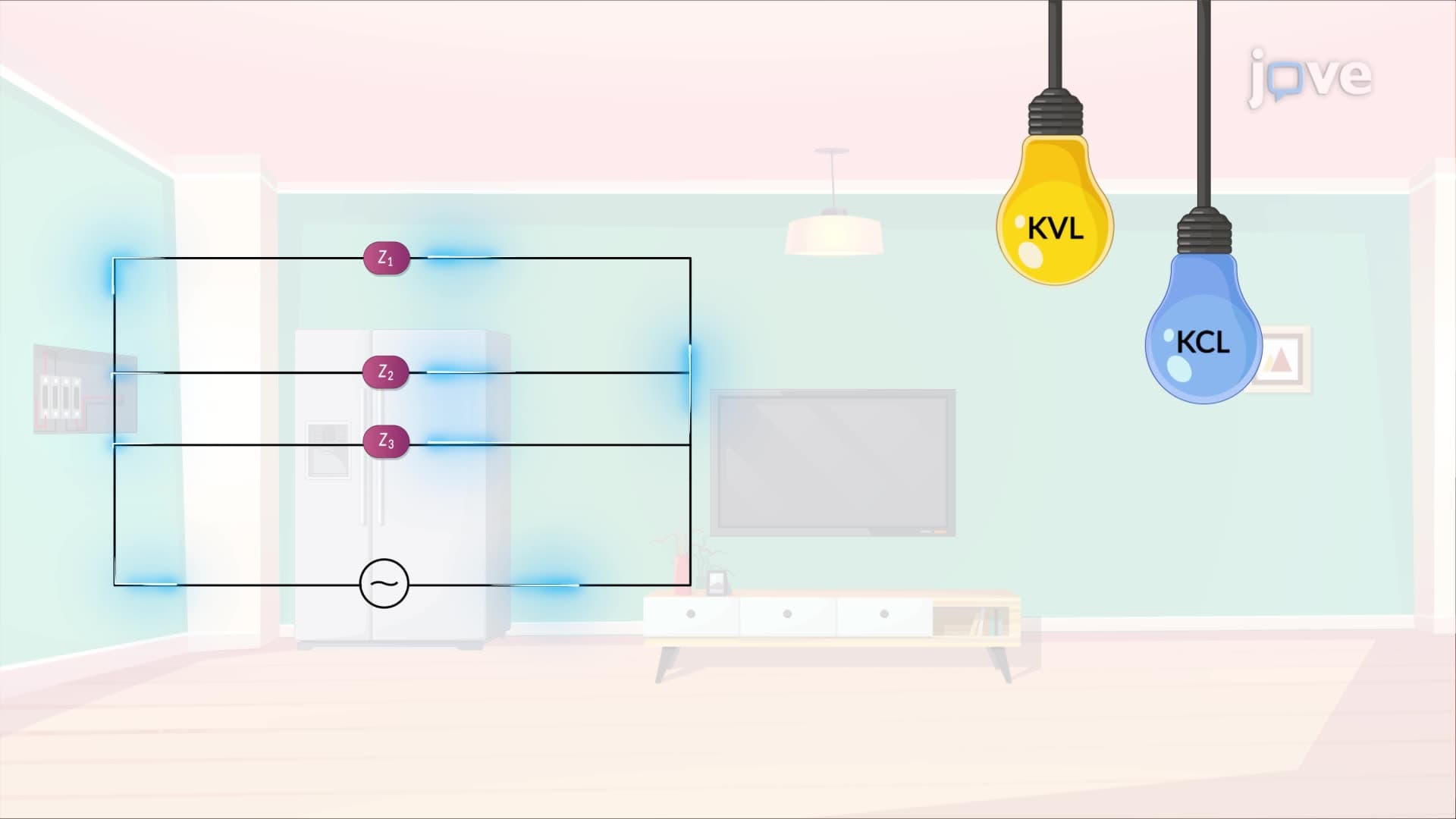

Video Summary: Kirchoffs Laws Using Phasors Explained
Ever wonder why your home's electrical circuits don't fail when you plug in multiple appliances simultaneously? Understanding impedances and admittance in AC circuits holds the key to this electrical engineering marvel. Kirchhoff's Laws Using Phasors Explained demonstrates how household circuits from your local power grid maintain stable operation through phasor analysis. This fundamental concept transforms complex AC circuit analysis into manageable mathematical relationships that govern everything from your smartphone charger to industrial power systems. Watch the full video on JoVE Coach to master this concept with expert-led visuals and step-by-step explanations.
Kirchhoff's laws form the cornerstone of electrical circuit analysis, and their application to AC circuits through phasor notation revolutionizes how engineers design and troubleshoot electrical systems. When Gustav Kirchhoff formulated these laws in 1845, he established fundamental principles that remain essential for understanding modern electrical engineering, from smartphone circuits to the US power grid.
Impedances and admittance represent the AC equivalents of resistance in DC circuits, but with added complexity due to reactive components. Impedance (Z) combines resistance and reactance into a single complex quantity, measured in ohms, while admittance (Y) serves as impedance's reciprocal, measured in siemens. The impedances and admittance definition encompasses how AC circuits respond to sinusoidal voltages and currents, accounting for both magnitude and phase relationships.
In practical terms, when you plug an air conditioner into your home outlet, the unit presents both resistive and reactive impedance to the circuit. The resistive component converts electrical energy to cooling work, while the reactive component stores and releases energy in the motor's magnetic fields. Understanding what is impedances and admittance in detail helps explain why some appliances draw different current patterns despite similar power ratings.
The impedances and admittance concept becomes crucial when analyzing complex systems like hospital electrical networks or university campus power distribution. Engineers use phasor analysis to ensure that when multiple MRI machines operate simultaneously at a medical center, the electrical system maintains stability and efficiency.
Students preparing for the AP Physics exam or college electrical engineering courses encounter these concepts in both theoretical problems and laboratory experiments. The impedances and admittance study guide approach typically progresses from simple resistive circuits to complex networks involving capacitors and inductors, building understanding systematically.
Kirchhoff's Voltage Law in phasor form states that the algebraic sum of phasor voltages around any closed loop equals zero: ΣV(phasor) = 0. Similarly, Kirchhoff's Current Law requires that phasor currents entering and leaving any node sum to zero: ΣI(phasor) = 0.
This mathematical framework enables engineers to design everything from the electrical systems in Tesla manufacturing plants to the power distribution networks serving major US cities. The impedances and admittance basics provide the foundation for advanced topics like power factor correction and harmonic analysis, essential skills for electrical engineering professionals.
Related Micro-courses