Loading video…


 20 Concepts
 25.8K views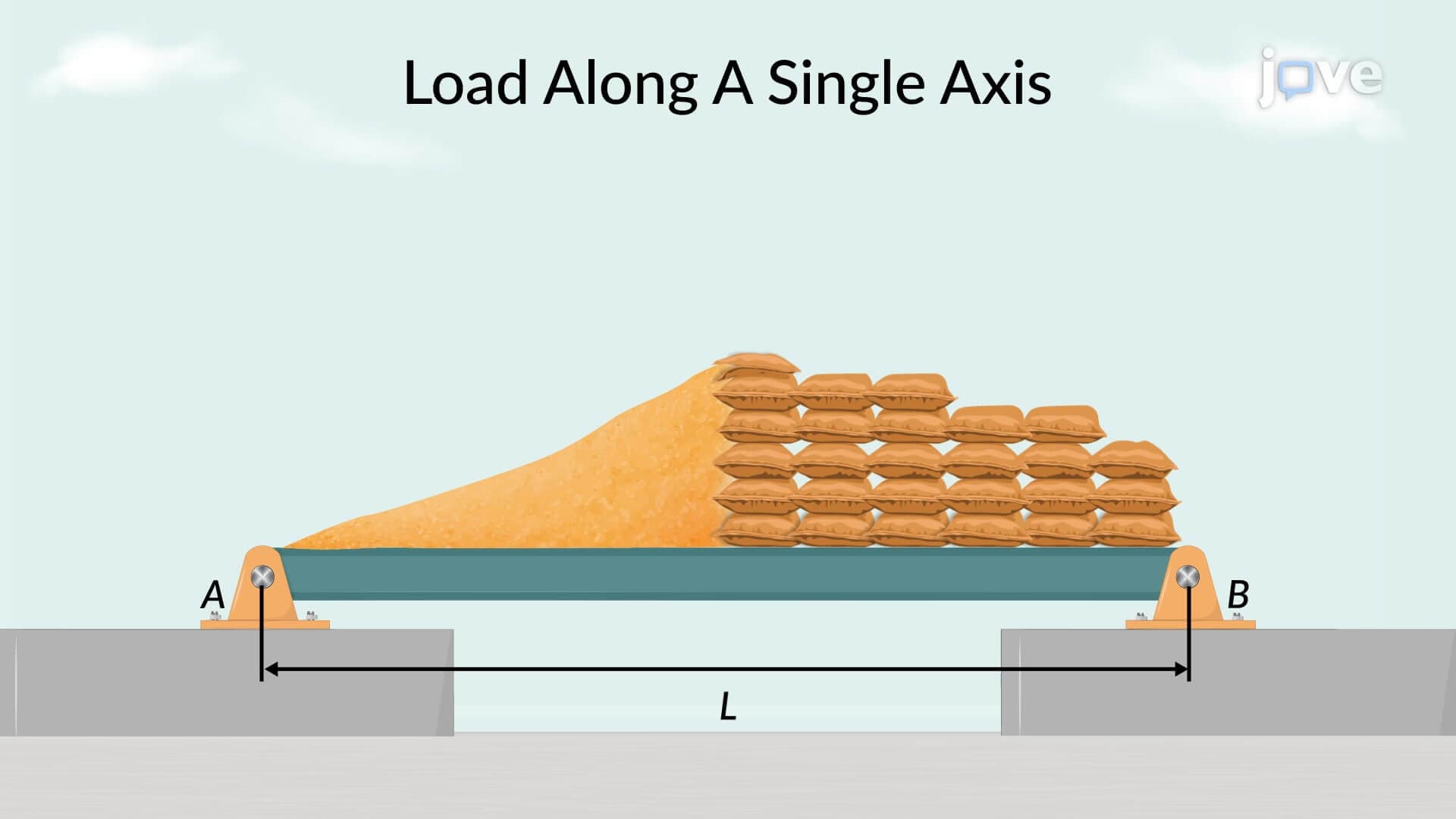

Video Summary: Load Along a Single Axis Explained
Ever wonder how engineers ensure the Brooklyn Bridge can safely carry thousands of cars daily? Understanding load along a single axis is crucial for analyzing how forces distribute across structural beams and supports. When forces vary along a beam's length-like traffic weight changing from one end of a bridge span to the other-engineers must calculate both the total load magnitude and its precise location to prevent structural failure. Load Along A Single Axis Explained demonstrates how parabolic and trapezoidal load distributions combine to create complex loading scenarios that real structures experience. Watch the full video on JoVE Coach to master this concept with expert-led visuals and step-by-step explanations.
Load along a single axis represents one of the most fundamental concepts in structural and mechanical engineering. When forces distribute continuously along a beam, column, or shaft, engineers cannot simply add up the magnitudes-they must also determine where the equivalent resultant force acts. This concept appears frequently in AP Physics C, college-level statics courses, and professional engineering licensing exams like the Fundamentals of Engineering (FE) exam.
Parabolic loading patterns occur naturally in many engineering scenarios. Consider a cantilever beam supporting a triangular distributed load from wind pressure on a building facade, or a diving board experiencing varying human weight distribution. To analyze parabolic loads, engineers use integration to sum infinitesimal force elements dR over differential lengths dx.
The mathematical approach involves setting up the integral: R = ∫(load function)dx over the beam length L. The resultant magnitude equals the area under the parabolic curve, while the centroid location determines where this equivalent point load acts. For a standard parabolic distribution y = kx², the centroid lies at 3L/4 from the origin, a relationship that appears consistently on engineering mechanics exams.
Trapezoidal loads frequently represent real-world loading conditions, such as snow accumulation on sloped roofs or hydrostatic pressure variations in retaining walls. The key insight involves decomposing trapezoidal areas into simpler rectangular and triangular components, each with known centroid locations.
For rectangular components, the centroid always sits at the geometric center (L/2 from either end). Triangular components have centroids located at L/3 from the base vertex. This decomposition strategy simplifies complex calculations and appears as a standard problem-solving technique in college statics textbooks and PE exam preparation materials.
Real structures rarely experience single load types. Highway bridge girders simultaneously carry uniform dead loads (rectangular distribution) and varying live loads (potentially parabolic from traffic patterns). Nuclear reactor pressure vessels experience combined thermal and mechanical loading that creates complex distribution patterns.
The superposition principle allows engineers to analyze each load component separately, then combine results using moment balance equations. This approach proves essential for ABET-accredited engineering programs and professional practice, where safety factors and load combinations follow American Society of Civil Engineers (ASCE) and American Institute of Steel Construction (AISC) standards.
Related Micro-courses