Loading video…


 20 Concepts
 25.8K views

Video Summary: What are Distributed Loads
Ever wonder why bridge engineers don't just calculate the weight of a single car, but instead consider traffic spread across the entire span? Distributed loads represent forces spread over an area or length rather than concentrated at a single point. From snow accumulating on a roof in Colorado to water pressure against the Hoover Dam, these loads create varying pressures measured in Pascals across surfaces. Understanding distributed loads is crucial for analyzing real-world engineering scenarios where forces aren't simply point loads. Watch the full video on JoVE Coach to master this concept with expert-led visuals and step-by-step explanations.
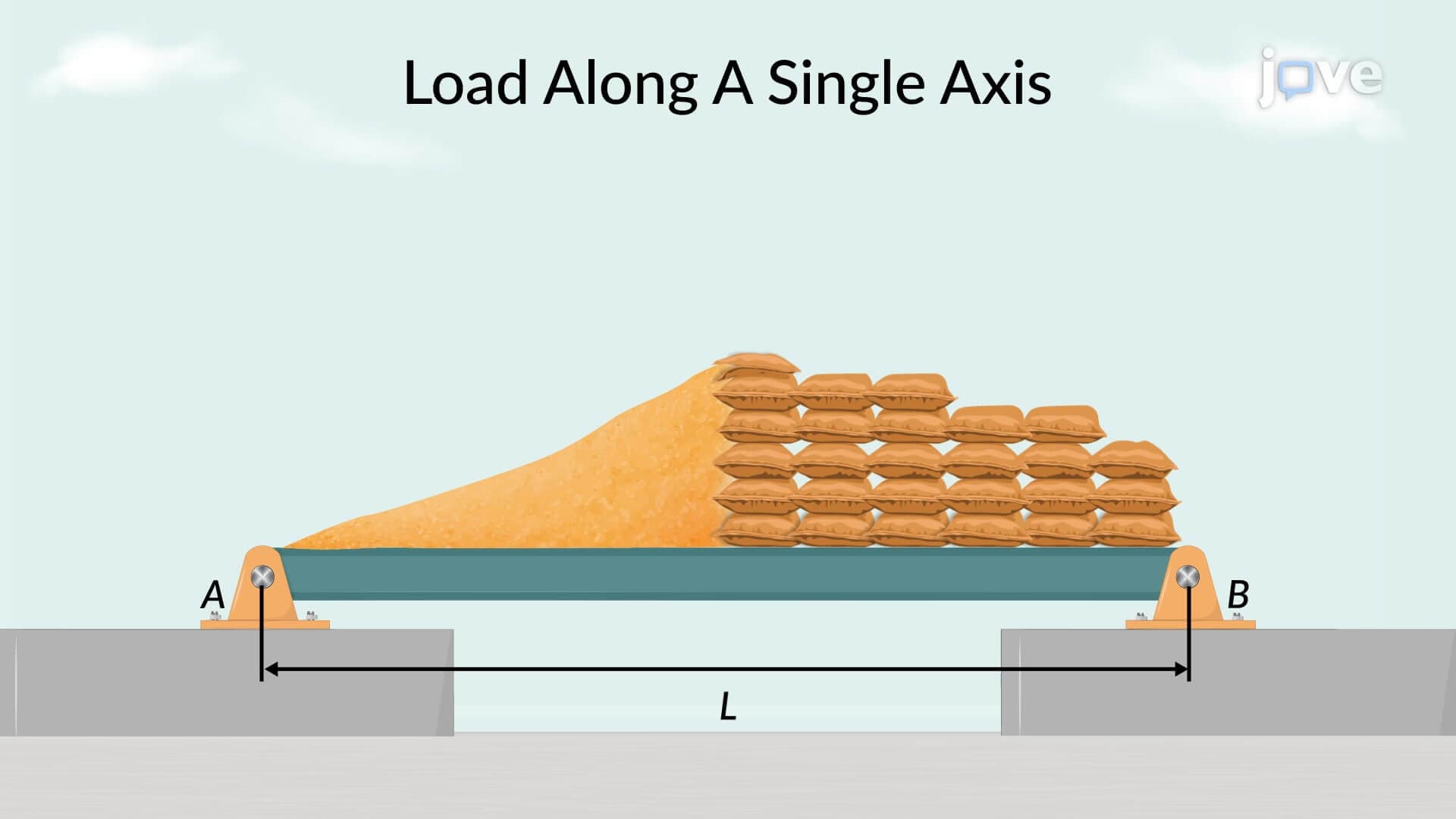
Distributed loads represent one of the most fundamental concepts in structural and mechanical engineering, describing forces that spread across an area or length rather than acting at a single point. Unlike concentrated loads that apply force at specific locations, distributed loads create varying pressure patterns across surfaces, measured in force per unit area (Pascals or pounds per square inch).
Engineers encounter several types of distributed loads in practice. Uniform distributed loads maintain constant intensity across the loaded area, such as snow uniformly covering a building roof in Minnesota. Variable distributed loads change intensity across the surface, like wind pressure on a skyscraper's facade in Chicago, where pressure increases with height. Triangular distributed loads often appear in fluid pressure applications, such as water pressure against the concrete face of California's Oroville Dam, where pressure increases linearly with depth.
The mathematical foundation of distributed loads involves integration to determine total forces and their points of application. For a distributed load function w(x), the total force equals the area under the load curve: F = ∫w(x)dx. This integration concept frequently appears on AP Physics C and college-level statics exams. The center of pressure represents where the resultant force acts, calculated using the centroid of the load distribution area. Understanding this concept proves essential for analyzing structures like the concrete arch of Arizona's Glen Canyon Dam, where engineers must precisely locate where water pressure forces act.
Distributed loads appear throughout American infrastructure. Highway bridge designers consider traffic loads distributed across bridge decks, following American Association of State Highway and Transportation Officials (AASHTO) standards. Building codes mandate analyzing distributed wind and seismic loads for structures in hurricane-prone Florida or earthquake-active California. These applications directly connect to coursework in civil engineering programs at institutions like MIT, Stanford, and the University of Texas at Austin, where students learn to model complex loading scenarios using distributed load principles.
Related Micro-courses