Loading video…


 17 Concepts
 21.8K views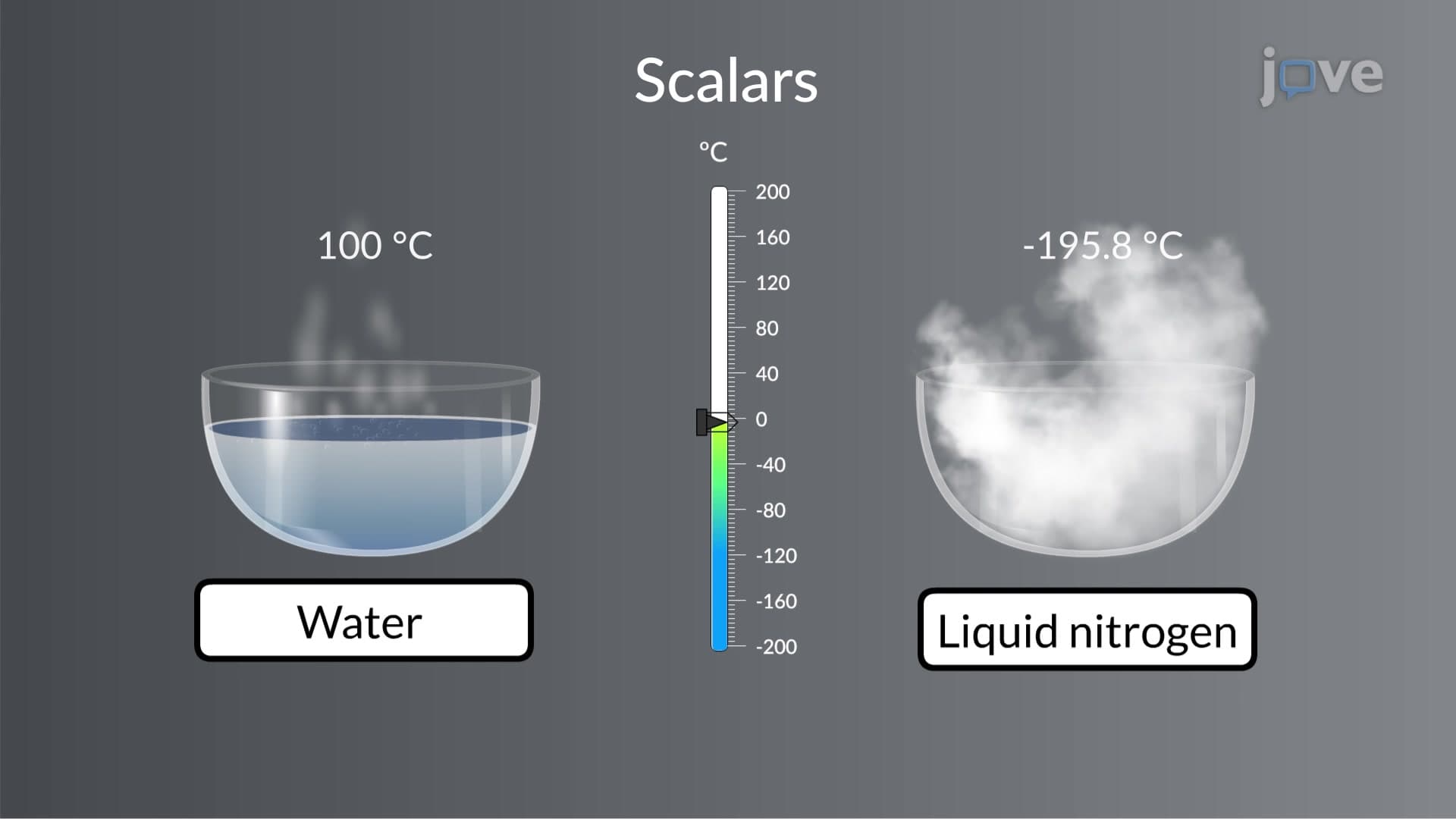

Video Summary: What are Scalar and Vectors
Did you know that when NASA tracks a spacecraft's journey to Mars, they must distinguish between how fast it's traveling and which direction it's heading? This fundamental difference between scalar and vectors forms the backbone of physics and engineering mechanics. What are scalar and vectors? Scalars represent quantities with only magnitude (like the 240,000 miles between Earth and the Moon), while vectors possess both magnitude and direction (like a hurricane's 150 mph winds moving northeast). Watch the full video on JoVE Coach to master this concept with expert-led visuals and step-by-step explanations.
The distinction between scalar and vectors represents one of the most fundamental concepts in physics and engineering mechanics. This classification system helps scientists and engineers precisely describe physical phenomena, from the motion of satellites to the forces acting on bridges. Understanding this difference is crucial for success in AP Physics, college-level mechanics courses, and professional engineering applications.
Scalar quantities possess only magnitude-they answer "how much" but not "which way." These quantities are completely described by a numerical value paired with an appropriate unit. Common examples include temperature (75°F), mass (150 pounds), speed (60 mph), and energy (500 joules). In mathematical notation, scalars appear as regular italicized letters or plain numbers.
Consider practical applications: when you check your car's speedometer reading 65 mph on Interstate 95, you're observing a scalar quantity. The measurement tells you the magnitude of your motion but reveals nothing about whether you're traveling north toward Boston or south toward Miami. Similarly, when meteorologists report that Miami reached 85°F yesterday, temperature serves as a perfect scalar example-it has magnitude but no directional component.
Vector quantities require both magnitude and direction for complete description. These measurements answer both "how much" and "which way," making them essential for describing motion, forces, and fields. Vectors appear in mathematical notation as bold letters (like F) or with arrows above them (F⃗), while their magnitudes use italicized letters (F).
The types of scalar and vectors become clearer through motion analysis. When describing an airplane's journey from New York to Los Angeles, displacement represents a vector quantity-approximately 2,450 miles in a southwest direction. The velocity vector might show 500 mph at 245° from due north. Meanwhile, the scalar distance traveled could exceed 2,450 miles if the flight path wasn't perfectly direct, and the scalar speed represents instantaneous magnitude without directional information.
This scalar and vectors overview extends far beyond theoretical physics. Civil engineers use vector analysis when calculating forces on suspension bridges like San Francisco's Golden Gate Bridge. The weight of each cable segment creates downward force vectors, while tension forces act along the cable's direction. GPS navigation systems process position vectors to calculate your location within meters, while acceleration vectors help stability control systems in modern vehicles prevent skidding during emergency braking.
For students preparing for standardized exams, this scalar and vectors concept appears frequently in AP Physics problems, SAT Subject Tests, and college entrance exams. MCAT questions often test vector addition in biomechanics contexts, while engineering entrance exams emphasize vector resolution and component analysis. Mastering these fundamentals provides the foundation for advanced topics including electromagnetic fields, fluid dynamics, and quantum mechanics.
Related Micro-courses