Loading video…


 17 Concepts
 17K views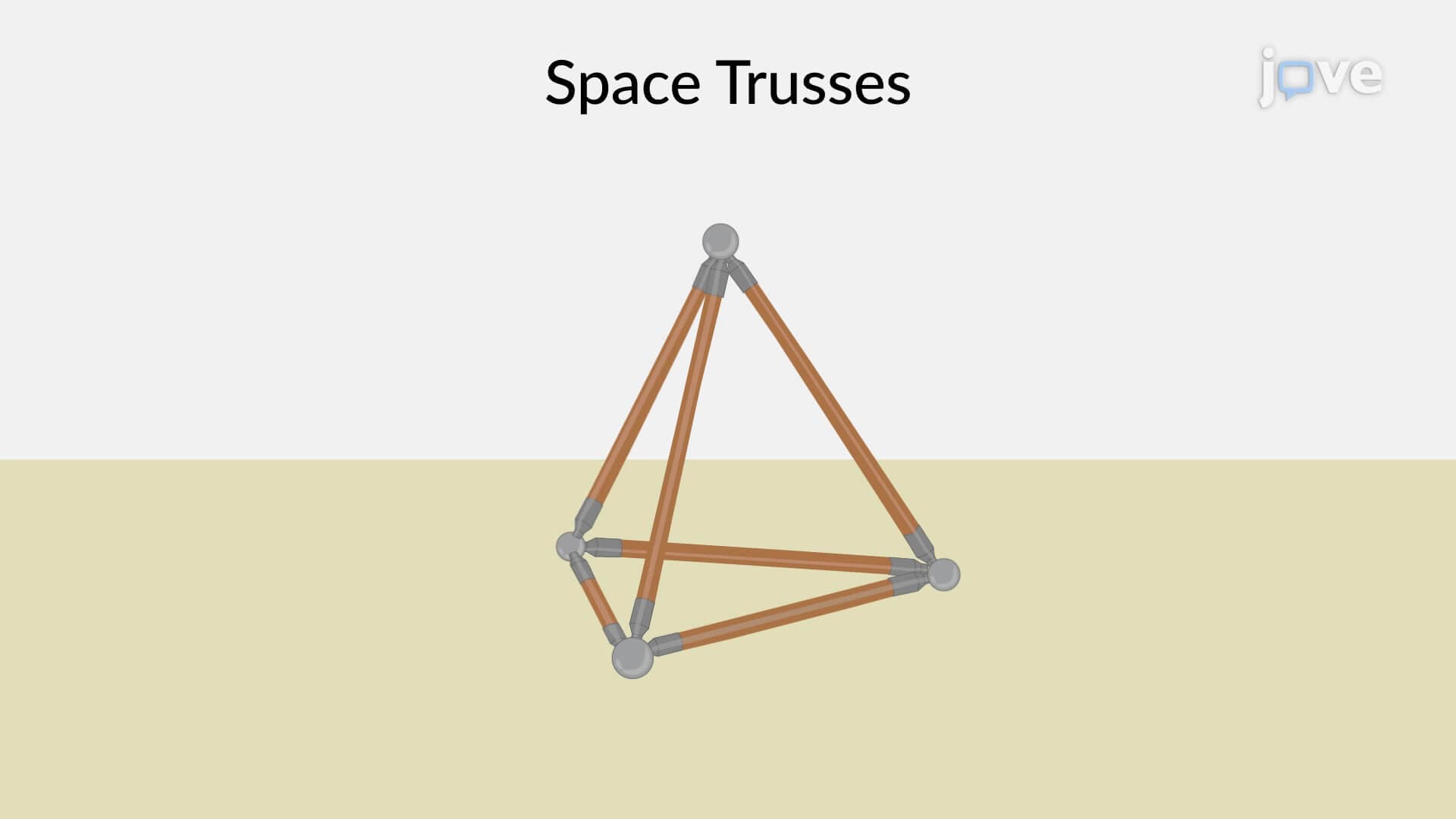

Video Summary: What are Space Trusses
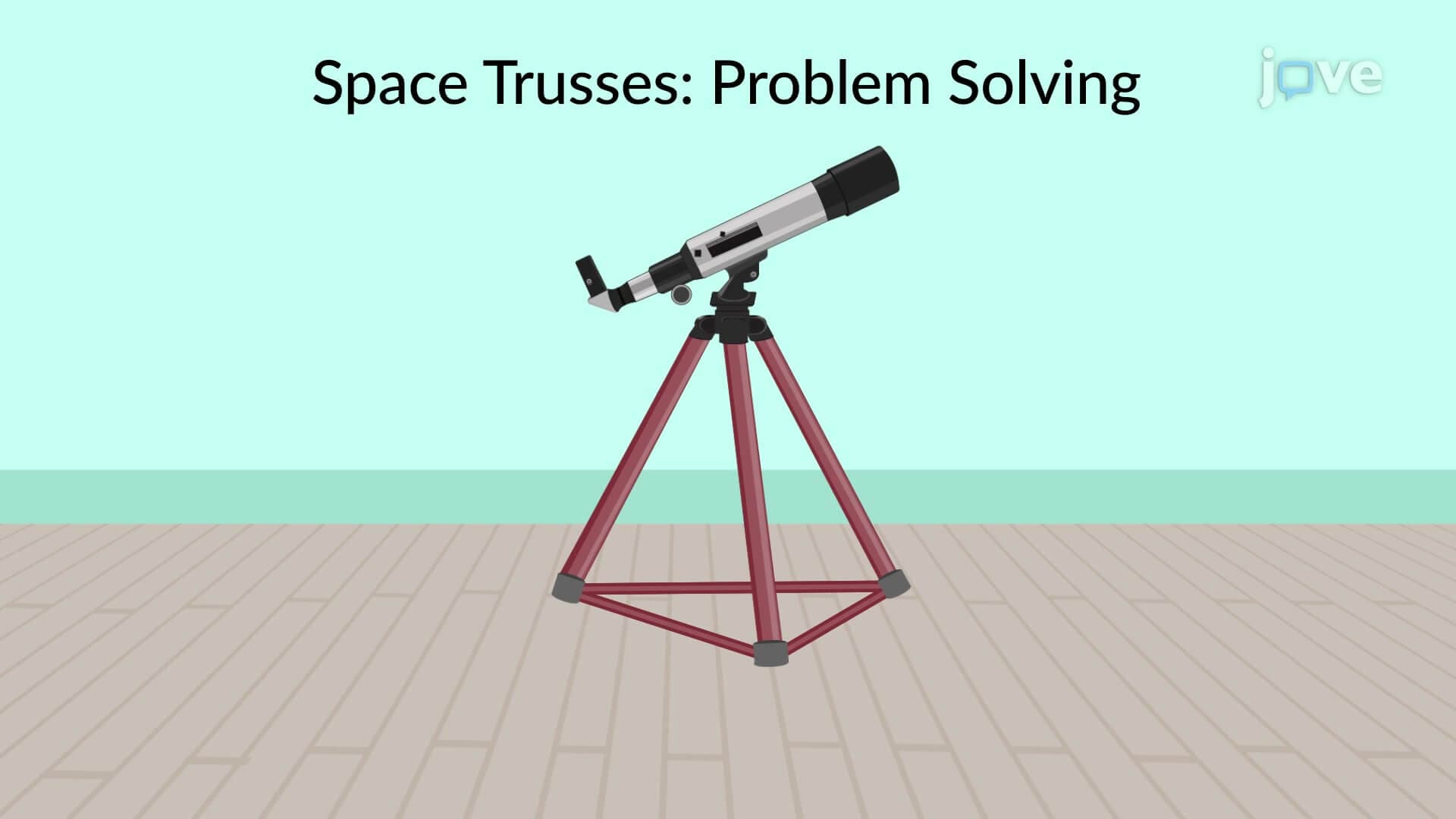
Ever wonder how massive stadium roofs like AT&T Stadium in Dallas support thousands of tons without collapsing? Space trusses make this engineering marvel possible through their three-dimensional framework design. These sophisticated structural systems extend beyond traditional flat trusses by connecting members in all three dimensions, creating incredibly strong and lightweight frameworks. The fundamental building block is a tetrahedron with six interconnected members that can expand into complex networks. Watch the full video on JoVE Coach to master this concept with expert-led visuals and step-by-step explanations.
Space trusses represent a significant advancement in structural engineering, extending the principles of traditional planar trusses into three-dimensional space. Unlike their two-dimensional counterparts that operate within a single plane, space trusses utilize members connected in all three spatial dimensions to create exceptionally strong and efficient structural frameworks. This three-dimensional approach allows engineers to distribute loads more effectively while minimizing material usage-a crucial consideration in modern construction economics.
The foundation of all space trusses lies in the tetrahedral unit, a three-dimensional structure composed of four joints connected by six members. This geometric configuration provides inherent stability in all directions, making it impossible for the structure to collapse under typical loading conditions. Engineers can expand these basic units by systematically adding joints and members, creating networks of interconnected tetrahedrons that form complex space truss systems.
Common types of space trusses include space frames used in airport terminals like Denver International Airport, tower structures supporting communication equipment, and roof systems spanning large areas without interior columns. Each type serves specific engineering requirements while maintaining the fundamental principles of three-dimensional load distribution.
Space truss analysis relies heavily on the two-force member assumption, which simplifies calculations significantly. For this assumption to remain valid, external loads must be applied exclusively at joints (typically ball-and-socket connections), and member weights must be negligible compared to applied loads. When member weight becomes significant-common in large-scale structures-engineers apply half the member's weight as vertical forces at each end, maintaining the two-force member condition.
Ball-and-socket joints play a crucial role in space truss functionality, allowing members to rotate freely while transmitting axial forces. This connection type eliminates moments at joints, ensuring that members experience only tension or compression forces along their longitudinal axes.
Space truss analysis requires satisfying equilibrium conditions in three dimensions, involving six equations: three force equilibrium equations (ΣFx = 0, ΣFy = 0, ΣFz = 0) and three moment equilibrium equations (ΣMx = 0, ΣMy = 0, ΣMz = 0). The relationship between member count and joint count determines whether a space truss is statically determinate, making it solvable using equilibrium equations alone.
Students preparing for AP Physics C: Mechanics or college-level statics courses should focus on understanding these equilibrium principles, as they form the foundation for analyzing complex three-dimensional structures. Practice problems often involve calculating member forces in simple tetrahedral configurations before progressing to more complex space frame systems.
Related Micro-courses