Loading…
Loading video…

70,000 views

When Ford analyzes fuel efficiency across thousands of vehicles, how do engineers determine if their sample data represents the entire population within 95% confidence? Finding critical values for chi square is the statistical method that separates likely results from unlikely ones in these real-world scenarios. This process involves locating specific boundary values on the chi-square distribution table using degrees of freedom and significance levels. Watch the full video on JoVE Coach to master this concept with expert-led visuals and step-by-step explanations.
Finding critical values for chi square forms the foundation of variance-based statistical inference. Unlike the symmetrical normal distribution, the chi-square distribution exhibits right-skewed asymmetry, making critical value determination more nuanced. This asymmetry directly impacts how we establish confidence intervals for population variance and standard deviation.
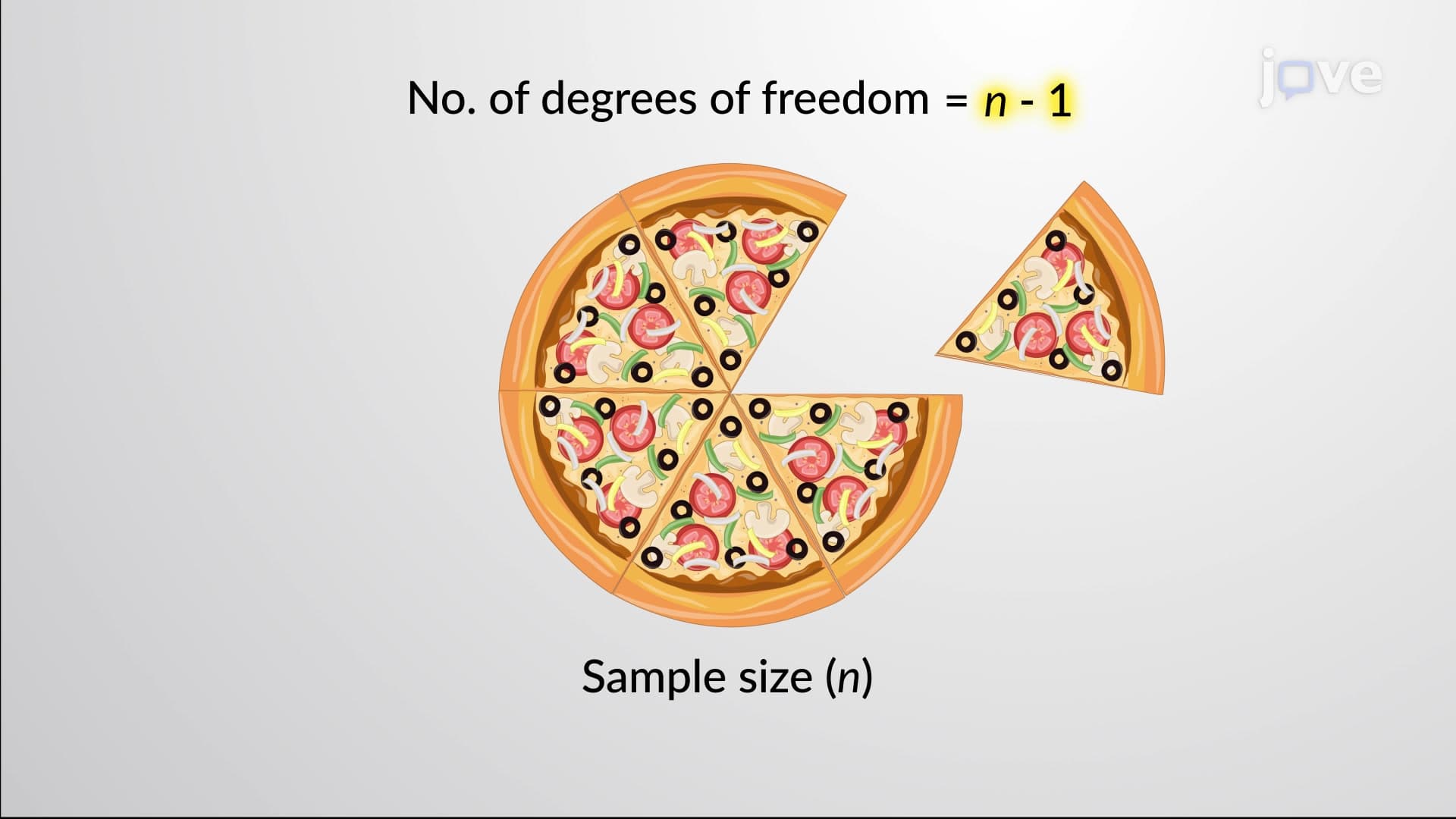
The chi-square distribution's shape depends entirely on degrees of freedom (df = n - 1, where n represents sample size). For a 95% confidence interval, we allocate 5% total error probability, split equally into 2.5% on each tail. However, due to the distribution's asymmetry, left and right critical values differ significantly.
Consider pharmaceutical quality control at Pfizer, where tablet weight variance must stay within FDA specifications. With 10 sample tablets (df = 9), finding the right critical value involves locating 0.025 in the upper tail, yielding 19.023 from standard chi-square tables. The left critical value requires calculating 1 - 0.025 = 0.975 cumulative probability, producing 2.700.
Students encounter this concept across multiple educational levels. AP Statistics students use chi-square critical values for goodness-of-fit tests and independence testing. College statistics courses emphasize confidence interval construction for variance estimates. Pre-med students applying to medical school encounter chi-square applications in MCAT practice problems involving clinical trial data analysis.
Manufacturing industries extensively use these techniques. General Motors engineers testing fuel efficiency variations across production lines rely on chi-square confidence intervals to ensure quality standards. Market researchers at Nielsen use chi-square critical values when analyzing consumer preference variations across demographic groups.
The systematic approach involves: (1) determining degrees of freedom from sample size, (2) establishing confidence level and corresponding alpha value, (3) calculating tail area probabilities, (4) consulting chi-square tables for both tails, and (5) interpreting results within the original problem context. This methodical process ensures accuracy across diverse applications, from academic homework to professional statistical analysis.
Frequently Asked Questions
Finding critical values for chi square identifies boundary points that separate likely from unlikely sample results when estimating population variance. This process is crucial for constructing confidence intervals and conducting hypothesis tests about population variability. It helps researchers determine whether observed data variations fall within expected ranges or indicate significant differences.
AP Statistics exams frequently test chi-square critical value identification in free-response questions involving goodness-of-fit and independence tests. College statistics midterms often require students to construct confidence intervals for population variance using critical values. MCAT practice problems incorporate chi-square critical values in biostatistics contexts, particularly in clinical research scenarios.
Chi-square critical values are asymmetrical and always positive, unlike normal distribution critical values that are symmetrical around zero. The left and right critical values in chi-square distributions have different numerical values even with equal tail areas. This asymmetry reflects the chi-square distribution's right-skewed shape, which changes based on degrees of freedom.
Pharmaceutical companies use chi-square critical values to establish acceptable variance ranges in drug manufacturing processes. When producing medications, companies must ensure consistent dosage levels across batches. Critical values help determine whether observed production variance falls within FDA-acceptable limits or requires process adjustments to maintain quality standards.
Basic algebra and understanding of probability concepts are sufficient prerequisites for learning chi-square critical values. Students comfortable with percentages, fractions, and table reading can successfully master this topic. The process relies more on systematic table navigation than complex mathematical calculations.
Practice with diverse problem types using actual chi-square tables rather than calculator functions initially. Focus on understanding the relationship between confidence levels, alpha values, and tail areas. Create step-by-step checklists for different scenarios (one-tailed versus two-tailed tests) and practice with real data from US industries or research studies.
Build upon this foundation by studying F-distribution critical values for comparing multiple variances, and ANOVA applications in experimental design. These concepts extend chi-square principles to more complex scenarios involving multiple populations and experimental groups commonly encountered in advanced statistics and research methods courses.
Related Micro-courses
Related Subjects
 Physics 33 micro-courses›
 Math Fundamentals 11 micro-courses›