Loading…
Loading video…
70,000 views
Did you know that when Coca-Cola tests new flavors with small customer groups, they can't use normal distribution statistics? The student t distribution becomes essential when analyzing small samples where the population standard deviation is unknown—exactly like market research scenarios where companies survey limited customer groups. Unlike normal distributions that require known population parameters, the student t distribution provides reliable confidence intervals even with sample sizes under 30, making it invaluable for real-world statistical analysis. Watch the full video on JoVE Coach to master this concept with expert-led visuals and step-by-step explanations.
The student t distribution serves as a cornerstone of inferential statistics, particularly when dealing with real-world scenarios where population parameters remain unknown. Unlike the idealized normal distribution that assumes known population standard deviation, t-distribution acknowledges the uncertainty inherent in using sample data to make population inferences. This distribution was developed by William Sealy Gosset, who published under the pseudonym "Student" while working at Guinness Brewery in Ireland, addressing practical brewing quality control challenges.
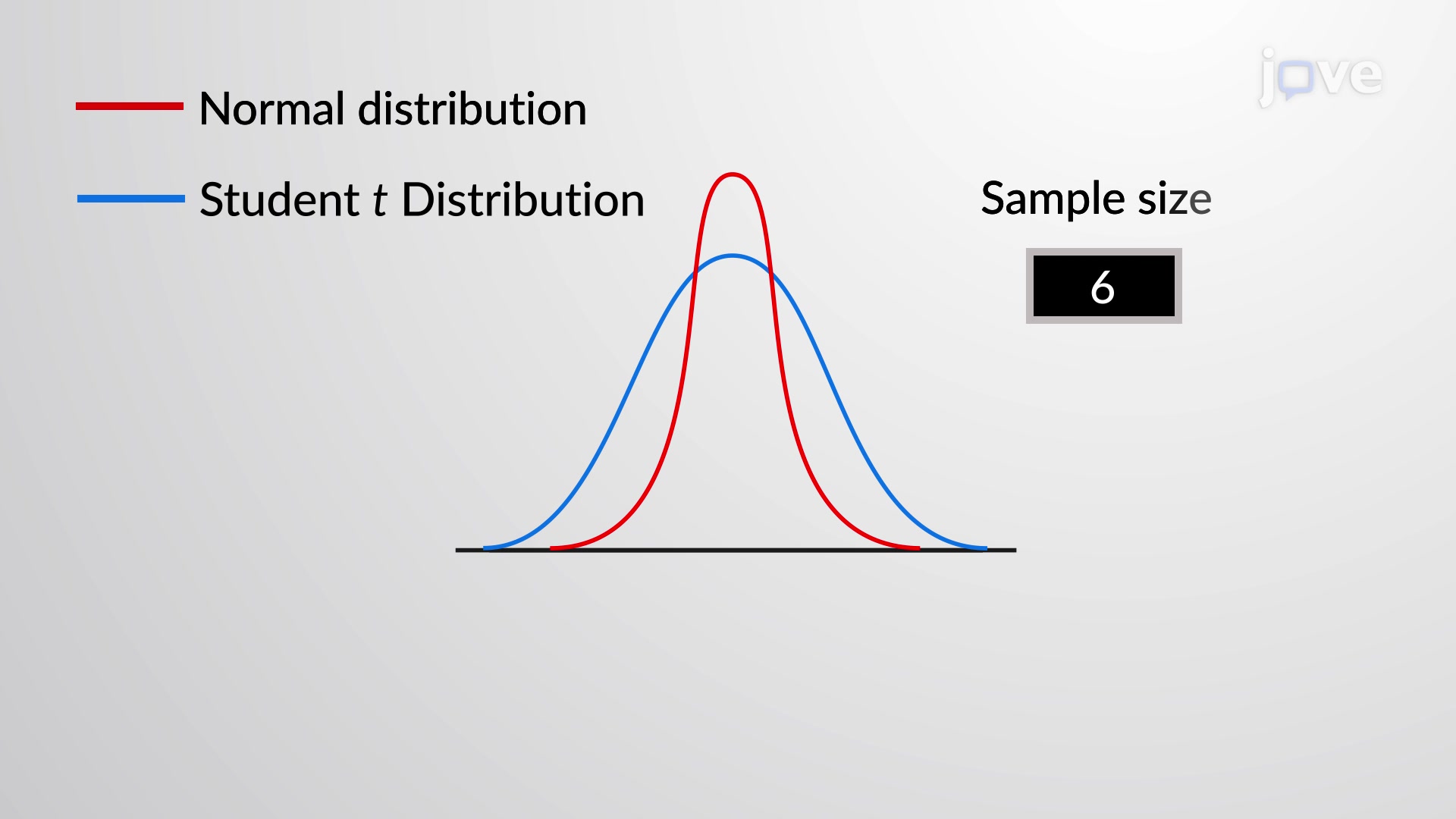
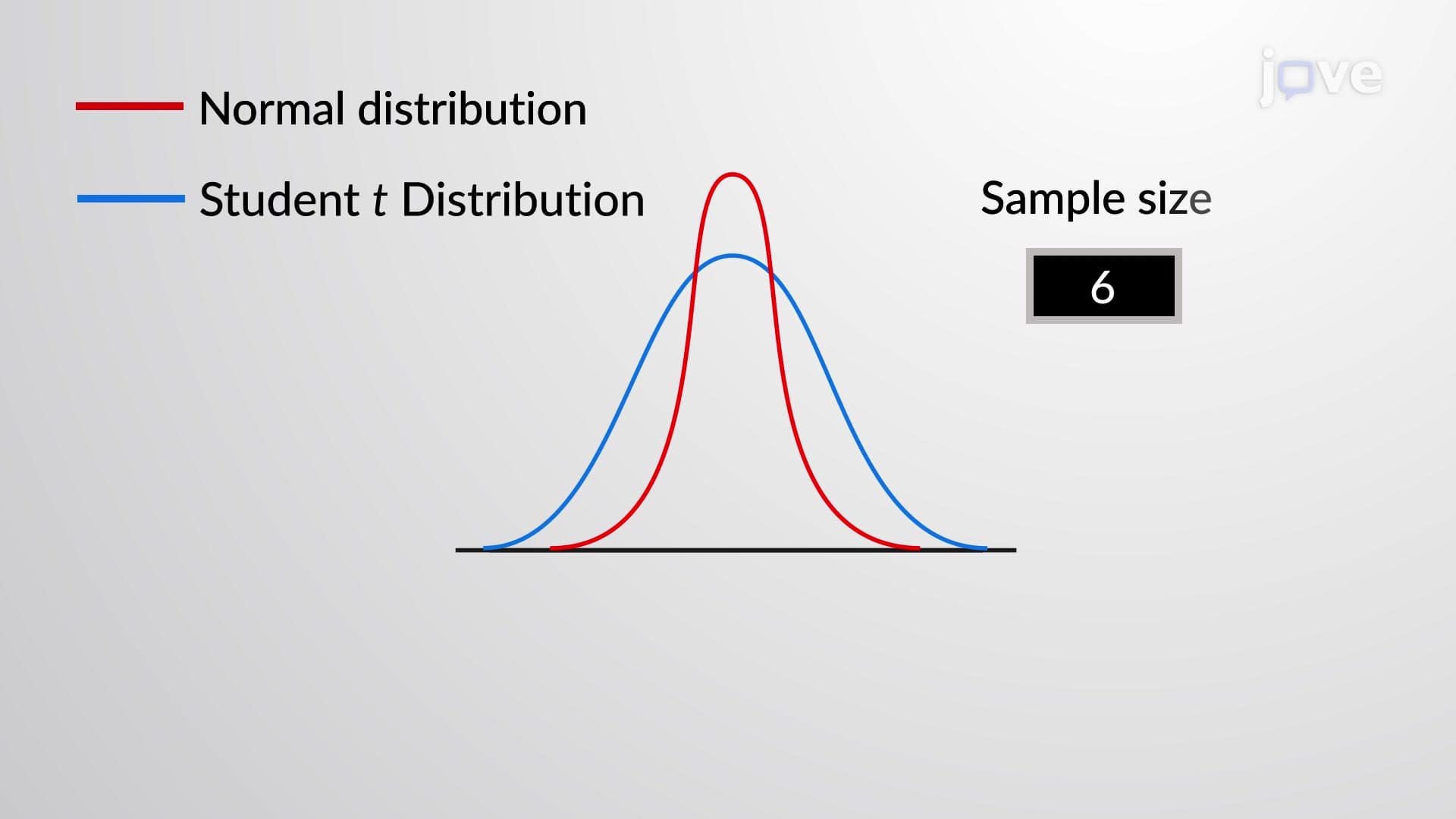
The t-distribution exhibits several distinctive features that make it invaluable for statistical analysis. It maintains perfect symmetry around zero, similar to the standard normal distribution, but displays notably wider tails and greater variability. This increased spread reflects the additional uncertainty introduced when estimating population parameters from sample data. The distribution's standard deviation always exceeds 1, contrasting with the standard normal distribution's unit standard deviation. As sample size increases, the t-distribution converges toward the standard normal distribution, with practical equivalence achieved around n=30.
Students encounter t-distribution applications across numerous academic disciplines and standardized tests. In AP Statistics courses, t-tests frequently appear in free-response questions involving hypothesis testing and confidence intervals. College-level courses in psychology, business, and medical research heavily emphasize t-distribution applications. For instance, pharmaceutical companies conducting clinical trials with limited participant groups rely on t-distribution methods to establish drug efficacy. Similarly, educational researchers studying classroom interventions often work with small sample sizes, making t-distribution analysis essential for valid conclusions.
The margin of error calculation using t-distribution follows the formula: ME = t(α/2) × (s/√n), where t(α/2) represents the critical t-value, s denotes sample standard deviation, and n indicates sample size. This formula demonstrates why confidence intervals widen with t-distribution compared to z-distribution—the t-critical values exceed corresponding z-values, particularly with smaller samples. Students preparing for MCAT statistics sections or college research methods courses must master these calculations, as they form the foundation for interpreting experimental results and making evidence-based decisions in professional practice.
Frequently Asked Questions
Student t distribution is a probability distribution used when analyzing samples with unknown population standard deviation, featuring wider tails than normal distribution. While normal distribution requires known population parameters, t-distribution accounts for additional uncertainty in small samples. It approaches normal distribution as sample size increases beyond 30. This makes t-distribution more practical for real-world statistical analysis where population parameters are rarely known.
Use t-distribution when population standard deviation is unknown and you're working with sample data, especially samples smaller than 30. Apply normal distribution only when population standard deviation is known or sample sizes exceed 30 with known parameters. T-distribution is standard for confidence intervals and hypothesis testing in most practical research scenarios. Both AP Statistics and college statistics courses emphasize this critical distinction.
T-distribution frequently appears in AP Statistics free-response questions involving confidence intervals and hypothesis testing scenarios. College midterms often include t-test calculations, interpretation of t-tables, and comparison with z-distribution methods. MCAT statistics sections may test t-distribution concepts in research design contexts. Expect questions about when to apply t-distribution versus normal distribution and calculating confidence intervals using t-critical values.
T-distribution confidence intervals are wider because t-critical values exceed corresponding z-values, especially with smaller samples. This accounts for additional uncertainty when estimating population parameters from limited sample data. The wider intervals provide more conservative estimates, reducing the risk of making incorrect inferences. As sample size increases, t-critical values approach z-values, making intervals nearly identical.
Netflix uses t-distribution when testing new recommendation algorithms with small user groups before nationwide implementation. With limited test participants, Netflix cannot assume known population variance, making t-distribution essential for valid statistical conclusions. Similarly, FDA drug approval processes rely on t-distribution analysis when clinical trials involve small patient cohorts. These applications demonstrate t-distribution's importance in business and medical decision-making.
T-distribution concepts are accessible to high school students with basic algebra and statistics background. AP Statistics courses successfully teach t-distribution alongside normal distribution, building on familiar confidence interval concepts. The key is understanding when to apply each distribution rather than complex mathematical derivations. Most students find t-distribution intuitive once they grasp that it accounts for additional uncertainty in real-world sampling situations.
Focus on recognizing t-distribution scenarios: unknown population standard deviation and sample-based analysis. Practice using t-tables to find critical values and memorize the margin of error formula. Create decision flowcharts distinguishing t-distribution from z-distribution applications. Work through multiple confidence interval problems, paying attention to interpretation rather than just calculation. Understanding the conceptual foundation makes exam problems more manageable.
After mastering t-distribution, explore chi-square distribution for categorical data analysis and ANOVA techniques for comparing multiple groups. Study regression analysis, which often incorporates t-distribution for coefficient testing. Advanced topics include paired t-tests, two-sample t-tests, and non-parametric alternatives. These concepts build naturally on t-distribution foundations and appear frequently in upper-level statistics courses and research applications.
Related Micro-courses
Related Subjects
 Physics 33 micro-courses›
 Math Fundamentals 11 micro-courses›