Loading…
Loading video…
130,604 views
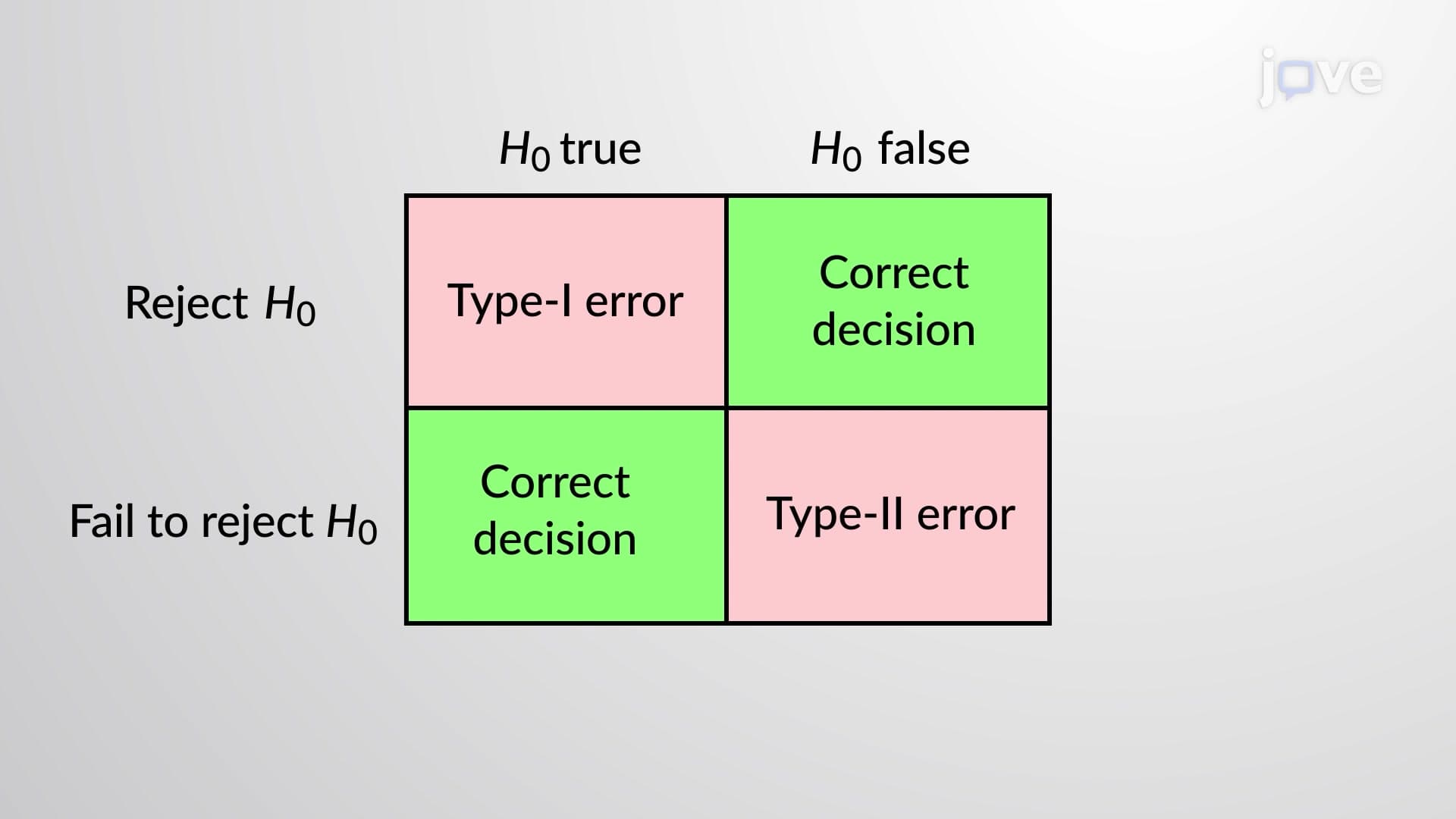
Did you know that FDA drug approval decisions rely heavily on avoiding statistical mistakes that could endanger millions of Americans? Errors in hypothesis tests occur when we make incorrect conclusions about our research questions, leading to two main types of mistakes. For instance, falsely concluding a new medication is effective when it isn't (Type I error) could result in harmful treatments reaching patients. Watch the full video on JoVE Coach to master this concept with expert-led visuals and step-by-step explanations.
Statistical hypothesis testing forms the backbone of scientific research, medical trials, and business decisions across the United States. However, even the most carefully designed studies can lead to incorrect conclusions due to errors in hypothesis tests. These errors represent the inherent uncertainty in making decisions based on sample data rather than complete population information.
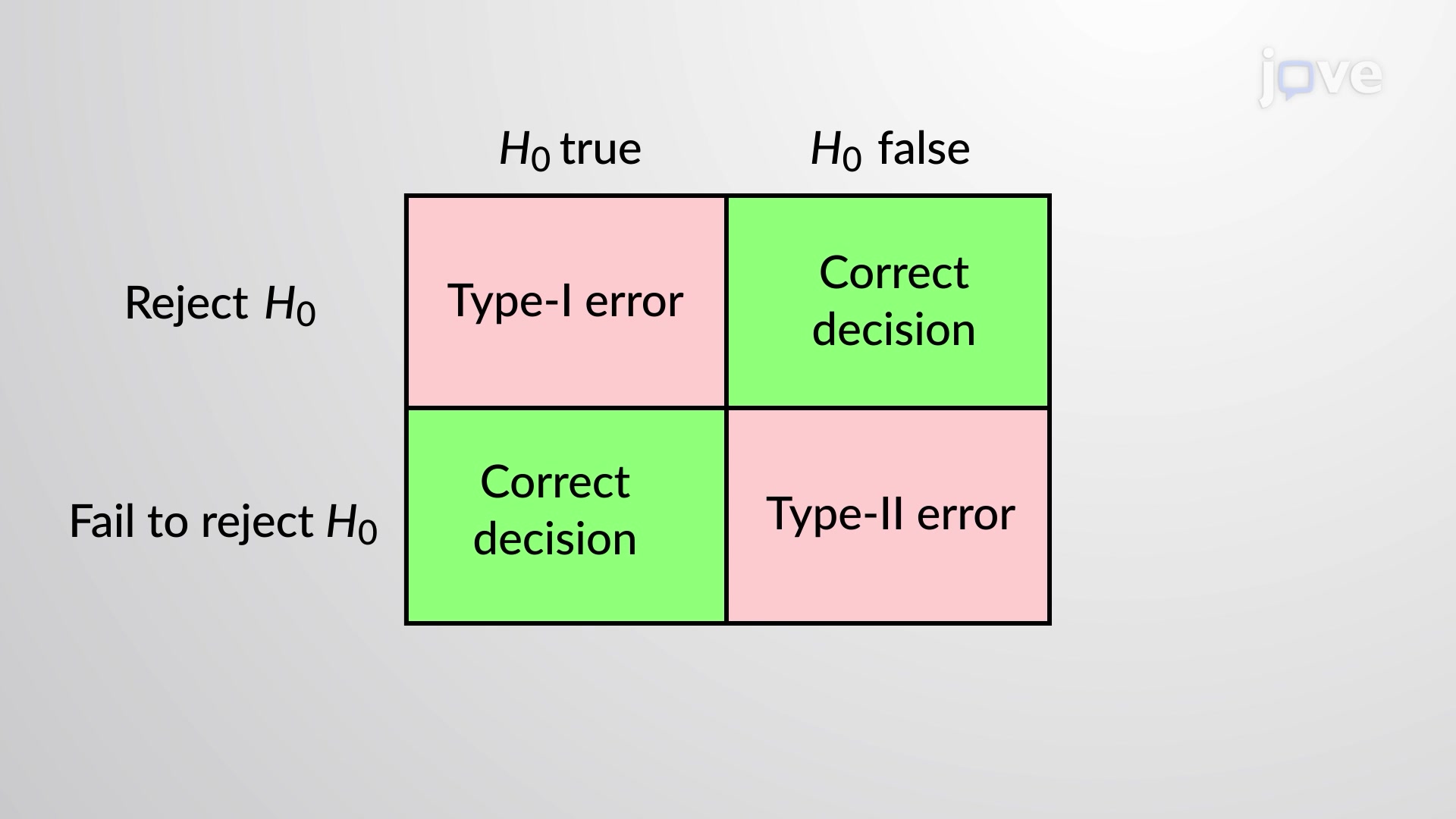
Type I Error: The False Positive A Type I error occurs when we incorrectly reject a true null hypothesis. Think of this as a "false alarm" situation. For example, if the FDA incorrectly concludes that a safe medication is dangerous and bans it from the market, patients lose access to beneficial treatment. The probability of making a Type I error is controlled by the significance level (α), typically set at 0.05 or 0.01 in most research studies.
Type II Error: The False Negative A Type II error happens when we fail to reject a false null hypothesis, essentially missing a real effect. Using our FDA example, this would mean approving an ineffective drug for market release. The probability of Type II error is denoted by β (beta), and it's inversely related to statistical power (1 - β).
In medical research, understanding types of errors in hypothesis tests is crucial for patient safety. The COVID-19 vaccine trials exemplify this balance: researchers needed sufficient evidence to avoid Type I errors (approving ineffective vaccines) while maintaining adequate power to avoid Type II errors (rejecting effective vaccines).
Quality control in manufacturing also relies heavily on error management. A semiconductor company like Intel must balance the cost of Type I errors (discarding good chips) against Type II errors (shipping defective products).
For AP Statistics students, errors in hypothesis tests frequently appear in free-response questions requiring interpretation of p-values and significance levels. College statistics courses, including those preparing for MCAT sections, emphasize calculating power and understanding the relationship between sample size, effect size, and error rates.
Students should practice identifying error types in context problems and understand that reducing one type of error often increases the other, unless sample size increases or effect size changes.
Frequently Asked Questions
Errors in hypothesis tests are incorrect conclusions we draw when making statistical decisions based on sample data. They matter because these mistakes can lead to wrong medical treatments, faulty business decisions, or flawed scientific conclusions that affect real people's lives and significant financial investments.
The two main types are Type I errors (rejecting a true null hypothesis, like concluding a safe drug is dangerous) and Type II errors (failing to reject a false null hypothesis, like missing the detection of a real treatment effect). Understanding both types helps researchers design better studies and interpret results correctly.
AP Statistics frequently tests error concepts through scenarios requiring students to identify error types, interpret significance levels, and explain consequences of incorrect decisions. Students must distinguish between Type I and Type II errors in context, often involving medical studies, quality control, or social research examples.
MCAT questions typically present medical research scenarios where students must identify potential errors in study conclusions, understand how significance levels affect error rates, and interpret the practical implications of false positives and false negatives in clinical decision-making.
Pharmaceutical companies like Pfizer and Moderna use rigorous statistical protocols with predetermined significance levels (usually α = 0.05) and power analyses to minimize both Type I errors (approving ineffective drugs) and Type II errors (rejecting beneficial treatments). This protects both patient safety and company investments.
Not at all! While the mathematical foundations can be complex, the core concepts are very intuitive and relate to everyday decision-making. High school students can easily grasp the ideas using familiar examples like medical testing, weather forecasting, or quality control in manufacturing.
Create flashcards linking error types to real-world consequences, practice identifying errors in research scenarios, and work through problems that require calculating significance levels and power. Focus on understanding the trade-offs between different types of errors rather than just memorizing definitions.
Build on this foundation by exploring confidence intervals, effect size calculations, and power analysis. These concepts deepen your understanding of statistical inference and prepare you for advanced topics like regression analysis and experimental design in college-level statistics courses.
Related Micro-courses



Related Subjects
 Physics 33 micro-courses›
 Math Fundamentals 11 micro-courses›